
How much does Flodesk cost in 2026?
Flodesk spent years as the platform with the simplest pricing in email marketing: one flat fee, unlimited subscribers, unlimited sending. That plan was retired for new members on 2 December 2025, and what replaced it is a conventional subscriber-based ladder with three tiers and thirty-three volume steps. This page reproduces the whole ladder, explains what the legacy plan means if you already have it, and flags a contradiction on Flodesk’s own pricing page about what the free tier actually does.
Every figure below was read from flodesk.com/pricing on 24 August 2026, in USD, including the structured pricing data embedded in the page itself.
The flat-rate plan is gone, unless you already have it
Flodesk’s own answer is unambiguous. “Flodesk’s original flat-rate unlimited plan was retired for new members on December 2, 2025. Pricing now scales based on your active subscriber count, similar to most email marketing platforms.” And crucially: “If you subscribed to a paid plan before December 2, 2025, you keep your legacy unlimited plan for as long as you maintain your subscription.”
Two consequences follow, and they point in opposite directions.
If you are a legacy subscriber, your plan is now the most valuable asset in your marketing stack and it is conditional on never lapsing. A cancellation, a failed card that goes unfixed, or a decision to pause for a quarter all put you back on the current ladder at your current list size. On a list of 100,000 that is a difference of roughly $689 a month.
If you are new, the flat rate is simply not available at any price, and any review, comparison table or forum post recommending Flodesk on the strength of its unlimited plan is describing something you cannot buy. Flodesk’s own framing is that the new model “means a lower starting price”, which is true at the bottom and false everywhere else.
The complete price ladder
Three paid tiers. Each cell shows monthly billing first, then the per-month cost on annual billing.
| Subscribers | Lite | Pro | Everything |
|---|---|---|---|
| 1,000 | $25 / $19 | $28 / $25 | $54 / $49 |
| 2,500 | $32 / $29 | $39 / $35 | $87 / $79 |
| 5,000 | $52 / $48 | $59 / $54 | $107 / $99 |
| 10,000 | $72 / $66 | $79 / $72 | $137 / $126 |
| 15,000 | $102 / $94 | $109 / $100 | $177 / $162 |
| 20,000 | $132 / $121 | $139 / $127 | $217 / $199 |
| 25,000 | $162 / $149 | $169 / $155 | $257 / $236 |
| 30,000 | n/a | $209 / $192 | $307 / $281 |
| 50,000 | n/a | $389 / $357 | $527 / $483 |
| 75,000 | n/a | $509 / $467 | $667 / $611 |
| 105,000 | n/a | $689 / $632 | $877 / $804 |
| 155,000 | n/a | $989 / $907 | $1,227 / $1,125 |
| 205,000 | n/a | $1,289 / $1,182 | $1,577 / $1,446 |
| 255,000 | n/a | $1,589 / $1,457 | $1,927 / $1,766 |
The published ladder ends at 255,000 subscribers. Lite stops much earlier: Flodesk caps it at 25,000 subscribers, so the two right-hand columns are the only options above that.
Pro costs $7 a month more than Lite. Everywhere. At 2,500 subscribers it is $32 against $39. At 5,000, $52 against $59. At 25,000, $162 against $169. The gap is exactly $7 at every shared tier except the smallest, where it is $3. For that $7 you get unlimited workflow automations instead of one, advanced analytics, the ability to hide the Flodesk footer, a second seat and an integrated checkout. It is the least defensible upsell gap on this site, and the answer is almost always Pro.
What the curve does per subscriber
| Subscribers | Pro, per 1,000 /month | Reading |
|---|---|---|
| 1,000 | $28.00 | Floor pricing, not volume pricing |
| 5,000 | $11.80 | Falling fast |
| 25,000 | $6.76 | Best value on the whole ladder |
| 50,000 | $7.78 | A genuine bump, worse than 25,000 |
| 105,000 | $6.56 | Back below the 25,000 rate |
| 255,000 | $6.23 | Cheapest, but only 8% better than at 25,000 |
The curve is not monotonic. Cost per thousand subscribers bottoms out at 25,000, rises through the thirty to sixty thousand range to a local peak of $7.78 at 50,000, then falls again. If your list is near 50,000 you are paying the worst rate on the ladder outside the entry tiers, and there is no way to buy around it.
The wider point is that the volume discount is largely spent by 25,000 subscribers. Growing from 25,000 to 255,000 multiplies your list tenfold and your bill by 9.4, scale barely helps.
The free plan contradiction
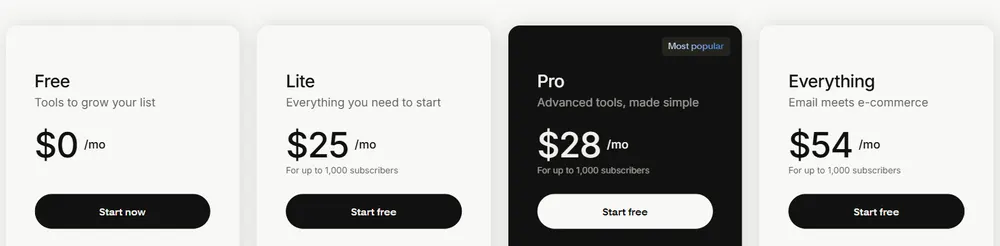
Flodesk’s pricing page lists four things under the Free plan: forms and landing pages, designer templates, audience segmentation, and email sending.
Flodesk’s own FAQ, on the same page, says the opposite. Asked whether it has a free plan, Flodesk answers that the Free plan “lets you build forms, landing pages, and link-in-bio pages to start growing your subscriber list at no cost” and then states plainly: “It does not include email sending or workflow automations.” The same denial appears again in the answer to “Which Flodesk plan is right for me?”, which describes Free as “This plan does not include email sending.”
Two statements on one page cannot both be right. The FAQ is the more specific and more recently worded of the two, it says the same thing twice, and it is what Flodesk’s structured data serves to search engines. Treat the free tier as a list-building tool that cannot send email, and treat the feature bullet as an error, but confirm before you build anything on it.
What Flodesk does offer instead is a free trial with full access to paid features, including sending, automations and templates, with no credit card required. When it ends you either pick a paid plan or drop to the Free plan and keep the forms and landing pages.
What separates the three paid tiers
| Lite | Pro | Everything | |
|---|---|---|---|
| Email sends | Unlimited | Unlimited | Unlimited |
| Subscriber ceiling | 25,000 | 255,000 published | 255,000 published |
| Workflow automations | 1 | Unlimited | Unlimited |
| Analytics | Standard | Advanced | Advanced |
| Hide the Flodesk footer | No | Yes | Yes |
| Seats | 1 | 2 | 3 |
| Integrated checkouts | None | 1 | Unlimited |
| Sales pages and funnels | No | No | Yes |
| Subscriptions, payment plans | No | No | Yes |
| Abandoned cart automations | No | No | Yes |
Note the two bonuses Flodesk currently marks as limited-time: one workflow on Lite and one checkout on Pro. They are promotional rather than structural, so a Lite plan bought later may have no workflow at all. If a single automation is why you are choosing Lite over Pro, that $7 gap starts looking like insurance.
The dedicated IP is listed but not priced. Flodesk’s feature comparison shows a “Dedicated IP” row under Add-ons across all three tiers with no figure attached and no link to one. On a pricing page that otherwise publishes thirty-three volume steps for three plans, it is the single unpriced item. If a dedicated sending IP matters to you, ask before committing.
How Flodesk counts subscribers
Only active subscribers are billable. Flodesk states that “Only subscribers with an ‘active’ status count toward your plan limit. Contacts who have unsubscribed, bounced, or been cleaned from your list are not counted.” That is the generous end of the market, matching EmailOctopus and standing in clear contrast to Drip, which keeps billing unsubscribers until you deactivate them, and Omnisend, which bills people who never opted in at all.
The mechanics when you outgrow a tier are equally reasonable, and Flodesk documents them precisely:
| Event | What happens |
|---|---|
| You cross your subscriber limit | Sending never stops |
| Billing | Automatic upgrade to the next tier at your next billing date |
| Warning | In-app and email notifications at 90%, 95% and 100% of the limit |
| List shrinks again | Plan can be downgraded accordingly |
| You upgrade manually | Immediate access to the new features |
| You downgrade manually | Takes effect at the end of the current billing cycle |
No blocked campaigns, no cancelled automations, no overage charge, and three warnings before it happens. Compared with Omnisend, where running out of email credits pulls contacts out of live workflows, this is a considerably safer failure mode.
Annual billing, and a discount that varies
Flodesk describes annual billing as one month free: “you pay for 11 months instead of 12”. At most tiers the displayed numbers agree, the annual per-month price is close to 11/12 of the monthly one, about 8% off. At the entry tier it is considerably better than that.
| Plan at 1,000 subscribers | Monthly | Annual, per month | Actual discount |
|---|---|---|---|
| Lite | $25 | $19 | 24% |
| Pro | $28 | $25 | 11% |
| Everything | $54 | $49 | 9% |
| Pro at 50,000 | $389 | $357 | 8% |
| Pro at 255,000 | $1,589 | $1,457 | 8% |
Lite at 1,000 subscribers is the outlier: a 24% reduction rather than the roughly 8% that “one month free” implies. That is the cheapest committed entry into Flodesk at $19 a month, and it is the number Flodesk quotes in its own marketing when it says the new model “means a lower starting price”.
One inconsistency to note. Flodesk’s worked example says the Pro plan at 1,000 subscribers is “$28/month on monthly billing, or $25/month on annual billing, saving you $33 over the year”. Twelve months at $28 is $336 and twelve at $25 is $300, a saving of $36; eleven months at $28 is $308, a saving of $28. Neither equals $33. The displayed prices are what matter, but the arithmetic in the explanation does not reconcile with them, so check your actual invoice total at checkout.
Flodesk Checkout, and what it does not charge
Flodesk sells commerce as part of the platform rather than as a separate product, and its position on fees is unusually clean.
| Item | Cost |
|---|---|
| Checkout on Pro | Included, 1 checkout, no platform fee |
| Checkout on Everything | Included, unlimited, no platform fee |
| Payment processing | Stripe’s standard rate, paid to Stripe |
| Flodesk transaction fee | None |
Flodesk states directly that it “does not add any transaction fees on top of Stripe’s processing costs”. For anyone who has priced a course or membership platform that takes a percentage on top of the processor, that is a meaningful difference, and it is the strongest argument for the Everything tier: unlimited sales pages, subscriptions, payment plans and abandoned cart automations with no cut taken.
Six things that catch people out
- The unlimited plan is closed to new members since 2 December 2025, and much of the advice about Flodesk online predates that.
- Legacy unlimited survives only while the subscription does. Lapse it and you cannot get it back.
- The free plan probably cannot send email, despite a bullet on the pricing card saying it can. Flodesk’s FAQ denies it twice.
- Lite is capped at 25,000 subscribers and one workflow, and that single workflow is flagged as a limited-time bonus rather than a permanent feature.
- 50,000 subscribers is the worst-value point on the ladder above the entry tiers, at $7.78 per thousand against $6.76 at 25,000.
- The dedicated IP has no published price on a page that publishes everything else.
Who Flodesk is priced for
Flodesk sells design. The templates, the editor and the finished look of the emails are the product, and the pricing assumes you value that enough not to shop purely on cost per subscriber. At $6 to $7 per thousand subscribers in the mid range it is roughly twice EmailOctopus and well under Klaviyo, which is a coherent place to sit.
The flat-rate retirement changes who it suits. The old plan made Flodesk the obvious answer for anyone with a large list and a small budget; the new ladder makes it a conventional purchase that has to win on merit. At 100,000 subscribers Pro is $689 a month, which is no longer a disruptive price.
Good fit: creators, coaches and small brands under about 25,000 subscribers who care how their email looks and want unlimited sending without counting; anyone selling digital products, where Everything bundles checkout, sales pages and subscriptions with no transaction fee; existing legacy subscribers, who should protect that plan.
Poor fit: large lists shopping on price, where the discount curve flattens early; anyone needing a free tier that sends; teams needing more than three seats or a priced dedicated IP; anyone who chose Flodesk specifically for flat-rate unlimited, which no longer exists for new accounts.
How to size Flodesk in four steps
- Check your signup date first. Before 2 December 2025 on a paid plan means you hold the legacy unlimited plan, and the rest of this page is academic. Protect it.
- Default to Pro. It costs $7 a month more than Lite at every shared tier and removes the one-workflow limit, the 25,000 ceiling and the Flodesk footer.
- Take Everything only if you sell. The premium over Pro grows from $26 to $338 a month across the ladder, and it buys commerce features, not email ones.
- Count active subscribers only. Unsubscribed, bounced and cleaned contacts are excluded, so your billable number is smaller than your database.
Frequently asked questions
How much does Flodesk cost?
Three paid tiers, priced on active subscribers. At 1,000 subscribers: Lite $25 a month or $19 on annual billing, Pro $28 or $25, Everything $54 or $49. At 25,000 subscribers: Lite $162, Pro $169, Everything $257 on monthly billing. At 100,000-plus the ladder runs to $689 for Pro at 105,000 subscribers and $1,589 at its published ceiling of 255,000. Every paid plan includes unlimited email sends with no per-email charge.
Does Flodesk still have its unlimited flat-rate plan?
Not for new customers. Flodesk states that “Flodesk’s original flat-rate unlimited plan was retired for new members on December 2, 2025” and that pricing now scales with active subscriber count. Anyone who subscribed to a paid plan before that date keeps the legacy unlimited plan “for as long as you maintain your subscription”, so it survives only while the subscription is continuously active. If you hold one, a cancellation or an unresolved failed payment puts you on the current ladder at your current list size, which on a 100,000-subscriber list is around $689 a month.
Can I send email on the Flodesk free plan?
Flodesk’s pricing card lists “Email sending” as a Free plan feature, but its own FAQ contradicts this twice, stating that the Free plan “does not include email sending or workflow automations” and describing it as a tool to build forms, landing pages and link-in-bio pages. The FAQ text is what Flodesk publishes as structured data, and it says the same thing in two separate answers, so the safer reading is that Free does not send. What is definitely available is a free trial with full access to sending, automations and templates, with no credit card required.
Should I choose Lite or Pro?
Pro, in almost every case. The gap is exactly $7 a month at every tier the two share, $32 against $39 at 2,500 subscribers, $162 against $169 at 25,000, and only $3 at 1,000. For that, Pro replaces Lite’s single workflow with unlimited automations, lifts the 25,000-subscriber ceiling, adds advanced analytics, a second seat, the ability to hide the Flodesk footer and an integrated checkout. Note also that Lite’s one workflow is currently marked a limited-time bonus rather than a permanent entitlement.
How does Flodesk count subscribers?
Only active ones. Flodesk states that “Only subscribers with an ‘active’ status count toward your plan limit. Contacts who have unsubscribed, bounced, or been cleaned from your list are not counted.” That puts it at the generous end of the market alongside EmailOctopus, and well ahead of Drip, which continues billing unsubscribers until you manually deactivate them, and Omnisend, which bills contacts who never opted into marketing.
What happens if I go over my subscriber limit?
Nothing breaks. Flodesk states that emails “will never stop sending” and that exceeding your tier triggers an automatic upgrade to the next tier at your next billing date, with no interruption to campaigns or workflows. You get in-app and email notifications at 90%, 95% and 100% of the limit first. If the list later falls back, the plan can be downgraded. There is no overage rate and no blocked send, which is a safer failure mode than several competitors.
Is annual billing worth it?
Yes, and at one tier it is unusually good. Flodesk describes annual as paying eleven months for twelve, roughly 8%, and that matches most of the ladder. Pro at 50,000 subscribers is $389 monthly against $357 annually. The exception is Lite at 1,000 subscribers, where $25 becomes $19, a 24% cut and the cheapest committed entry to the platform. One caveat: Flodesk’s own worked example claims a $33 annual saving on a plan that shows $28 monthly and $25 annual, which reconciles to neither $36 nor $28. Check the total at checkout.
Where is the best value on Flodesk’s price curve?
At 25,000 subscribers, which works out at $6.76 per thousand on Pro. The curve is not monotonic: it falls steeply from $28.00 per thousand at 1,000 subscribers, bottoms at 25,000, then rises to a local peak of $7.78 at 50,000 before falling again to $6.23 at the 255,000 ceiling. If your list is around 50,000 you are on the worst rate above the entry tiers. The broader point is that the volume discount is mostly spent by 25,000 subscribers, a tenfold increase from there raises the bill 9.4 times.
Does Flodesk charge transaction fees on sales?
No. Flodesk Checkout is included at no additional platform fee on Pro, which gets one checkout, and on Everything, which gets unlimited checkouts along with sales pages, funnels, subscriptions, payment plans and abandoned cart automations. Payment processing runs through Stripe at Stripe’s standard rate, and Flodesk states it “does not add any transaction fees on top of Stripe’s processing costs”. That is a genuine differentiator against course and membership platforms that take a percentage.
What does a dedicated IP cost on Flodesk?
Flodesk does not publish it. The feature comparison lists a “Dedicated IP” row under Add-ons against all three paid tiers, with no price and no link to one. It is the only unpriced item on a page that otherwise publishes thirty-three volume steps across three plans. If a dedicated sending IP is a requirement, get the figure from Flodesk before committing.
Continue reading about Flodesk
Pricing is one part of the evaluation, and with Flodesk the design tooling is most of the rest. For connection details, authentication, integrations and sending behaviour, see the SMTP settings, API and integrations tabs on this platform. The alternatives tab compares Flodesk with the other design-led and creator-focused platforms, and with the low-cost options that undercut it on pure subscriber pricing.
Sources. All figures were read from flodesk.com/pricing on 24 August 2026, in USD, including the complete price matrix and the FAQ text embedded in the page’s own structured data. Cost-per-thousand figures are our own arithmetic and labelled as such. Prices change; where a figure here disagrees with the vendor’s page, the vendor’s page is correct and we would be glad to be told.
This review follows our email infrastructure testing methodology. We disclose affiliate relationships in our editorial independence policy.