
How much does Klaviyo cost in 2026?
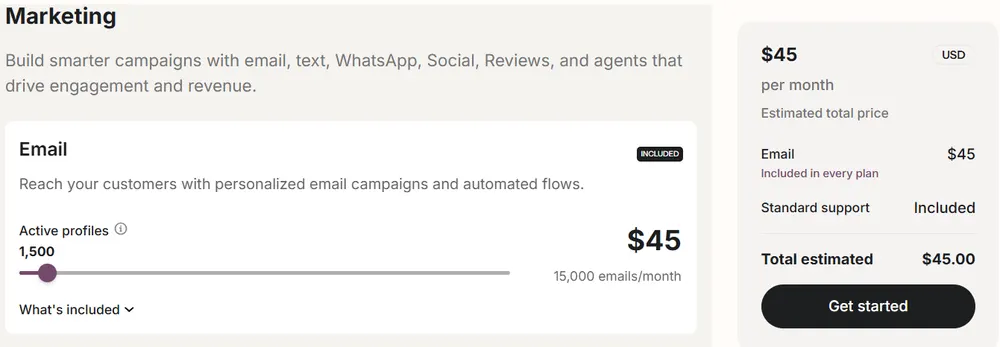
The old Email and Email + SMS plans no longer exist. Klaviyo now sells a Free tier plus separately priced modules: Marketing, Data + Analytics, Service, and two AI agents, Composer and Customer Agent. Email is included in every plan and priced on active profiles: $20/mo at 500 profiles, $45 at 1500, $100 at 5000, $350 at 15 000. Every tier includes exactly 10 emails per profile per month. Service, Composer and Customer Agent all carry a 30% off promotional badge. Any article still describing Klaviyo tiers by name is describing a product that no longer exists.
What changed: from plans to a module builder
This is the most important thing to understand about Klaviyo pricing in 2026, and it invalidates most of what is written about it elsewhere.
Klaviyo used to sell bundled tiers. You picked Email, or Email + SMS, at a contact volume, and that was your plan. That model is gone. What replaced it is a plan builder: you start from a base and add priced modules, and the total is assembled from what you switch on.
The catalogue as Klaviyo publishes it:
| Free | The entry point. Real, permanent, and more capable than most free tiers in the category. |
|---|---|
| Marketing | Email, text, WhatsApp, Social, Reviews and agents. Email is included in every plan and is the module that carries the base price. |
| Data + Analytics | Reporting and analytics beyond the built-in dashboards. |
| Service | Customer Hub and Helpdesk. Currently carries a 30% off badge. |
| Composer | AI content agent, billed in credits. 30% off, described by Klaviyo as special introductory pricing available for a limited time. |
| Customer Agent | AI service agent. 30% off. |
| Professional Services / Enterprise | Quote only, via sales. |
Service, Composer and Customer Agent all show 30% off, and Klaviyo explicitly frames the Composer rate as introductory and time-limited. Build your budget on the undiscounted rate for anything you intend to keep past the promotional window, because a 30% reduction unwinding is a 43% increase on what you were paying.
The free plan: what you actually get
Klaviyo maintains a genuine permanent free tier, not a trial. What it includes:
| Active profiles | 250 |
|---|---|
| Email sends | 500 per month |
| Mobile messages | $5 worth per month, denominated in dollars rather than message count |
| Composer credits | 10 000 |
| Reporting | Built-in dashboards included |
| Support | Email support, for the first 60 days only |
The 60-day support window is the detail nobody mentions. Free support is not permanent even though the plan is. After two months you are on Klaviyo Academy, the community forum, the help centre and documentation.
What is genuinely unusual is the breadth. The free tier carries the drag-and-drop editor and basic email templates, an AI-powered subject line generator, mobile app marketing, social auto-responses, built-in reporting and dashboards, campaign performance metrics, basic segmentation, list growth tracking, revenue attribution for campaigns, and engagement and click-through rates. On the service side it includes Customer Hub with a basic self-service portal, account management, order tracking and one-click buy again, plus a Helpdesk with basic ticket management, personalised macros, multiple agent support and a shared email inbox.
Mailchimp Free gives 250 contacts and 500 sends with no automation beyond a welcome email and no attribution. AWeber Free gives 500 subscribers and 3000 sends but no ecommerce attribution. Klaviyo matches Mailchimp on the caps and then includes the thing ecommerce operators actually buy Klaviyo for. If you run a small store and want to see attributed revenue before paying, this is the strongest free tier available.
The ceiling arrives fast though. 500 sends across 250 profiles is two emails per contact per month. One newsletter and one automated flow exhausts it.
The 60-day support cliff
The free plan is permanent. The support attached to it is not. Klaviyo includes email support for the first 60 days, and the pricing page lists that limit alongside permanent benefits, which makes it easy to miss.
After day 60 a free account keeps Klaviyo Academy courses, the community, the help centre and documentation, getting started guides and release notes. What it loses is a human. For a small store that adopted Klaviyo precisely because ecommerce attribution is fiddly to set up, losing support at the two-month mark lands at roughly the moment the difficult questions start.
| Days 1 to 60 on Free | Email support included, same as any paid account. |
|---|---|
| Day 61 onward on Free | Self-service only: Academy, community, documentation. |
| Any paid plan | Standard support appears as an included line item in the plan builder summary, at no separate charge. |
How to use this rather than be caught by it. Treat the first two months as a supported onboarding window and front-load the hard work into it: integration with your store, profile and event mapping, attribution setup, and the first two or three flows. Those are the tasks where support actually helps. Leave template polishing and campaign cadence for later, when self-service is enough.
Email pricing: the curve that determines your bill
Email is included in every paid plan and priced by active profiles. These figures were read directly from the Klaviyo plan builder in USD.
| Active profiles | Monthly price | Emails included |
|---|---|---|
| 250 (Free) | $0 | 500 |
| 500 | $20 | 5 000 |
| 1 500 | $45 | 15 000 |
| 5 000 | $100 | 50 000 |
| 15 000 | $350 | 150 000 |
| 150 000+ | Talk to sales | Quote |
The send allowance is exactly ten times your profile count, at every tier we sampled. 500 profiles gives 5000 emails, 15 000 profiles gives 150 000. Note that the free tier breaks this rule: 250 profiles gives 500 sends, a multiplier of two, not ten. The jump from free to paid multiplies your send headroom fivefold before you add a single profile.
Prices exist only inside the plan builder, revealed as you move the active profiles slider. There is no static list to compare against, and above 150 000 profiles the slider stops and hands you to sales. The figures above are the ones the builder returned at those exact positions; intermediate tiers exist and are not published anywhere we can cite.
Where the curve turns against you
Cost per profile does not fall monotonically. It improves, then reverses, and the reversal happens in a band a lot of stores sit in.
| 500 profiles | $0.040 per profile per month |
|---|---|
| 1 500 profiles | $0.030 per profile |
| 5 000 profiles | $0.020 per profile-the most efficient point on the published curve |
| 15 000 profiles | $0.023 per profile, worse than at 5000 |
Between 5000 and 15 000 profiles, the price triples while the list only triples in name: you pay $250 more per month for 10 000 additional profiles, which is a marginal rate of $0.025 per profile against the $0.020 you were averaging. Growth through that band is more expensive per head than the list you already had.
The per-email view tells the opposite story. Divide price by included sends and the trend is monotonic: $0.0040 per email at 500 profiles, $0.0030 at 1500, $0.0020 at 5000, $0.0023 at 15 000. Both views matter. If you send at full allowance, Klaviyo gets cheaper as you grow. If you hold a large list and send to a fraction of it, you are paying for profiles you do not mail.
Active profiles, not contacts
Klaviyo bills on active profiles. The distinction matters because a profile can exist in your account without being billable, and the definition of active is what determines whether list growth translates into a bill. Before committing at any tier, confirm with Klaviyo exactly which profiles count, because on a contact-priced platform this single definition is the difference between two adjacent tiers.
How to get your actual price out of the builder
Since the builder is the only place Klaviyo prices exist, operating it properly is part of pricing the platform. Four practical notes from doing exactly that:
| The site is geolocated | It opens in your local language and currency. A French browser gets euros. Use the globe icon in the header to switch to United States if you need USD figures comparable to published benchmarks. |
|---|---|
| The slider only responds to dragging | Clicking a position on the track does nothing, and arrow keys do nothing once the handle is focused. You have to drag the handle. |
| Prices update live in the right panel | The summary shows each module as a line item plus a total. Standard support appears as an included line rather than a charge. |
| The slider stops at 150 000+ | Past that point the price is replaced by a Talk to sales button. There is no published ceiling figure. |
Model the modules you actually intend to switch on. The default state shows Email only. Every module you add changes the total, so the number you screenshot on your first visit is almost never the number you will pay. Build the plan you would really buy, then record the total.
Profile hygiene is a pricing lever, not housekeeping
Because Klaviyo bills on active profiles and the marginal rate through the middle of the curve is worse than the average, pruning has an unusually direct financial effect here.
Consider an account at 5200 profiles. It sits above the 5000 tier, where the price is $100/mo. Removing 200 genuinely inactive profiles keeps the account at the efficient point on the curve instead of pushing it into the band where the marginal rate rises to $0.025 per profile.
The same logic applies harder above 5000. Every profile you carry between 5000 and 15 000 costs more than the ones below it, so an unengaged segment you keep out of sentiment is charged at the worst rate on the published curve. On a platform with unlimited sends and flat contact pricing this would be a deliverability question. On Klaviyo it is a line on the invoice.
Ask what active means before you prune
Klaviyo bills active profiles, and the definition determines whether suppressing, archiving or deleting a profile actually removes it from the count. These are three different operations with potentially three different billing outcomes. Confirm which one drops a profile off the bill before running a cleanup, or you will do the work without the saving.
The other modules and the 30% promotion
Beyond Email, four paid modules can be added. Klaviyo does not publish their prices outside the builder, and we are not going to estimate them.
| Data + Analytics | Reporting and analytics above the built-in dashboards that come free. No promotional badge, so presumably at list price. |
|---|---|
| Service 30% off | Customer Hub and Helpdesk at full capability. The free tier already includes basic versions of both, so this module buys depth rather than access. |
| Composer 30% off | AI content agent, billed in credits rather than a flat fee. Free accounts get 10 000 credits. Klaviyo labels the current rate special introductory pricing, available for a limited time. |
| Customer Agent 30% off | AI agent for customer service. Pairs with the Service module. |
Why the promotion matters more than it looks. Three of the four add-on modules are discounted simultaneously, which is not how mature pricing behaves. It is how a launch behaves. Klaviyo is pushing adoption of its AI agents and its service product, and the 30% is the incentive. That is fine, but it means the price you model today is not the price you renew at.
Concretely: a module at $100 after 30% off has a list price of about $143. When the promotion ends, your bill for that module rises by 43%, not 30%. Anyone building a twelve-month budget should model the undiscounted figure and treat the discount as a windfall.
Composer credits and mobile message dollars
Klaviyo now meters two things in units that are not the subscription: Composer credits and mobile messages denominated in dollars.
The free plan makes both visible: 10 000 Composer credits and $5 of mobile messages per month. Note the phrasing on the second one. Klaviyo does not give you a number of texts, it gives you a dollar balance to spend on them, because SMS and WhatsApp rates vary by country and message type.
A competitor quoting $0.02 per SMS segment gives you a number you can multiply. A dollar balance gives you a budget without a rate. To compare Klaviyo mobile messaging against Mailchimp SMS or a dedicated provider, you need the per-message rate for your country, which is not on the pricing page. Ask for it before assuming mobile is cheap here.
Composer credits behave the same way: 10 000 credits is only meaningful if you know what one generation costs. Klaviyo does not publish a credit consumption rate.
Budgeting against a dollar allowance
A dollar-denominated messaging allowance is harder to plan against than a per-message rate, and the difficulty is worth spelling out because it affects how you compare Klaviyo to anything else.
If a competitor charges $0.02 per SMS segment, you multiply by your volume and you have a number. Klaviyo gives you a balance instead. To turn $5 into a message count you need three things Klaviyo does not put on the pricing page: the rate for your destination country, the rate for your message type, and how multi-segment messages are counted.
| Ask for the rate by country | SMS pricing varies enormously by destination. A US rate tells you nothing about your UK or French volume. |
|---|---|
| Ask how segments are counted | A message over the single-segment character limit is billed as two or three. Emoji and accented characters shorten the limit sharply. |
| Ask whether WhatsApp is rated separately | Klaviyo lists WhatsApp alongside text under Marketing. WhatsApp is normally priced on a different model from SMS. |
The one useful thing about the dollar model. It fails safe. A balance cannot overrun into a surprise invoice the way an uncapped per-message meter can, because you are spending against a known amount. For a team nervous about SMS cost control, that is a real advantage over providers that bill after the fact.
The same reasoning applies to Composer credits, with one difference: 10 000 credits has no dollar equivalent published either, so it is a balance in a unit whose value is undefined until you ask.
What you cannot price in advance
Klaviyo publishes less hard pricing than any platform we have documented. Five variables a buyer cannot determine from the public site.
Any Klaviyo budget built from the website alone is a floor, not an estimate.
- Intermediate profile tiers. The builder reveals prices as you drag. There is no list, so you cannot compare tiers side by side without operating the widget.
- Module prices. Data + Analytics, Service, Composer and Customer Agent are priced inside the builder only.
- List price behind the 30% badge. The discounted figure is shown; the underlying rate is not.
- Mobile message rates. Denominated in dollars, not cents per message, with no published per-message rate by country.
- Composer credit consumption. You are given a credit balance without a stated burn rate.
Two more that matter and are not stated anywhere public: what happens when you exceed the included send allowance, and whether an annual billing discount exists at all. On the old plan structure Klaviyo offered no annual discount. Whether that carries into the module model is not documented, so ask.
Common misconceptions
Not any more. Those tiers were the previous structure and have been replaced by the module builder described above. Email is now included in every plan rather than being a plan, and mobile messaging is a dollar-denominated allowance rather than a bundled tier. Comparison articles listing Klaviyo plan names and prices are describing a product Klaviyo no longer sells.
“Klaviyo has no free plan.” It does, and it is permanent: 250 active profiles, 500 emails per month, $5 of mobile messages and 10 000 Composer credits. The confusion comes from the 60-day support window, which is time-limited even though the plan is not.
“The free plan send limit is 10x profiles like the paid tiers.” No. Free gives 500 sends on 250 profiles, a multiplier of two. Paid tiers move to ten.
“The 30% off is a standing discount.” Klaviyo describes the Composer rate as special introductory pricing available for a limited time. Treat all three discounted modules as promotional.
How Klaviyo compares on price
Compared at 5000 contacts or profiles, the tier where the ecommerce decision is usually made. Klaviyo figures are the Email module alone, with no add-on modules.
| Platform | Monthly @ 5000 | Sends included | Free plan | Annual discount |
|---|---|---|---|---|
| Klaviyo (Email module) | $100 | 50 000 (10x) | 250 profiles, 500 sends | Not published |
| Moosend Pro | $48 monthly, $38 annual | Unlimited | 30-day trial only | 20% |
| AWeber Plus | $90 monthly, $75 annual | 60 000 (12x) | 500 subs, 3000 sends | 16.7% |
| Mailchimp Standard | $75 | 60 000 (12x) | 250 contacts, 500 sends | None |
| iContact Premium | $73 | 60 000 (12x) | 30-day trial only | 15% |
Klaviyo is the most expensive option on this table and the gap is not small. At 5000 profiles it costs more than double Moosend annual and roughly a third more than Mailchimp Standard, while including a lower send multiplier than three of the four competitors.
On a pure cost-per-email basis Klaviyo loses to everything here. The case for paying it has never been the price and is not now: it is ecommerce revenue attribution, product-triggered flows and the depth of the Shopify and WooCommerce data model. If those move your revenue by more than the price gap, Klaviyo wins. If you are sending newsletters, you are paying a large premium for machinery you will not use.
One genuine structural advantage: unlike Mailchimp, Klaviyo does not bill the same person twice for appearing in two audiences. And the free tier includes revenue attribution, which none of the others do.
If you are already a Klaviyo customer
A restructure of this size raises an obvious question for anyone already paying, and Klaviyo does not answer it on the pricing page.
The public site describes the new module model as if every visitor is new. It says nothing about what happens to accounts on the previous Email or Email + SMS tiers: whether they are grandfathered, migrated automatically, migrated at renewal, or repriced. We are not going to guess. There is no published transition policy we can cite, and inventing one on a page that people use to plan budgets would be worse than saying nothing.
1. Is my current plan grandfathered, and for how long?
2. When I am moved to the module model, which modules will my current features map to, and at what price?
3. Does anything I have today become a separately priced module?
That third question is the one that matters. In the new structure, Service, Data + Analytics and the AI agents are priced separately from Email. If capabilities that were bundled into your old tier now sit behind those modules, your renewal is not a price change, it is an unbundling. That is exactly the pattern Moosend ran in 2024 when it moved transactional email, dedicated IPs and SSO out of its base plan and into quote-only add-ons.
The practical advice. Get your renewal terms in writing before the promotional window on Service, Composer and Customer Agent closes. If your renewal lands after the discount ends and your old bundle maps onto discounted modules, you face the price change and the promotional unwind at the same time.
What lift does the premium actually require?
Saying Klaviyo is worth it for ecommerce is easy. Putting a number on it is more useful, and the arithmetic is simple enough to do for your own account.
At 5000 profiles the Email module costs $100/mo against Moosend Pro at $38/mo on annual billing. The delta is $62/mo, or $744 a year. That is what the attribution and flow machinery has to earn back.
| Email drives $2000/mo revenue | At a 30% margin that is $600 of profit. Klaviyo needs a 10.3% lift to break even. Demanding. |
|---|---|
| Email drives $5000/mo revenue | $1500 profit. Klaviyo needs a 4.1% lift. Plausible for a store moving from basic campaigns to product-triggered flows. |
| Email drives $15 000/mo revenue | $4500 profit. Klaviyo needs a 1.4% lift. At this level the price difference stops being a real consideration. |
The honest reading. Below roughly $3000 a month of email-attributed revenue, the premium is hard to justify on arithmetic alone and you are buying it on conviction. Above $10 000, the subscription is a rounding error against the programme it manages and the only sensible question is whether the tooling is better, not whether it is cheaper. Substitute your own margin, since 30% is a placeholder and yours is the number that matters.
Who should pay for what
| Small store validating email | Free. 250 profiles with revenue attribution included is the best free ecommerce tier available. Note the 60-day support window. |
|---|---|
| Store under 1500 profiles | Email module at $20 to $45/mo. Justified only if attributed revenue exceeds what a $9 Moosend plan would cost you in lost attribution. |
| Store at 5000 profiles | Email module at $100/mo, the most efficient point on the curve at $0.020 per profile. This is where Klaviyo makes most sense. |
| Growing from 5000 to 15 000 | Watch this band. The marginal rate is $0.025 per profile, worse than what you were averaging. Prune inactive profiles before crossing. |
| Newsletter publisher, no ecommerce | Look elsewhere. You are paying for attribution machinery you will not use, at more than double the price of Moosend with a send cap on top. |
| Anyone considering the AI agents | Model the undiscounted price. Composer and Customer Agent are at 30% off on introductory terms, and unwinding that is a 43% increase. |
| Above 150 000 profiles | Sales quote. The builder stops here. |
Frequently asked questions
Does Klaviyo still have Email and Email plus SMS plans?
No. Klaviyo has replaced its bundled tiers with a plan builder. You now start from a Free tier and add priced modules: Marketing, Data + Analytics, Service, Composer and Customer Agent. Email is included in every plan rather than being a plan of its own, and mobile messaging is a dollar-denominated allowance. Articles listing Klaviyo plan names and prices are describing the previous structure.
Does Klaviyo have a free plan in 2026?
Yes, a permanent one: 250 active profiles, 500 email sends per month, $5 of mobile messages per month and 10 000 Composer credits, with built-in reporting. It also includes revenue attribution for campaigns, basic segmentation, Customer Hub and a basic Helpdesk. Email support is included for the first 60 days only, after which you rely on the Academy, community and documentation.
How much does Klaviyo cost at 5000 profiles?
$100 per month for the Email module, which includes 50 000 email sends. That is the most efficient point on the published curve at $0.020 per profile per month. Add-on modules such as Data + Analytics, Service, Composer and Customer Agent are priced separately inside the plan builder.
How many emails does Klaviyo include?
Exactly 10 times your active profile count per month on paid tiers: 500 profiles gives 5000 emails, 5000 profiles gives 50 000, 15 000 profiles gives 150 000. The free plan is the exception at 500 sends for 250 profiles, a multiplier of two. Klaviyo does not publish what happens if you exceed the allowance.
Why does Klaviyo not publish a price table?
Prices exist only inside the plan builder, revealed as you drag the active profiles slider. There is no static list on the pricing page, no per-module rate card, and no published list price behind the 30% promotional badges. Above 150 000 profiles the slider stops and directs you to sales.
What is the Klaviyo 30% discount?
Three modules currently carry a 30% off badge: Service, Composer and Customer Agent. Klaviyo describes the Composer rate as special introductory pricing available for a limited time. Model your budget on the undiscounted rate, because a 30% discount unwinding is a 43% increase on what you were paying.
What are Composer credits?
Composer is Klaviyo AI content agent, billed in credits rather than a flat monthly fee. Free accounts receive 10 000 credits. Klaviyo does not publish how many credits a single generation consumes, so the allowance cannot be converted into a usable volume without asking.
How does Klaviyo mobile messaging pricing work?
It is denominated in dollars rather than message count. The free plan includes $5 of mobile messages per month. Klaviyo does not publish a per-message rate by country on the pricing page, because SMS and WhatsApp rates vary. That makes direct comparison against a competitor quoting cents per segment impossible without requesting the rate for your market.
Is Klaviyo worth it against cheaper alternatives?
Not on price. At 5000 profiles Klaviyo costs $100/mo against Moosend at $38 annual with unlimited sends and Mailchimp Standard at $75, and it includes a lower send multiplier than most. The case for Klaviyo is ecommerce revenue attribution, product-triggered flows and the depth of its Shopify and WooCommerce data model. For newsletters without ecommerce, the premium buys machinery you will not use.
Does Klaviyo offer an annual billing discount?
Not that Klaviyo publishes. Under the previous plan structure there was no annual discount, and the module builder does not display one. Since three modules are currently on promotional pricing instead, confirm with sales whether an annual commitment changes anything before assuming it does.
Changelog (recent)
- 2026-08-20 Pricing tab fully rewritten. Klaviyo has replaced its Email and Email plus SMS tiers with a module builder (Marketing, Data + Analytics, Service, Composer, Customer Agent), so the previous version of this page described a product that no longer exists. Email module prices, the free plan limits and the module catalogue were read directly from the official Klaviyo plan builder in USD. Per-module prices, the list price behind the 30 percent promotional badges, mobile message rates, Composer credit consumption and any annual discount are not published by Klaviyo and are reported as unpublished rather than estimated. No transition policy for legacy plans is published either.
This review follows our email infrastructure testing methodology. We disclose affiliate relationships in our editorial independence policy.