
How much does Constant Contact cost in 2026?
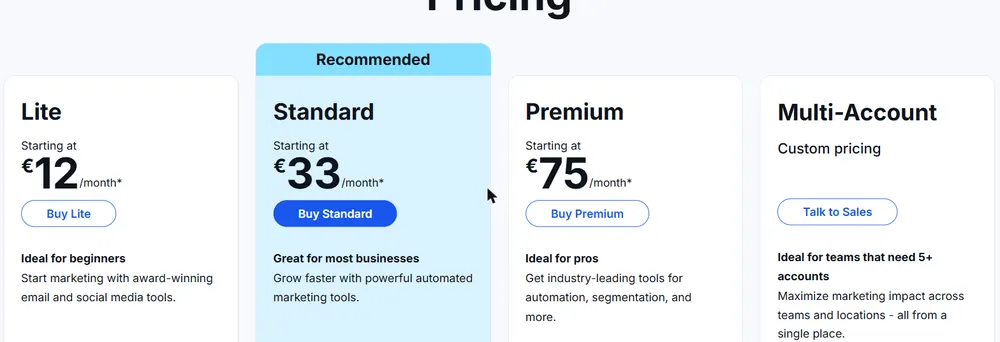
Constant Contact sells three plans priced by contact count: Lite from $12/mo, Standard from $35/mo and Premium from $80/mo, plus a quote-only Multi-Account option. Annual prepayment takes a consistent 15% off all three. There is no free plan, and the 30-day trial is capped at 100 total email sends, which almost nobody mentions. Two things make this pricing genuinely distinctive: Premium carries a 24x send multiplier, the highest in the category, and Constant Contact publishes its overage rate at $0.002 per send, or $2 per thousand. Almost no competitor does either.
All plans at a glance
Prices below are the entry contact tier. Every plan scales with contact count, and the annual column is a flat 15% reduction verified across all three plans.
Send allowance 10x your contact count. Constant Contact positions this one for beginners. It is the cheapest way onto the platform and the tightest on send headroom, which matters more here than on platforms with unlimited sending.
Send allowance 12x contacts. Marked Recommended by Constant Contact and described as suiting most businesses. The step from Lite is $23/mo at entry, which is a large proportional jump but buys a 20% larger send allowance plus the feature set.
Send allowance 24x contacts, double Standard. Includes 500 SMS messages per month at no extra charge. The multiplier alone is the strongest argument for this tier and it is buried in a comparison table rather than sold on the pricing page.
For teams needing 5 or more accounts. Priced by sales rather than published. Aimed at agencies and multi-brand operators who need genuine account separation rather than lists inside one login.
The pricing page states that your price depends on the plan you choose and how many contacts you have, then reveals the number through an interactive selector. The entry figures above are what the page shows before you set a contact count. Intermediate tiers exist and are not published anywhere we can cite, so treat the entry price as a floor and get your actual tier price from the selector before comparing against any competitor table.
The 30-day trial is capped at 100 sends
This is the single most misrepresented fact about Constant Contact pricing, and it is documented plainly in their own knowledge base.
There is no free plan. What exists is a 30-day free trial with no credit card required. On the surface that is generous: 30 days is double the 14-day trial Mailchimp and MailerLite run, and every campaign type is accessible including automated emails, landing pages, survey pages, events and social posting.
Constant Contact counts each email to a unique contact as one send, so a single campaign to 100 contacts exhausts the entire trial allowance in one click. You can upload as many contacts as you like, and then mail 100 of them, once.
The gap between what the trial appears to offer and what it actually permits is the widest we have measured in this category. Compare it honestly:
| Constant Contact trial | 30 days, 100 total sends, unlimited contact uploads |
|---|---|
| AWeber free plan | Permanent, 500 subscribers, 3000 sends per month |
| Mailchimp free plan | Permanent, 250 contacts, 500 sends per month |
| Moosend trial | 30 days, up to 1000 contacts, unlimited sends |
Moosend gives you thirty days of unlimited sending. Constant Contact gives you thirty days and one hundred emails. Both are described as a 30-day trial.
What the trial is actually good for. Building, not sending. All campaign types are available and your drafts stay saved after the trial ends, you simply cannot publish them without upgrading. So use the month to construct your templates, landing pages, forms and automation logic, and accept that you will not see meaningful engagement data before you pay. If validating deliverability or open rates matters to your decision, this trial cannot do it.
The 24x multiplier is the real Premium feature
Constant Contact caps monthly sends at a multiple of your contact count, and the Premium multiplier is an outlier the pricing page barely mentions.
| Plan | Multiplier | At 5000 contacts | At 25 000 contacts |
|---|---|---|---|
| Lite | 10x contacts | 50 000 sends | 250 000 sends |
| Standard | 12x contacts | 60 000 sends | 300 000 sends |
| Premium | 24x contacts | 120 000 sends | 600 000 sends |
Set that against the rest of the category. Mailchimp tops out at 15x on Premium. iContact tops out at 15x on Ultimate. AWeber tops out at 12x on Plus. Klaviyo runs 10x active profiles. Constant Contact Premium at 24x gives more send headroom per contact than any comparable plan on any of those platforms.
Translate the multiplier into cadence: it is how many emails each contact can receive per month. At 10x on Lite you have room for roughly two campaigns a week plus a light automation. At 24x on Premium you can mail every contact almost daily. A store running abandoned cart, browse abandonment, post-purchase, win-back and a weekly campaign lands around 8 to 12 emails per contact per month, which is comfortable on Premium, tight on Standard and over the line on Lite.
The trap on Lite. Ten times sounds like plenty until you count automations. Every flow fires per contact, and flows fire continuously rather than on your schedule. Two campaigns a month plus four automated flows on an engaged list gets to 10x faster than most people model, and unlike a contact overage there is no automatic upgrade to catch it. You just start paying overage, which brings us to the next section.
Turning the multiplier into a cadence you can plan
The multiplier is abstract until you convert it into emails per contact per month, which is the number your marketing calendar actually produces. Here is what each plan supports:
| Your programme | Emails per contact monthly | Fits on |
|---|---|---|
| Monthly newsletter only | About 1 | Lite, with enormous headroom |
| Weekly newsletter | About 4.3 | Lite comfortably |
| Weekly newsletter plus welcome and re-engagement flows | 6 to 8 | Lite is tight, Standard is safe |
| Ecommerce with cart, browse, post-purchase and win-back flows | 8 to 12 | Standard is at the ceiling, Premium is safe |
| Daily campaign plus a full flow stack | 30+ | Nothing here. Price a platform with unlimited sending. |
The counting mistake almost everyone makes. People model their campaign calendar and forget the flows. A campaign is something you schedule, so you know how many you send. A flow fires per contact on their behaviour, continuously, whether or not you are looking. Four active flows on an engaged ecommerce list routinely produce more sends than the campaigns do.
Work it out the other way round instead: take last month total sends from your current platform, divide by your contact count, and compare that ratio against 10, 12 and 24. That single number tells you which plan you need, and it is more reliable than any feature comparison.
Constant Contact publishes its overage rate, and that is rare
Most platforms in this category either throttle silently or say nothing about what happens past the allowance. Constant Contact gives you a number.
Credit where due. AWeber does not publish overage behaviour. iContact does not. Moosend has no send cap so the question does not arise, but Mailchimp throttles delivery without saying so on the pricing page. Constant Contact tells you the price of going over, which means you can actually plan for it.
It also means you can arbitrage it, and the maths is worth doing because the answers are not obvious.
When to buy the upgrade instead of the overage
An upgrade is worth it when your regular overage exceeds the price difference. At the entry contact tier:
| Lite to Standard | Costs $23/mo more. At $0.002 per send that equals 11 500 overage sends. If you routinely exceed Lite by more than that, upgrade. |
|---|---|
| Standard to Premium | Costs $45/mo more, equal to 22 500 overage sends. |
But the second row is misleading, and this is the useful finding. Moving from Standard to Premium does not just buy you the equivalent of 22 500 paid sends. It doubles your multiplier from 12x to 24x. At 5000 contacts that is an extra 60 000 included sends per month. Buying those 60 000 sends as overage on Standard would cost $120, against a Premium upgrade of $45.
Any account that consistently runs past its Standard allowance is paying nearly three times what the upgrade would cost. Because overage arrives as a variable line rather than a plan change, it is easy to bleed it for months without noticing. Check your send volume against your multiplier every quarter, not your contact count.
Add-ons: SMS and Inbox Preview
Two published add-ons, both with real prices, which is more transparency than most of the category offers.
| SMS Marketing | Starting at $10/mo. Premium includes 500 messages per month at no extra cost. |
|---|---|
| Inbox Preview | $10/mo, available on all plans. Renders your email across clients before you send. |
The bundled SMS on Premium is worth naming because it changes the tier comparison. If you intend to run SMS at all, Premium at $80/mo against Standard at $35 plus the $10 SMS add-on narrows the real gap from $45 to $35, and you get 500 messages plus the 24x multiplier for it.
What is not published: the per-message rate above the included 500, and how rates vary by destination. The $10 is a starting price, not a rate card. Ask for the per-message cost in your market before budgeting SMS volume.
Is Inbox Preview worth $10? It renders your email across clients before you send, which catches the layout breaks that Outlook and older Gmail still produce. At $120 a year it costs more than the entire Lite subscription, so the honest answer depends on volume: for a business sending two campaigns a month it is expensive insurance against a problem you could catch by sending yourself a test. For a team shipping several templates a week to a large list, one avoided broken send pays for it. Available on all plans, so it is a genuine choice rather than an upgrade lever.
Annual billing: a clean, consistent 15%
Constant Contact applies annual prepayment savings uniformly, which is refreshingly simple. Verified across all three plans at the entry tier:
| Plan | Monthly billing | Annual prepay (per month) | Saved per year |
|---|---|---|---|
| Lite | $12.00 | $10.20 | $21.60 |
| Standard | $35.00 | $29.75 | $63.00 |
| Premium | $80.00 | $68.00 | $144.00 |
Every row is exactly 15%, with no volume thresholds and no exceptions. Against the category that is mid-pack and predictable: Moosend gives 20%, AWeber effectively 16.7%, iContact 15%, MailerLite 10%, and Mailchimp gives nothing at all.
The saving scales with your tier rather than being front-loaded, so the argument for prepaying gets stronger as your contact count grows. Given the trial cannot show you meaningful engagement data, however, most buyers should run a month or two on monthly billing before locking in a year.
What five real accounts pay, overage included
Annual billing at the entry contact tier, with overage priced at the published $0.002 per send. This is the total, not the sticker.
| Account | Contacts | Sends/mo | Plan | Overage | Verdict |
|---|---|---|---|---|---|
| Local business, monthly newsletter | 1 200 | 1 200 | Lite | $0 | Uses one tenth of its allowance. Lite is correct. |
| Newsletter, weekly plus welcome flow | 3 000 | 18 000 | Lite | $0 | Six per contact, inside the 10x cap. Still Lite. |
| Store, four flows plus weekly campaign | 5 000 | 55 000 | Lite | $10 | 5000 sends over the 50 000 cap. Cheaper to stay and pay than upgrade. |
| Same store, one growth year later | 5 000 | 95 000 | Lite | $90 | Now absurd. Premium at $68 includes 120 000 sends outright. |
| Ecommerce, full stack plus SMS | 10 000 | 110 000 | Premium | $0 | Inside the 24x cap at 240 000, and 500 SMS bundled. |
Rows three and four are the same account twelve months apart, and they are the whole argument of this page. At 55 000 sends the overage is trivial and staying on Lite is rational. At 95 000 sends the same account pays $90 a month in overage on top of a $10.20 subscription, when Premium at $68 would include the volume with room to spare.
Contact tier changes are visible: you see the plan price move. Overage is a variable line that scales with your send volume, and send volume grows with every flow you switch on. The account in row four is paying $1080 a year in overage to avoid a $694 upgrade.
Common misconceptions
It does not. The trial permits 100 total email sends across the entire 30 days. You can build everything and send almost nothing, which means you cannot evaluate deliverability, open rates or list engagement before paying. Treat the trial as a build environment and plan to spend at least one paid month on monthly billing to actually assess the platform.
“Constant Contact has a free plan.” No. Only the trial. AWeber, MailerLite and Mailchimp maintain permanent free tiers; Constant Contact does not.
“Lite is fine, I will just pay the overage if I go over.” True at small overages and false quickly. At $0.002 per send, exceeding by 11 500 sends already costs more than upgrading Lite to Standard. Overage is a reasonable buffer, not a strategy.
“The 24x multiplier is marketing.” It is the most concrete advantage on the platform. Mailchimp Premium runs 15x, iContact Ultimate 15x, AWeber Plus 12x, Klaviyo 10x. Nothing comparable reaches 24x, and it is the reason a heavy-automation account can be cheaper here than on a nominally cheaper platform.
“Annual saves up to 15%, so probably less on cheap plans.” It is exactly 15% on all three plans at the entry tier, with no thresholds. The up to phrasing is conservative rather than a sliding scale.
Who should pay for which plan
| Beginner, one list, occasional campaigns | Lite at $10.20/mo annual. Fine while you send under 10 emails per contact per month. Count your automations before assuming you do. |
|---|---|
| Most businesses, regular campaigns plus a few flows | Standard at $29.75/mo annual. The 12x allowance covers a weekly campaign plus moderate automation. |
| Ecommerce with a full flow stack | Premium. The 24x multiplier is the reason, not the feature list. At 8 to 12 emails per contact monthly, Standard is tight and Lite is over the line. |
| Anyone using SMS | Premium. The bundled 500 messages narrow the real gap over Standard to about $35/mo, and you get the doubled multiplier included. |
| Consistently running over your allowance | Upgrade rather than pay overage. Premium costs roughly a third of buying the equivalent sends at $0.002. |
| Agency or multi-brand, 5+ accounts | Multi-Account, quote only. Do not try to run separate clients as lists inside one account. |
| Price-first buyer | Look elsewhere first. Moosend at $7/mo annual and MailerLite at around $10.80 both undercut Lite and both include unlimited sending. |
How Constant Contact compares on price
Entry pricing on annual billing, with the structural differences that matter more than the headline numbers.
| Platform | Entry annual | Free plan | Send limit | Overage published | Annual discount |
|---|---|---|---|---|---|
| Constant Contact Lite | $10.20 | 30-day trial, 100 sends | 10x contacts | $0.002/send | 15% |
| Constant Contact Premium | $68.00 | Same trial | 24x contacts | $0.002/send | 15% |
| Moosend Pro | $7.00 | 30-day trial, unlimited sends | Unlimited | No cap exists | 20% |
| MailerLite Comfort | ~$10.80 | 250 subs, 2500 sends | 10x subscribers | No cap exists | 10% |
| AWeber Lite | $12.50 | 500 subs, 3000 sends | 10x subscribers | Not published | 16.7% |
| Mailchimp Essentials | $13.00 | 250 contacts, 500 sends | 10x contacts | Not published | None |
Reading this table. Constant Contact Lite is competitive on entry price and weak on everything structural: the worst trial in the group, a 10x cap, and no free tier where AWeber, MailerLite and Mailchimp all keep one.
Premium is the plan that justifies the brand. The 24x multiplier is unmatched here, the overage rate is published, and SMS is bundled. At $68/mo annual it is expensive against Moosend, but Moosend sells transactional email only by quote and runs support 24/5 with no weekend cover.
Where Constant Contact genuinely wins beyond the multiplier: it has been operating since 1995 and its support reputation is the most consistently cited reason customers stay. That does not show up in a price table, and it is the main thing buyers are actually paying the premium for.
What you cannot price in advance
None are hidden fees. They are simply not published, so a budget built from the pricing page alone is a floor.
| Contact tier prices | Only entry rates are shown. Your actual price at 5000 or 25 000 contacts comes from the selector. |
|---|---|
| SMS per-message rate | $10/mo is a starting price. The rate above Premium bundled 500 messages, and how it varies by country, is not published. |
| Multi-Account pricing | Quote only for 5+ accounts. |
| Refund policy | No money-back guarantee window is stated on the pricing page. Since annual is prepaid, get the terms in writing before committing. |
Getting your real number in five minutes
Because the contact tier table is not published, the only way to price Constant Contact properly is to do it yourself. The sequence that produces an accurate figure rather than a floor:
| 1. Get your send ratio | Take last month total sends from your current platform and divide by your contact count. That single number decides between 10x, 12x and 24x, and it decides before any feature comparison does. |
|---|---|
| 2. Set your real contact count in the selector | Not your rounded-up ambition. The selector prices the tier you are in today, and contact tiers are the axis the whole bill turns on. |
| 3. Add the SMS line if you use it | $10/mo minimum on Lite and Standard, bundled at 500 messages on Premium. Ask for the per-message rate in your country above that. |
| 4. Model twelve months, not one | Your contact count and your flow count both grow. Price the tier above the one you need today and see whether the jump is survivable. |
Three questions worth putting to sales in writing, since none are answered publicly: what the refund terms are on an annual prepayment, what the per-message SMS rate is for your destinations, and whether crossing a contact tier mid-cycle is prorated or billed at the next renewal. That last one matters on a platform where growth moves you between tiers automatically.
Frequently asked questions
Does Constant Contact have a free plan?
No. There is a 30-day free trial with no credit card required, but no permanent free tier. AWeber, MailerLite and Mailchimp all maintain free plans; Constant Contact does not. The trial is also far more limited than its length suggests, at 100 total email sends.
How limited is the Constant Contact free trial?
Severely, and it is the most misunderstood fact about their pricing. The trial runs 30 days and allows 100 total email sends, not per day and not per campaign. Each email to a unique contact counts as one send, so one campaign to 100 contacts uses the entire allowance. You can upload unlimited contacts and access every campaign type, and your drafts stay saved after the trial, but you cannot publish without upgrading. Use it to build, not to measure engagement.
How much does Constant Contact cost?
Lite starts at $12/mo or $10.20 billed annually, Standard at $35/mo or $29.75 annually, and Premium at $80/mo or $68 annually. Those are entry contact tier prices. Constant Contact does not publish a full contact tier table; your actual price comes from the selector on their pricing page. A quote-only Multi-Account option exists for teams needing 5 or more accounts.
What are Constant Contact send limits?
Monthly sends are capped at a multiple of your contact count: 10x on Lite, 12x on Standard and 24x on Premium. The Premium multiplier is the highest among mainstream ESPs, ahead of Mailchimp Premium and iContact Ultimate at 15x and AWeber Plus at 12x. At 5000 contacts that is 50 000, 60 000 and 120 000 monthly sends respectively.
What happens if I exceed my Constant Contact send limit?
You are billed $0.002 for every send over the allowance, which Constant Contact states as $2 for every 1000 sends over the monthly limit. Publishing this rate is unusual: AWeber and iContact do not disclose overage behaviour at all. Because overage appears as a variable charge rather than a plan change, check your send volume against your multiplier quarterly.
Should I upgrade or just pay the overage?
Upgrade, in almost every case. Lite to Standard costs $23/mo more, equal to 11 500 overage sends. Standard to Premium costs $45/mo more but doubles your multiplier from 12x to 24x, which at 5000 contacts adds 60 000 included sends. Buying those as overage would cost $120, so Premium is roughly a third of the price of the equivalent overage.
How much does Constant Contact SMS cost?
SMS Marketing starts at $10/mo as an add-on, and Premium includes 500 messages per month at no extra charge. That bundling narrows the real gap between Standard plus the SMS add-on and Premium to about $35/mo. The per-message rate above the included 500, and how it varies by country, is not published, so ask before budgeting volume.
How much does annual billing save on Constant Contact?
A flat 15% across all three plans with no volume thresholds: Lite drops from $12 to $10.20, Standard from $35 to $29.75, Premium from $80 to $68. That is mid-pack: Moosend gives 20%, AWeber 16.7%, MailerLite 10%, and Mailchimp offers no annual discount at all.
Is Constant Contact good value against cheaper alternatives?
Not on entry price. Moosend at $7/mo annual and MailerLite at around $10.80 both undercut Lite and both include unlimited sending. Constant Contact competes on the Premium tier instead, where the 24x multiplier is unmatched, the overage rate is published, and SMS is bundled. Its long-standing support reputation is the other reason customers pay the premium, and it does not show up in a price table.
Does Constant Contact offer refunds?
No money-back guarantee window is stated on the pricing page. Since annual billing is prepaid, get the refund terms in writing from support before committing to a year. The 30-day trial is not a substitute for evaluation given its 100 send cap, so a month or two on monthly billing is the realistic way to test the platform properly.
Changelog (recent)
- 2026-08-20 Pricing tab rewritten and expanded. All plan prices, the flat 15 percent annual discount, the 10x/12x/24x send multipliers, the published $0.002 per send overage rate, the SMS and Inbox Preview add-ons and the Multi-Account option were verified against the official Constant Contact pricing page. The 30-day trial limit of 100 total email sends was verified against the Constant Contact knowledge base and added, as it was previously undocumented here. A stale claim that Mailchimp Free offers 500 contacts forever was corrected to 250 contacts and 500 sends, and an unsourced Enterprise price estimate drawn from third-party community reports was removed. Contact tier prices, the SMS per-message rate, Multi-Account pricing and refund terms are not published and are reported as such.
This review follows our email infrastructure testing methodology. We disclose affiliate relationships in our editorial independence policy.
