
How much does Brevo cost in 2026?
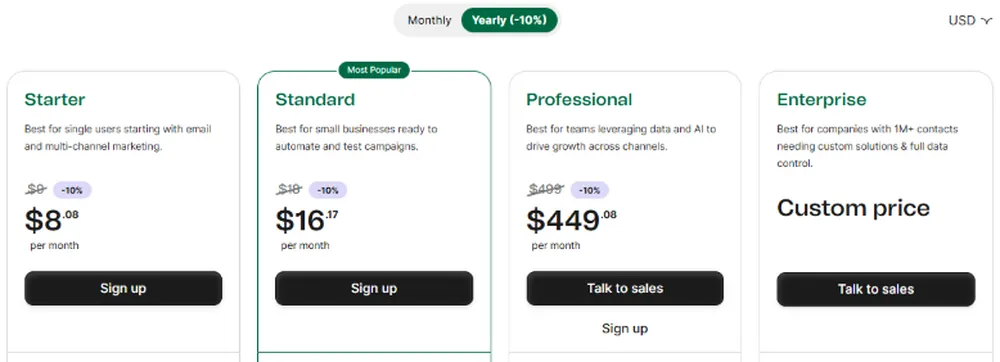
Brevo is the one mainstream ESP that bills you for emails sent, not contacts stored. Starter is $9/mo monthly or $8.08 yearly, Standard $18 or $16.17, both from 5000 emails a month. Professional jumps to $499 or $449.08, but starts at 150 000 emails, so the per-email rate barely moves. Yearly billing takes 10% off. Two things almost nobody mentions: transactional email is included on every plan, API and SMTP alike, and on Starter removing the Brevo logo is a $10.80 add-on, which costs more than the plan it sits on.
Brevo bills on emails sent, not contacts stored
This is the structural fact that decides whether Brevo is cheap or expensive for you, and it puts the platform in a category of its own.
Every other mainstream ESP prices on how many people are in your database. Mailchimp, AWeber, MailerLite, Constant Contact, iContact and Klaviyo all bill contacts and then derive a send allowance from a multiplier. Brevo inverts that: the meter is monthly email volume, campaigns and transactional combined.
| Large list, mailed rarely | Brevo wins, often decisively. A 50 000 contact list mailed twice a year costs the same as a 500 contact list mailed at the same volume. Everyone else charges you monthly for storing it. |
|---|---|
| Small list, mailed constantly | Brevo loses. A 2000 contact list mailed daily is 60 000 emails a month. On a contact-priced platform that is a cheap tier; here it is your entire meter. |
| Heavy transactional volume | Counts against the same allowance as your campaigns, because Brevo does not separate them. |
This is the detail that catches ecommerce teams. Your order confirmations, password resets and shipping notifications draw from the same monthly email volume as your newsletters. On SendGrid those are two separate products with two separate bills; on Brevo they are one number. Add both before choosing a tier, not just your campaign volume.
The practical test is simple: divide your monthly email volume by your contact count. If the ratio is low, meaning a big list you mail infrequently, Brevo is structurally cheaper than anything else here. If the ratio is high, look at a platform with unlimited sending like Moosend instead.
The ratio test, worked through
Since Brevo bills sends and everyone else bills contacts, the only honest way to compare is to compute your own ratio and price both models. Take your monthly email volume and divide by your contact count.
| Profile | Contacts | Emails/mo | Ratio | Verdict |
|---|---|---|---|---|
| Archive list, annual mailing | 30 000 | 2500 | 0.08 | Brevo, overwhelmingly |
| Quarterly newsletter | 12 000 | 4000 | 0.33 | Brevo, clearly |
| Monthly newsletter | 5000 | 5000 | 1 | Brevo, comfortably |
| Weekly newsletter | 5000 | 21 500 | 4.3 | Close. Price both. |
| Store with four flows | 5000 | 50 000 | 10 | Contact-priced platforms win |
| Daily sender | 5000 | 150 000 | 30 | Moosend or MailerLite Power |
The crossover sits around a ratio of 4 to 5, which is roughly a weekly newsletter with no automation. Below that, the volume model saves you real money because you stop paying rent on contacts you are not mailing. Above it, you are buying send volume that a contact-priced competitor would have thrown in under a multiplier.
The reason this matters more on Brevo than anywhere else is that the ratio is the only variable. On a contact-priced platform, growing your list raises your bill whether you mail the new people or not. Here, an inactive contact is free. That is either the best feature of the platform or an irrelevance, depending entirely on which side of the crossover you sit.
All plans at a glance
Prices are USD at the entry email volume. Yearly billing takes a flat 10% off, verified on all three published tiers.
Up to 300 emails per day once your account is approved for sending. No credit card to sign up. You can upload contacts immediately and start sending after approval. The daily ceiling is the constraint, not a monthly total.
From 5000 emails per month. Email and SMS, drag and drop editor, templates, AI content generator, advanced segmentation, forms, basic reporting, email support in six languages. The Brevo logo stays on your emails unless you buy the $10.80 add-on.
Everything in Starter, plus the features that make it a real platform. Unlimited multi-step marketing automation, A/B testing, advanced reporting with click heatmaps and geography, AI send time optimisation, web and event tracking, 1 landing page, and no Brevo logo, included.
From 150 000 emails per month. Adds WhatsApp, popups and push, 10 seats, contact scoring with RFM and CLV, advanced ecommerce features, AI segmentation, AI Data Analyst, phone support and 3 hours a year of Deliverability Specialist time.
Enterprise is quote only and adds multi-account management, custom objects, Brevo Mobile Wallet, a custom loyalty engine, custom data integrations, a dedicated IP, SSO and SAML, tailored onboarding and CSM support.
The jump to Professional looks brutal and mostly is not
Standard at $18 to Professional at $499 is a 27x increase, which reads like a wall. Do the arithmetic properly and it is something else.
The two tiers do not start at the same volume. Standard begins at 5000 emails a month; Professional begins at 150 000. That is 30 times the volume for 27 times the price.
| Standard at its entry volume | $18 for 5000 emails = $0.0036 per email |
|---|---|
| Professional at its entry volume | $499 for 150 000 emails = $0.0033 per email |
The headline gap is a change of volume class, not a punitive upsell. What you are really buying at Professional is the feature set: WhatsApp and push channels, ten seats, contact scoring, AI segmentation, phone support and deliverability specialist hours. Those are worth having or they are not, but the email itself costs the same either way.
The real problem is the gap in between. There is no published tier between 5000 and 150 000 emails with Professional features. Standard scales through the volume slider, so a business sending 60 000 emails a month can stay on Standard and pay for that volume. But if it needs contact scoring or a second team seat, the only route up is Professional at $449 minimum, whether or not it will ever send 150 000 emails.
That is the genuine cliff: not the price of the volume, but being forced to buy 150 000 emails to get a feature.
Transactional email is included on every plan
This is Brevo strongest and least advertised structural advantage, and it is worth measuring against what competitors charge for the same thing.
Brevo states that all plans give access to transactional email features: RESTful APIs, SMTP, outbound webhooks and unlimited log retention. Not an add-on, not a separate product, not a higher tier.
| Platform | How you get transactional email |
|---|---|
| Brevo | Included on every plan, free tier upward |
| SendGrid | A separate product with its own subscription |
| Moosend | Quote-only add-on, Moosend+ tier, no public price |
| Mailchimp | Separate Mandrill add-on |
| AWeber, iContact, Constant Contact | Not offered as a transactional product |
For a store or a SaaS that needs both marketing and transactional email, this collapses two vendors into one bill and one sending reputation. It is the single best reason to choose Brevo, and the pricing page barely mentions it.
The catch is the shared meter
Included does not mean free. Transactional volume counts against the same monthly email allowance as your campaigns. A store sending 40 000 receipts and 20 000 campaign emails needs a 60 000 email plan, not a 20 000 one. SendGrid charges you twice but meters separately; Brevo charges once and meters together. Neither is free, and which is cheaper depends on your mix.
Removing the Brevo logo costs more than the Starter plan
A small number with a large consequence, and the clearest example of why the entry price is not the price.
On Starter, your emails carry a Brevo footer. Removing it is a paid add-on at $10.80 per month. Starter itself costs $8.08 per month on yearly billing.
| Configuration | Monthly cost, yearly billing | What you get |
|---|---|---|
| Starter alone | $8.08 | Brevo footer on every send |
| Starter plus logo removal | $18.88 | Clean emails, no automation, no A/B testing |
| Standard | $16.17 | Clean emails and automation, A/B testing, advanced reporting, a landing page |
$16.17 against $18.88, and Standard throws in unlimited marketing automation, A/B testing, click heatmaps, AI send time optimisation and a landing page. If you were going to pay to remove the logo, you should be on Standard. There is no configuration in which Starter plus the add-on makes sense.
So Starter has exactly one honest use case: a sender who genuinely does not mind the Brevo footer. Charities, internal newsletters, hobby projects, early-stage validation. The moment branding matters, Starter is the wrong plan regardless of budget.
The free plan and its daily ceiling
Brevo runs a permanent free plan with no credit card required at signup. You can upload contacts immediately, and once Brevo approves your account for sending you can send up to 300 emails per day.
Note the shape of that limit. It is a daily cap, not a monthly one, which puts Brevo in the same category as the SendGrid Email API rather than alongside the contact-based free tiers.
| Brevo Free | 300 emails per day, roughly 9000 a month if spread evenly |
|---|---|
| SendGrid Marketing Campaigns Free | 2000 contacts, 6000 emails per month |
| MailerLite Free | 250 subscribers, 2500 emails per month |
| AWeber Free | 500 subscribers, 3000 emails per month |
| Mailchimp Free | 250 contacts, 500 emails per month |
Spread evenly, 300 a day is the most generous monthly volume on this list. Concentrated, it is the least usable: a single campaign to 1000 subscribers cannot be sent in one go, because the ceiling resets daily rather than monthly.
It fits transactional traffic and drip automations, which trickle. It does not fit campaign sending, which is bursty by design. If your free-tier plan is one newsletter a week to a few hundred people, Brevo Free will not do it in a single send. If it is a welcome sequence firing continuously, it is the most generous free tier available.
There is also no contact limit mentioned on the free plan. On a platform that bills sends rather than contacts, that follows logically, and it means you can park a large list on Brevo at zero cost while you decide.
Pay-as-you-go credits that never expire
Alongside subscriptions, Brevo sells email credits. One email sent deducts one credit, and Brevo states plainly that credits do not expire. Its own documentation describes credits as pricing based on the number of emails, with no daily sending limit and no expiration date.
| What you keep | All Brevo features and services |
|---|---|
| What you lose | Phone support is not included with credits |
| Who it suits | Businesses that send infrequently, or that do not have a large contact list |
| Flexibility | Buy more credits or move to a monthly plan at any time |
Non-expiring credits are rarer than they should be. Mailchimp expires its credits after 12 months with no rollover and no refund. Moosend and Brevo both let them sit indefinitely. For a seasonal sender, that difference is the whole decision: an unused Mailchimp block is a write-off, an unused Brevo block is next year budget.
Note also that credits remove the daily sending limit, which the free plan imposes. If the 300 a day ceiling is your only problem, credits solve it without committing to a subscription.
Add-ons and the Sales modules
| Add-on | Price | Notes |
|---|---|---|
| No Brevo logo | $10.80/mo | Starter only. Included from Standard upward. |
| Sales Essentials | $27.92/mo | 1 seat included. Available on Starter and Standard. |
| Sales Advanced | $58.50/mo per user | Professional and Enterprise. Priced per user, not per account. |
| SMS campaigns | By volume and destination | SMS credits sold separately from email. No flat rate published. |
| Email credits | By volume | No daily limit, no expiry. |
Sales Advanced is per user, and that changes the arithmetic
Sales Essentials at $27.92 covers one seat on the whole account. Sales Advanced at $58.50 is charged per user. A five-person sales team on Advanced is $292.50 a month on top of a Professional plan at $449. Price the seat count before treating Sales Advanced as a line item rather than a second subscription.
SMS deserves the same caution. Brevo bundles SMS access into the Starter feature list, but the credits are sold separately and priced by volume and destination country. There is no published per-message rate, so an SMS programme cannot be budgeted from the pricing page. Ask for the rate in your markets.
Pricing a store on a shared meter
Because receipts and campaigns draw from the same allowance, an ecommerce buyer has to add two numbers most platforms keep apart. It is worth doing carefully, because the transactional half is usually the one people forget.
| Order confirmations | One per order. A store doing 800 orders a month sends 800. |
|---|---|
| Shipping and delivery notices | Often two per order, so another 1600. |
| Password resets and account emails | Low volume but continuous. |
| Abandoned cart and post-purchase flows | The largest hidden component. Fires per visitor, not per order. |
| Campaigns | The only number most people estimate. |
A worked example. A store with 8000 contacts sending a weekly campaign is 34 400 campaign emails a month. Add 800 orders producing 2400 transactional emails, plus abandoned cart and post-purchase flows firing perhaps 18 000 times. The real meter is around 55 000 emails, not the 34 400 the campaign calendar suggests.
On a contact-priced platform this error is invisible, because you bought contacts and the sends came with a multiplier. On Brevo it lands directly on the bill. Pull your actual total sends from your current provider for a full month rather than estimating from your campaign schedule, and price the tier from that number.
The flip side deserves stating too: because both streams share one allowance, a quiet month costs less. A store with seasonal order volume pays for what it actually sent rather than carrying peak capacity all year, which is the opposite of how a contact tier behaves.
What five real accounts pay
Yearly billing, using the published rates. Remember the meter counts campaigns and transactional together.
| Account | Contacts | Emails/mo | Plan | Cost | Note |
|---|---|---|---|---|---|
| Drip sequence, no campaigns | 4000 | 8000 trickled | Free | $0 | Under 300/day. Contacts are irrelevant here. |
| Weekly newsletter, small list | 1000 | 4300 | Starter | $8.08 | Only if the Brevo footer is acceptable. |
| Same, but branding matters | 1000 | 4300 | Standard | $16.17 | Cheaper than Starter plus the $10.80 add-on. |
| Dormant list, two sends a year | 40 000 | 6700 average | Standard | $16.17+ | Where Brevo wins. Elsewhere 40 000 contacts is a large monthly bill. |
| Store, receipts plus campaigns | 8000 | 55 000 combined | Standard | Volume tier | One meter for both. Price the combined figure. |
Row four is the argument for Brevo in a single line. A 40 000 contact list mailed twice a year costs almost nothing here, because you are billed for the 80 000 emails you actually send across the year rather than for storing 40 000 people for twelve months. On Mailchimp or AWeber that same list is a serious monthly line item whether you mail it or not.
How Brevo compares on price
| Platform | Entry paid | Billed on | Free tier | Transactional | Annual discount |
|---|---|---|---|---|---|
| Brevo Starter | $8.08 yearly | Emails sent | 300/day | Included | 10% |
| Moosend Pro | $7.00 yearly | Contacts | 30-day trial | Quote-only add-on | 20% |
| MailerLite Comfort | $10.80 yearly | Subscribers | 250 subs, 2500 emails | Not offered | 10% |
| Constant Contact Lite | $10.20 yearly | Contacts | 30-day trial, 100 sends | Not offered | 15% |
| Mailchimp Essentials | $13.00, no discount | Contacts | 250 contacts, 500 sends | Mandrill add-on | None |
| SendGrid Marketing | $15.00 | Contacts and sends | 2000 contacts, 6000 emails | Separate product | None published |
Reading this table. On entry price Brevo sits second behind Moosend and the gap is about a dollar, so price alone should not decide it. What decides it is the billing axis and the transactional inclusion.
Brevo is the only platform here that bills sends rather than contacts, and the only one that includes transactional email at every tier. For a business with a large list it mails occasionally, or one that needs receipts and newsletters from one vendor, nothing else in this table matches the structure at any price.
Where Brevo loses: a small list mailed constantly. Moosend at $7 with unlimited sends is strictly better for a daily sender, and MailerLite Power removes the send cap too. Brevo also has the steepest feature cliff, since anything above Standard means Professional at $449.
Who should pay for which plan
| Automated sequences, no big campaigns | Free. 300 a day suits trickling traffic and there is no contact limit to grow into. |
|---|---|
| Small sender, Brevo footer acceptable | Starter at $8.08 yearly. The only situation where Starter is the right answer. |
| Anyone who wants clean branding | Standard at $16.17. Cheaper than Starter plus the logo add-on and vastly better equipped. |
| Large list, infrequent campaigns | Standard at your volume tier. This is where Brevo structurally beats every contact-priced competitor. |
| Store needing receipts and newsletters | Standard, priced on combined volume. One vendor, one bill, one sending reputation. |
| Need contact scoring, WhatsApp or 10 seats | Professional at $449. Be aware you are buying 150 000 emails whether you need them or not. |
| Seasonal or occasional sender | Pay-as-you-go credits. They never expire and they lift the daily sending limit. |
| Small list mailed daily | Look at Moosend at $7 with unlimited sends. A volume meter works against you here. |
What you cannot price in advance
Brevo publishes its plan prices clearly, which is better than most. What it does not publish is everything metered.
| Price at each email volume tier | Only the entry rates at 5000 and 150 000 emails are shown. The rest comes from the volume slider in the plan builder. |
|---|---|
| SMS per-message rate | Priced by volume and destination country. No rate card published. |
| Email credit pricing | Based on number of emails, but the rate per credit is not published on the pricing page. |
| Enterprise | Quote only. We are not going to estimate it. |
Two things Brevo does publish that competitors do not, and which deserve credit: there are no hidden fees beyond the plan and the credits you choose, and cancellation is self-serve at any time from the account, with your data either retained for later or deleted on request. Payment is by card through Adyen, or PayPal, and a monthly subscription runs on a 30-day period charged at the start.
One last practical note on the volume slider. Because the meter is emails rather than contacts, your tier can move without anything changing in your marketing. A product launch, a seasonal peak, or simply switching on one more automated flow all push the same number. Set a reminder to check your actual monthly volume against your tier every quarter, the same way a contact-priced account should audit its list size.
Frequently asked questions
Does Brevo charge by contacts or by emails?
By emails sent. Brevo bills on monthly email volume, counting campaigns and transactional together, and does not charge for contacts stored. That makes it structurally cheaper than every contact-priced competitor for a large list mailed infrequently, and more expensive for a small list mailed constantly. Divide your monthly send volume by your contact count: a low ratio favours Brevo.
How much does Brevo cost?
Starter is $9/mo monthly or $8.08 on yearly billing, Standard $18 or $16.17, both from 5000 emails per month. Professional is $499 or $449.08 and starts at 150 000 emails per month. Enterprise is quote only. Yearly billing takes a flat 10% off.
Is the Brevo free plan really free?
Yes, permanently, with no credit card at signup. Once Brevo approves your account for sending you can send up to 300 emails per day. Note that it is a daily ceiling rather than a monthly allowance, so it suits trickling automated sends better than a weekly campaign to a few hundred people. There is no contact limit, which follows from Brevo billing sends rather than contacts.
Does Brevo put its logo on my emails?
On the free plan and on Starter, yes. Removing it is a $10.80 per month add-on on Starter, and it is included from Standard upward. Since Starter costs $8.08 yearly, Starter plus the add-on comes to $18.88 against Standard at $16.17. If branding matters to you, go straight to Standard; the add-on never makes financial sense.
Why is Professional so much more expensive than Standard?
Because it starts at a different volume. Standard begins at 5000 emails a month and Professional at 150 000, so 30x the volume for 27x the price. Per email, Professional is marginally cheaper at $0.0033 against $0.0036. The real constraint is that there is no middle tier: needing a Professional feature such as contact scoring means buying 150 000 emails whether you send them or not.
Is transactional email included with Brevo?
Yes, on every plan including free. Brevo gives all plans access to RESTful APIs, SMTP, outbound webhooks and unlimited log retention. That is unusual: SendGrid sells transactional as a separate product, Moosend as a quote-only add-on, Mailchimp through Mandrill, and AWeber, iContact and Constant Contact do not offer it. The catch is that transactional volume counts against the same monthly email meter as your campaigns.
Do Brevo email credits expire?
No. Brevo states that pay-as-you-go credits do not expire, with one email sent deducting one credit, no daily sending limit and no expiration date. Mailchimp expires its credits after 12 months with no rollover. Credits keep all Brevo features but do not include phone support, and you can switch to a monthly plan at any time.
How much do the Brevo Sales modules cost?
Sales Essentials is $27.92 per month with 1 seat included, available on Starter and Standard. Sales Advanced is $58.50 per month per user on Professional and Enterprise. The per-user pricing matters: a five-person team on Advanced adds $292.50 a month on top of the plan, so price your seat count before treating it as a small line item.
How much does Brevo SMS cost?
SMS credits are sold separately from email and priced by volume and destination country. Brevo does not publish a per-message rate card on its pricing page, so an SMS programme cannot be budgeted from the public site. Ask for the rate in the countries you actually send to before committing.
Can I cancel Brevo at any time?
Yes. You choose monthly or yearly commitment at signup, and you can cancel from your account at any time. Brevo states there are no hidden fees and no additional charges beyond the plan or credits you buy. Your data is stored in case you return, or deleted entirely on request. A monthly subscription runs as a 30-day period charged at the start of each cycle.
Changelog (recent)
- 2026-08-20 Pricing tab written from scratch to replace a 1.4 KB scaffold. Verified against the official Brevo pricing page with the currency switched to USD: Starter $9 monthly and $8.08 yearly, Standard $18 and $16.17, Professional $499 and $449.08, flat 10 percent yearly discount, Starter and Standard from 5000 emails per month and Professional from 150000. Add-on prices read from the plan builder: No Brevo logo $10.80/mo on Starter, Sales Essentials $27.92/mo with one seat, Sales Advanced $58.50/mo per user. Free plan at 300 emails per day and non-expiring pay-as-you-go credits confirmed from the official FAQ. Per-tier volume pricing, SMS rates by destination, credit pricing and Enterprise are not published and are reported as such.
This review follows our email infrastructure testing methodology. We disclose affiliate relationships in our editorial independence policy.