
How much does MailerLite cost in 2026?
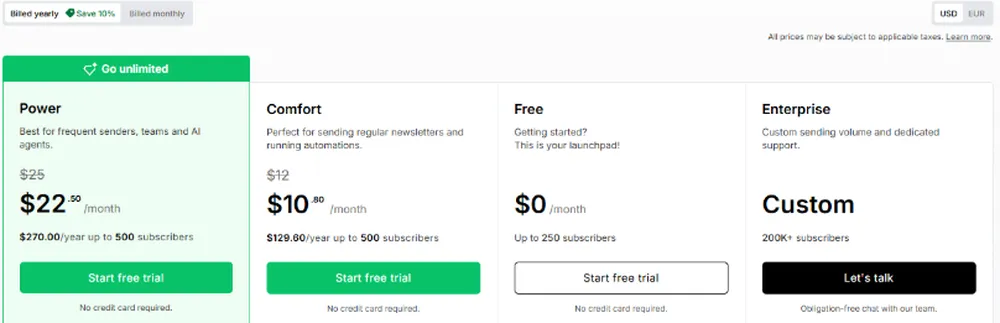
MailerLite runs a genuinely useful free plan at 250 subscribers and 2500 emails per month, then Comfort from $12/mo and Power from $25/mo, plus a custom Enterprise tier. Annual billing takes 10% off. The plans were renamed in the last cycle: Growing Business became Comfort and Advanced became Power, and that rename brought a change worth knowing about. Comfort is now capped at 10x your subscriber tier per month. The old plans carried no explicit sending limit. Only Power keeps unlimited sending, under a fair use policy. If you picked MailerLite because sending was uncapped, check which plan you are on.
All plans at a glance
Prices below are the entry subscriber tier, billed monthly. Every paid plan scales with subscriber count, and annual billing takes a flat 10% off.
Up to 250 subscribers and 2500 monthly emails. Includes 2 user seats, 3 automations, 1 website and 1 landing page, and 1 digital product or booking. Two seats and real automations on a free tier is unusual.
Sending capped at 10x your subscriber tier ceiling. Adds unlimited templates, 50 automations, 10 websites and landing pages, 5 digital products or bookings, 10 signup forms, the AI writing assistant and smart sending. 3 user seats.
Unlimited monthly emails, subject to a fair use policy. Unlimited user seats, unlimited automations, landing pages, digital products and signup forms. Adds multiple automation triggers and 24/7 live chat and email support. The uncapped sending is the reason to be here.
Priced by sales, not published. Adds a dedicated success manager, an account audit with performance improvements, a dedicated IP and deliverability support. The dedicated IP is the concrete deliverable; the rest is service.
The pricing page shows starting rates and reveals your actual price through a subscriber slider. There is no static list to compare against. The figures above are the entry tier; get your real number from the calculator before setting a budget or comparing against a competitor table.
The rename brought a new sending cap
This is the detail that matters most and the one nobody flags, because a rename looks cosmetic.
MailerLite renamed its paid plans: Growing Business is now Comfort, and Advanced is now Power. Any article still using the old names is describing the previous structure, and there are a lot of them.
MailerLite gives the worked example itself: at 5000 subscribers you can send 50 000 monthly emails. Power keeps unlimited sending under a fair use policy.
Read that plainly. The entry paid plan went from uncapped sending to a multiplier cap, and the change arrived alongside a name change rather than a price increase. For most senders the cap is generous and nothing changes. For high-frequency senders it is a material downgrade at the Comfort price point, and the only way back to uncapped sending is Power at roughly double.
Who this actually affects. The multiplier is how many emails each subscriber can receive per month. At 10x you have room for a daily send to a third of your list, or roughly ten emails per subscriber. A weekly newsletter uses about 4.3. A store running four automated flows plus campaigns lands between 8 and 12, which is where Comfort starts to bind.
MailerLite does not publish what happens when you exceed the Comfort cap
Neither the pricing page nor the plan update FAQ states whether going over throttles delivery, queues the overflow, or triggers a charge. Constant Contact publishes an overage rate of $0.002 per send; MailerLite publishes nothing equivalent. If your programme runs anywhere near 10x, get the overage behaviour confirmed before committing to an annual term.
The free plan: what you actually get
MailerLite keeps one of the few free tiers in the category that is genuinely usable rather than a demo.
| Subscribers | 250 |
|---|---|
| Monthly emails | 2500, which is 10x the subscriber cap, the same multiplier as Comfort |
| User seats | 2 |
| Automations | 3 |
| Websites and landing pages | 1 website and 1 landing page |
| Digital products or bookings | 1 |
Mailchimp Free gives 1 seat and no automation beyond a single welcome email. AWeber Free gives 1 seat. Klaviyo Free gives 250 profiles but only 500 sends. MailerLite gives you five times Mailchimp send allowance, a colleague, three real automated flows and a website builder, at zero. For a small business testing whether email works at all, this is the most complete free tier available.
Where it runs out. The 250 subscriber cap binds long before the send allowance does. At 2500 emails you have ten sends per subscriber, which comfortably covers a weekly newsletter plus flows. It is list growth that pushes you to Comfort, not sending volume, which is the opposite of how most free tiers fail.
MailerLite also runs a 14-day premium trial separately from the free plan, so you can test paid features without leaving the free tier permanently.
Free plan versus the 14-day premium trial
MailerLite runs both, they are different things, and using them in the right order saves you money.
| Free plan | Permanent. 250 subscribers, 2500 monthly emails, 2 seats, 3 automations. No expiry, no card. |
|---|---|
| 14-day premium trial | Time-limited access to paid features, separate from the free plan. Lets you test what Comfort and Power add without committing. |
The sequence that works. Start on Free and build your real programme: import a list, set up your three automations, publish a landing page and send actual campaigns to real people. That gives you engagement data no trial can produce, because the free plan is permanent and your sends are real.
Then, when you are close to needing a paid plan, activate the premium trial to test the specific thing you are about to pay for. If it is the seat limit, add a colleague. If it is automation depth, build the flow that Comfort would cap. Fourteen days is short, so spend it answering one question rather than exploring.
Doing it the other way round wastes the trial. Burning fourteen days evaluating features before you have a list or a cadence tells you very little, and you cannot restart it later when the decision actually matters.
Comfort versus Power: what the upgrade actually buys
At entry the gap is $13/mo, or $11.70 on annual billing. That is a 108% premium, the steepest proportional step in the lineup, so it deserves scrutiny.
| Capability | Comfort | Power |
|---|---|---|
| Monthly sending | 10x subscriber tier | Unlimited, fair use |
| User seats | 3 | Unlimited |
| Automations | 50 | Unlimited |
| Websites and landing pages | 10 | Unlimited |
| Digital products or bookings | 5 | Unlimited |
| Signup forms | 10 | Unlimited |
| Multiple automation triggers | No | Yes |
| Support | 24/7 live chat and email | |
| AI writing assistant, smart sending | Yes | Yes |
Be honest about the Comfort caps. Fifty automations, ten landing pages and ten signup forms are not limits most businesses hit. A team of four hits the three-seat cap on day one, and a high-frequency sender hits the 10x cap every month. Those two are the real triggers; the rest of the Power column is headroom you will probably never use.
Comfort caps you at fifty automations but Power is what lets a single automation fire from more than one trigger. If your flows need to start from several events, that is an architectural difference, not a quota. It is easy to miss because it reads like a feature bullet rather than a constraint.
How pricing scales with your list
Both paid plans price per subscriber tier. MailerLite does not publish the tier table, so this section is about the shape of the decision rather than a price list we cannot cite.
What is published: Comfort starts at $12/mo and Power at $25/mo at the entry tier, annual billing removes 10%, and Comfort sending scales with your tier ceiling at 10x. So as your list grows, your send allowance grows with it proportionally, which is a fairer structure than a fixed send cap.
| Comfort at 500 subscribers | 5000 monthly emails included |
|---|---|
| Comfort at 5000 subscribers | 50 000 monthly emails, the example MailerLite gives itself |
| Comfort at 25 000 subscribers | 250 000 monthly emails |
| Power at any tier | Unlimited, subject to fair use |
The practical test is the same one that decides every multiplier-capped platform. Take your total sends last month, divide by your subscriber count, and compare the ratio to 10. Under it, Comfort is correct and you are paying the lower price for nothing lost. Over it, you are choosing between Power and a platform that does not meter sends at all.
The product breadth nobody puts in a price comparison
Price tables compare emails and contacts, so they miss what MailerLite actually bundles. Every paid plan includes a website builder, landing pages, signup forms, and the ability to sell digital products or take bookings.
| Free | 1 website, 1 landing page, 1 digital product or booking |
|---|---|
| Comfort | 10 websites and landing pages, 5 digital products or bookings, 10 signup forms |
| Power | Unlimited on all four |
Why this changes the comparison. On most competitors these are separate purchases or separate products entirely. Selling a digital product usually means a Gumroad or Podia subscription. Taking bookings usually means Calendly. A website means Squarespace or a WordPress host. MailerLite folds all of them into a plan that starts at $10.80/mo annual.
For a solo operator or a small business, that consolidation can be worth more than the email pricing. If MailerLite replaces a booking tool and a digital product platform you are already paying for, the effective cost is negative against a nominally cheaper ESP that does email only.
Bundled tools are rarely best in class. A MailerLite website is not a Squarespace site, and its digital product checkout is not Gumroad. The question is not whether the bundled version is as good, it is whether it is good enough for what you actually need. For a landing page behind a signup form, it usually is. For a real storefront, it usually is not.
This is also the clearest answer to why MailerLite still competes after losing its uncapped-sending advantage on Comfort. It stopped being the cheapest way to send email and became the cheapest way to run a small operation that includes email.
What “unlimited, fair use applies” actually means
Power sending is described as unlimited with a fair use policy attached. That asterisk is worth taking seriously rather than dismissing.
Fair use clauses exist so a provider can intervene when one account degrades shared sending infrastructure for everyone else. In practice they are rarely invoked against normal marketing programmes, and MailerLite does not publish a numeric threshold at which it applies. But unlimited with a policy is not the same promise as unlimited without one.
If your volume is ordinary for your list size, ignore the clause. If you are planning something unusual, such as very high frequency to a large list, a sudden order-of-magnitude increase, or migrating a big list and mailing it immediately, ask MailerLite what the policy means for your specific plan before you commit. Getting a number in writing costs one email and removes the only real ambiguity in the Power proposition.
Compare the alternatives honestly: Moosend also sells unlimited sending on every paid plan, and its entry price is $9/mo against Power at $25. If uncapped sending is the single thing you are buying, Moosend delivers it cheaper. What Power adds over Moosend is unlimited seats, 24/7 live chat, and a website and landing page builder Moosend does not match.
Enterprise and the dedicated IP
Enterprise is quote-only and adds four things: a dedicated success manager, an account audit with performance improvements, a dedicated IP, and deliverability support.
Of those, only the dedicated IP is a hard deliverable; the other three are services whose value depends entirely on the people attached. That makes Enterprise hard to price-compare, and it means the question to ask is not what it costs but what the audit actually covers and how the success manager is measured.
A dedicated IP is not automatically an upgrade
A dedicated IP isolates your sending reputation, which helps when your volume is high and consistent enough to build one. On irregular or low volume it performs worse than a well-warmed shared pool, because receiving servers have no history to judge you on. Do not treat the dedicated IP as a reason to move to Enterprise unless your send volume is genuinely large and regular. The included deliverability support exists precisely because warming an IP correctly is not trivial.
What five real accounts pay
Annual billing at the entry subscriber tier, with the plan chosen by the constraint that actually binds rather than by list size alone.
| Account | Subscribers | Sends/mo | Seats | Plan | What decided it |
|---|---|---|---|---|---|
| Newsletter, just starting | 200 | 900 | 1 | Free | Nothing binds. Free covers it entirely. |
| Consultant, weekly send | 1 200 | 5 200 | 1 | Comfort | Subscriber count, not sending. Ratio is 4.3, well under 10x. |
| Small store, four flows | 4 000 | 38 000 | 2 | Comfort | Ratio 9.5. Inside 10x, but only just. Watch it. |
| Same store, one flow more | 4 000 | 46 000 | 2 | Power | Ratio 11.5. Over the cap, and the overage behaviour is unpublished. |
| Agency team of five | 8 000 | 30 000 | 5 | Power | The seat cap alone. Sending ratio is only 3.8. |
Rows three and four are the same store after switching on one additional flow. Nothing about the list changed; the send ratio crossed 10 and the plan had to double. That is the practical consequence of the Comfort cap, and it arrives from a product decision rather than from growth.
The last row is the other pattern worth noticing: an account well inside the sending cap that still needs Power, purely because Comfort stops at three seats. Two completely different constraints push you to the same upgrade, and only one of them has anything to do with email volume.
What you cannot price in advance
None are hidden fees. They are simply not published, which makes any budget built from the pricing page a floor rather than an estimate.
| Subscriber tier prices | Only the $12 and $25 entry rates are shown. Your price at 5000 or 25 000 subscribers comes from the calculator. |
|---|---|
| Comfort overage behaviour | Not stated anywhere. Unknown whether exceeding 10x throttles, queues or bills. |
| Fair use threshold on Power | No numeric limit published. |
| Enterprise pricing | Quote only. We are not going to estimate it from third-party reports. |
Refund terms are not published either. Since annual billing is prepaid for the 10% discount, get them in writing before committing to a year, and use the free plan plus the 14-day premium trial as your real evaluation window.
If the Comfort cap changed your maths
A lot of MailerLite customers chose it specifically because sending was uncapped at a low price. If that was you and you are now on Comfort, the platform you bought is not quite the platform you have. Three honest options:
| Stay on Comfort | Correct if your send ratio is under 10, which covers most newsletter senders. Nothing has actually changed for you. Check the ratio before assuming. |
|---|---|
| Move to Power | $22.50/mo annual restores uncapped sending under fair use, and adds unlimited seats and 24/7 chat. Roughly double Comfort. |
| Move to Moosend | $7/mo annual with unlimited sending on every paid plan. Cheaper than Comfort and uncapped, but no website builder, no digital products, and transactional email is quote-only. |
Do the ratio before doing anything else. Total sends last month divided by subscriber count. If the answer is comfortably under ten, this whole section is academic and Comfort remains the right plan at a fair price. Most senders discover they are at four or five.
If you are over, the choice is between paying for headroom you will use and switching to a platform that does not meter sends at all. Weigh what MailerLite bundles that Moosend does not: the site builder, landing pages, digital products and bookings. If you use none of them, the switching case is strong. If you use two, it mostly disappears.
Common misconceptions
No longer true, and this is the most consequential error circulating about MailerLite pricing. Comfort is capped at 10x your subscriber tier per month. Only Power is unlimited, and that carries a fair use policy. Under the previous plan structure there were no explicit sending limits, which is why so many comparison articles still say otherwise.
“MailerLite has Growing Business and Advanced plans.” Those names are retired. Growing Business became Comfort and Advanced became Power. The rename also introduced the Comfort sending cap.
“The free plan gives 1000 subscribers.” An older figure. The current free plan is 250 subscribers and 2500 monthly emails. It is still the most capable free tier in the category, but the caps moved.
“Annual billing saves 15 or 20 percent.” It saves 10%. That is the lowest annual discount among the major ESPs: Moosend gives 20%, AWeber effectively 16.7%, iContact and Constant Contact 15%.
How MailerLite compares on price
Entry pricing on annual billing, with the structural differences that decide more than the headline numbers.
| Platform | Entry annual | Free plan | Sending on entry paid plan | Annual discount |
|---|---|---|---|---|
| MailerLite Comfort | $10.80 | 250 subs, 2500 sends, 2 seats | 10x subscribers | 10% |
| MailerLite Power | $22.50 | Same free tier | Unlimited, fair use | 10% |
| Moosend Pro | $7.00 | 30-day trial only | Unlimited | 20% |
| AWeber Lite | $12.50 | 500 subs, 3000 sends | 10x subscribers | 16.7% |
| Mailchimp Essentials | $13.00 | 250 contacts, 500 sends | 10x contacts | None |
| Constant Contact Lite | $10.20 | 30-day trial, 100 sends | 10x contacts | 15% |
Reading this table. MailerLite Comfort is competitive but no longer distinctive on sending: at 10x it now matches AWeber Lite, Mailchimp Essentials and Constant Contact Lite rather than beating them. Moosend undercuts it on price and gives uncapped sending on the same plan.
Where MailerLite still clearly wins is the free tier. 250 subscribers with 2500 monthly emails, two seats, three automations and a website builder is more than any competitor gives away, and it is a genuine on-ramp rather than a demo. The paid plans are priced fairly rather than aggressively, and the 10% annual discount is the weakest in the group.
The honest summary: MailerLite used to win on uncapped sending at a low price. After the rename it wins on the free tier and on product breadth, with websites, landing pages, digital products and bookings bundled in rather than sold as add-ons. That is a different value proposition and worth re-evaluating if uncapped sending was your original reason for choosing it.
One last comparison point that rarely gets made: MailerLite is the only platform in this table whose free tier includes a second user seat. That sounds minor until you are a two-person business, because every competitor forces you onto a paid plan the moment a colleague needs to log in. On MailerLite that trigger does not arrive until the fourth person.
Who should pay for which plan
| Under 250 subscribers, starting out | Free. The most capable free tier available. Two seats and three automations mean you can run a real programme, not a demo. |
|---|---|
| Growing past 250, sending under 10x | Comfort at $10.80/mo annual. The caps on automations, landing pages and forms are generous enough that most businesses never touch them. |
| Team of four or more | Power. Comfort stops at 3 seats. Nothing else matters if a fourth person needs access. |
| High-frequency sender | Power, or price Moosend. Comfort at 10x will bind, and MailerLite does not publish what happens when it does. |
| Flows needing several triggers | Power. Multiple automation triggers is a Power capability, not a quota you can work around. |
| Only buying uncapped sending | Price Moosend first at $7/mo annual. Power at $22.50 is worth the difference only if you also want unlimited seats, 24/7 chat and the site builder. |
| Large, regular volume with deliverability concerns | Enterprise for the dedicated IP and deliverability support. Not worth it on irregular volume. |
Frequently asked questions
Does MailerLite still have unlimited sending on paid plans?
Only on Power. Comfort is capped at 10x the ceiling of your subscriber tier per month, so at 5000 subscribers you can send 50 000 monthly emails. Power remains unlimited, subject to a fair use policy. Under the previous plan structure there were no explicit sending limits, which is why many comparison articles still say all paid plans are uncapped.
What happened to the Growing Business and Advanced plans?
They were renamed. Growing Business is now Comfort and Advanced is now Power. The rename also introduced the 10x monthly sending cap on Comfort. Articles using the old plan names are describing the previous structure.
What does the MailerLite free plan include?
250 subscribers, 2500 monthly emails, 2 user seats, 3 automations, 1 website and 1 landing page, and 1 digital product or booking. Two seats and three real automations on a free tier is unusual: Mailchimp Free gives one seat and no automation beyond a welcome email. MailerLite also runs a separate 14-day premium trial.
How much does MailerLite cost?
Comfort starts at $12/mo and Power at $25/mo at the entry subscriber tier, with 10% off for annual billing, so roughly $10.80 and $22.50. MailerLite does not publish a subscriber tier table; your actual price comes from the calculator on their pricing page. Enterprise is quote only.
What is the difference between Comfort and Power?
Comfort gives 10x sending, 3 seats, 50 automations, 10 websites and landing pages, 5 digital products and 10 signup forms. Power gives unlimited sending under fair use, unlimited seats, unlimited automations, landing pages, digital products and forms, multiple automation triggers, and 24/7 live chat and email support. In practice the two triggers for upgrading are the seat cap and the sending cap.
What happens if I exceed the Comfort sending limit?
MailerLite does not publish the answer. Neither the pricing page nor the plan update FAQ states whether exceeding 10x throttles delivery, queues the overflow or triggers a charge. By comparison Constant Contact publishes an overage rate of $0.002 per send. If your programme runs near the cap, get the behaviour confirmed before committing to an annual term.
What does fair use mean on the Power plan?
MailerLite describes Power sending as unlimited with a fair use policy applying, and does not publish a numeric threshold. Fair use clauses exist so a provider can act when one account degrades shared infrastructure, and they are rarely invoked against ordinary marketing programmes. If you plan very high frequency, a sudden large volume increase, or migrating and immediately mailing a big list, ask what the policy means for your plan first.
How much does MailerLite annual billing save?
10%, which is the lowest annual discount among the major ESPs. Moosend gives 20%, AWeber effectively 16.7%, iContact and Constant Contact both give 15%, and Mailchimp gives nothing at all.
Is MailerLite still the best value for uncapped sending?
Not clearly. Since Comfort gained the 10x cap, uncapped sending requires Power at $22.50/mo annual, while Moosend Pro sells unlimited sending on every paid plan from $7/mo annual. Power is worth the difference if you also want unlimited seats, 24/7 live chat and the website and landing page builder, which Moosend does not match.
Is the MailerLite Enterprise dedicated IP worth it?
Only on high and consistent volume. A dedicated IP isolates your sending reputation, but on irregular or low volume it performs worse than a well-warmed shared pool because receiving servers have no history to judge. Enterprise also includes a dedicated success manager, an account audit and deliverability support, which is why the dedicated IP comes with help warming it. Pricing is quote only.
Changelog (recent)
- 2026-08-20 Pricing tab rewritten and expanded. Verified against the official MailerLite pricing page and the paid plans update FAQ: Growing Business was renamed Comfort and Advanced was renamed Power, and the rename introduced a new monthly sending cap of 10x the subscriber tier ceiling on Comfort. Only Power remains unlimited, under a fair use policy. The previous version of this page stated that all paid plans had unlimited sending, which is no longer accurate; the same correction was propagated to the moosend, aweber and constantcontact comparison tables. An unsourced Enterprise price estimate drawn from third-party community reports was removed. Subscriber tier prices, Comfort overage behaviour, the fair use threshold, Enterprise pricing and refund terms are not published and are reported as such.
This review follows our email infrastructure testing methodology. We disclose affiliate relationships in our editorial independence policy.
