
How much does Benchmark Email cost in 2026?
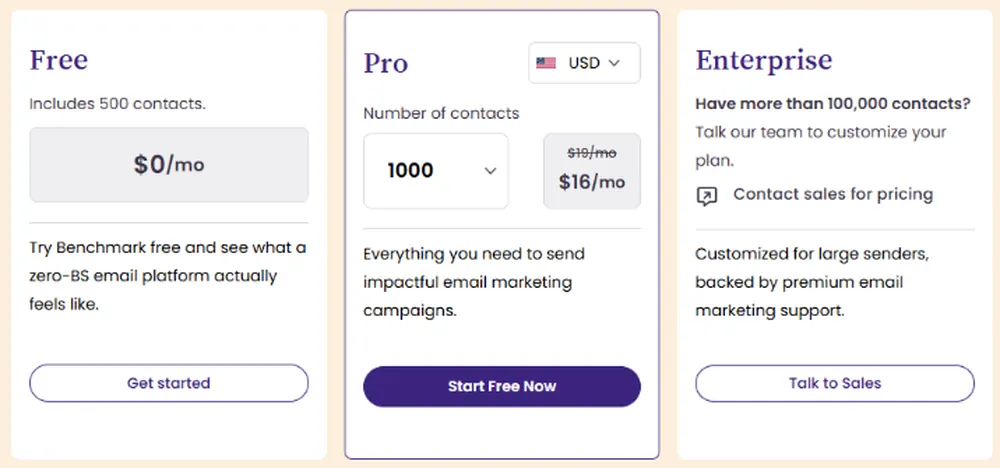
Benchmark Email sells exactly three things: a Free plan (500 contacts, 2,500 sends a month), a single Pro plan from $19/mo monthly or $16/mo annual at 1,000 contacts, and Enterprise above 100,000 contacts on quote. There is no Starter-versus-Plus decision to make, because every feature is in every plan-the tiers differ only on capacity. Extra users are $15/mo each, the only published per-seat price in this category. The question mark: neither the pricing page’s own feature inventory nor the features page lists marketing automation, workflows, autoresponders or A/B testing. If you need those, read the section below before anything else.
What Benchmark Email actually costs in 2026
Benchmark publishes one paid plan across twelve contact steps. Both the monthly and the annual rate are shown side by side, which is rarer than it should be. Figures below are USD, read from the pricing page with the region selector set to USD.
| Contacts | Pro monthly | Pro annual | Monthly send allowance | Cost per contact (monthly) |
|---|---|---|---|---|
| Up to 500 (Free) | $0 | $0 | 2,500 | – |
| 1,000 | $19 | $16 | 10,000 | $0.0190 |
| 2,500 | $37 | $31 | 25,000 | $0.0148 |
| 5,000 | $63 | $54 | 50,000 | $0.0126 |
| 10,000 | $93 | $79 | 100,000 | $0.0093 |
| 15,000 | $129 | $109 | 150,000 | $0.0086 |
| 20,000 | $149 | $127 | 200,000 | $0.0075 |
| 25,000 | $179 | $152 | 250,000 | $0.0072 |
| 30,000 | $209 | $179 | 300,000 | $0.0070 |
| 40,000 | $269 | $229 | 400,000 | $0.0067 |
| 50,000 | $299 | $255 | 500,000 | $0.0060 |
| 75,000 | $399 | $339 | 750,000 | $0.0053 |
| 100,000 | $499 | $425 | 1,000,000 | $0.0050 |
| Above 100,000 | Enterprise, quote | Quote | Quote | – |
The curve is well behaved. Cost per contact falls from $0.019 to $0.005 without a single reversal, which sounds unremarkable until you compare it to the rest of the category: Campaign Monitor’s Essentials curve reverses between 10,000 and 25,000 contacts, and ActiveCampaign’s Starter plan has no volume discount at all. Benchmark simply gets cheaper as you grow.
Going from 30,000 to 40,000 contacts costs $60 more. Going from 40,000 to 50,000 costs only $30 more for the same 10,000 extra contacts. If you are sitting anywhere in the low forties, the 50,000 tier gives you a quarter more headroom for half the usual marginal rate. It is the one place on this ladder where buying ahead is clearly worth it.
Every feature in every plan, including the free one
This is Benchmark’s actual product decision and it deserves to be stated plainly, because it inverts how the rest of this category works.
The pricing page carries a heading that reads Every Feature in Every Plan, and the comparison table backs it up. The Free and Pro columns differ on six lines only, and every one of them is a capacity limit:
| Limit | Free | Pro |
|---|---|---|
| Contacts | Up to 500 | 1,000 to 100,000 |
| Email sends | Up to 2,500 per month | 10× contact limit |
| Users | 1 user max | 1 included, $15/mo per extra |
| Domains | 1 max | 10 max |
| API keys | 2 | 10 |
| List verification | Not included | Validate 1 list up to plan size |
Nothing else is gated. The editor, the drag-and-drop form builder, custom fields, segmentation, personalisation, AI-generated images, the email audit checklist, reporting, the engagement timeline, the API, Zapier and playable video are all listed as available on both plans.
Mailchimp puts Journey Builder behind Standard. ActiveCampaign caps Starter automations at five actions. Campaign Monitor marks the non-human click filter and engagement segments as paid add-ons inside plans you have already bought. GetResponse gives Starter one workflow. Benchmark’s Free plan, at $0-has the same feature set as its $499 plan. Whether that feature set is deep enough is the next section, but the pricing model itself is the most honest in the category.
What is not in the published feature inventory
A pricing model that gates nothing only helps you if the product does what you need. Here we have to report an absence rather than a figure, and it is the single most important thing on this page.
We read Benchmark’s complete Every Feature in Every Plan inventory on the pricing page, and separately their features page. Between them, the categories presented are: email editor, sign-up forms, contact management, personalisation, deliverability tools, reporting and insights, integrations, and API.
Neither page lists marketing automation, workflows, autoresponders, or A/B testing
These are not shown as limited, capped or reserved for a higher tier. They are simply not present in the published feature inventory at all. Given that automation depth is the axis on which ActiveCampaign, GetResponse, Klaviyo and Mailchimp all compete, an email platform whose own pricing page never uses the word is a material fact for anyone shopping on features.
We are reporting what is published, not asserting what the product cannot do. A feature can exist and be absent from a marketing page. But if automated sequences or split testing are a requirement for you, do not assume they are included because “every feature is in every plan”, get confirmation in writing before you buy, because that phrase is doing a lot of work.
Read positively, this tells you who Benchmark is built for: senders who write and broadcast campaigns to segmented lists and want a clean editor, good forms and honest reporting, without paying for an automation engine they will never open. Read as a warning, it tells you that a store needing abandoned-cart recovery is looking at the wrong platform regardless of price.
Fifteen dollars a seat: the only published seat price in the category
Benchmark includes one user on Pro and sells additional users at a flat $15/mo each. Nobody else in this comparison prices a seat at all, they make you change plan instead.
That difference is worth real money to a small team. Here is what a second login costs on each platform at 10,000 contacts:
| Platform | One user | Two users | Cost of the second seat |
|---|---|---|---|
| Benchmark Pro | $93 | $108 | +$15/mo |
| ActiveCampaign | Plus $189 | Pro $375 | +$186/mo (no seat add-on) |
| Mailchimp | Essentials includes 3 | Included | No charge below 3 seats |
| GetResponse | Not metered | Not metered | No charge |
| Campaign Monitor | Unlimited | Unlimited | No charge |
So Benchmark is not the cheapest place to add people. GetResponse and Campaign Monitor give seats away, but it is dramatically cheaper than ActiveCampaign, and unlike ActiveCampaign the cost is predictable. You add a person, you pay fifteen dollars. You do not discover that a hire forces a plan migration.
The seat price bites hardest at the bottom of the ladder
At 1,000 contacts Pro costs $19 and a second user costs $15-that is 79% of the plan price for one extra login, taking a two-person team to $34. At 100,000 contacts the same seat is 3% of the bill. A three-person agency on a small list pays more for its people than for its contacts, which is the one scenario where Benchmark’s flat seat price works against you.
The free plan, and how it compares
Benchmark’s free tier is permanent and unusually complete. Here is what it actually allows against the rest of the category.
| Platform | Free contacts | Free monthly sends | Features gated on free? |
|---|---|---|---|
| Benchmark | 500 | 2,500 | No, capacity limits only |
| MailerLite | 250 | 2,500 | Some |
| Mailchimp | 500 | 500, and 250/day | Heavily |
| Brevo | Unlimited | 300/day | Some |
| GetResponse | Not published | Not published | Badge on every message |
| Campaign Monitor | None, 30-day trial only | 500 total | n/a |
Benchmark’s 500 contacts and 2,500 monthly sends give you a 5× send multiplier on a free account, which is more sending headroom per contact than Mailchimp allows on its free tier by a factor of five. And because nothing is feature-gated, the free plan is a genuine evaluation of the real product rather than a demo of a stripped one.
The published free-plan limits are the six capacity lines in the table above and nothing else. Benchmark’s pricing page does not mention any branding or badge requirement on free accounts; it also does not state that there is none, so confirm it inside the product if a Benchmark logo on your emails would be a problem.
The 10x send multiplier, and where it sits
Pro allows monthly sends up to ten times your contact limit. That is mid-table for the category and generous relative to the price.
| Benchmark Pro | 10×-100,000 sends at 10,000 contacts |
|---|---|
| Mailchimp Essentials | 10×, rising to 12× on Standard and 15× on Premium |
| ActiveCampaign Starter and Plus | 10×, rising to 12× on Pro and 15× on Enterprise |
| Constant Contact Lite | 10×, rising to 24× on Premium |
| Campaign Monitor Lite | 5×-the tightest in the category |
| GetResponse | Unlimited on every paid plan |
The difference at Benchmark is that 10× is not a floor you upgrade away from. There is no higher tier that raises the multiplier, because there is no higher tier. Ten times your contact count is the deal at every list size up to 100,000, and above that you are negotiating an Enterprise contract.
For most senders this is plenty: ten campaigns a month to your whole list, or a mix of campaigns and segment sends totalling the same. If your ratio runs above 10×-a daily newsletter, for instance. Benchmark has no answer at self-serve prices, and GetResponse’s unlimited sending is the structural fit.
The annual discount is real, but Benchmark never names it
The pricing page shows a Monthly and an Annual figure side by side and attaches no percentage to the saving. We measured it across all twelve steps.
| Contacts | Monthly | Annual | Measured discount |
|---|---|---|---|
| 1,000 | $19 | $16 | 15.8% |
| 5,000 | $63 | $54 | 14.3% |
| 10,000 | $93 | $79 | 15.1% |
| 25,000 | $179 | $152 | 15.1% |
| 50,000 | $299 | $255 | 14.7% |
| 100,000 | $499 | $425 | 14.8% |
Across the whole ladder the saving lands between 14.3% and 16.1%, averaging close to 15%. That is not a rounded published rate, it is what falls out of two independently set price lists, which is why the percentage wobbles slightly from tier to tier. Benchmark states no figure, so 15% is our measurement, not their claim.
In context, 15% is competitive: Moosend gives 20%, GetResponse 18%, AWeber roughly 16.7%, Constant Contact and iContact 15%, MailerLite and Campaign Monitor 10%, and Mailchimp publishes none.
Benchmark’s pricing page offers BRL, CAD, CNY, EUR, GBP, INR, JPY, MXN, TWD and USD from a dropdown. That is the widest currency support we have found in this category, and it beats Campaign Monitor and GetResponse outright, both of those serve a single currency by geolocation with no way to switch. Figures on this page were read with the selector set to USD.
What real accounts pay
Five worked examples at published USD rates.
| Profile | Monthly | Composition | The point |
|---|---|---|---|
| Newsletter, 400 subscribers, weekly send | $0 | Free, 1,600 sends against a 2,500 allowance | Full feature set at no cost |
| Small business, 4,000 contacts, two campaigns a month | $63 | Pro at 5,000, monthly billing | $54 on annual, saving $108 a year |
| Two-person marketing team, 10,000 contacts | $108 | Pro $93 + one extra seat $15 | The same team on ActiveCampaign pays $375 |
| Agency, 42,000 contacts, three users | $329 | Pro at 50,000 ($299) + two seats | Buying the 50,000 tier instead of 40,000 costs $30 and adds 8,000 contacts of headroom |
| Publisher, 10,000 subscribers, daily send | Not viable | ~220,000 sends against a 100,000 allowance | The 10× cap has no upgrade path below Enterprise |
Where Benchmark sits against the category
At 10,000 contacts, monthly billing, one user, comparing like for like on the entry plan that a small business would actually buy:
| Platform and plan | Price at 10,000 contacts | Send cap | Automation included? |
|---|---|---|---|
| Benchmark Pro | $93 | 10× | Not in the published feature list |
| ActiveCampaign Plus | $189 (annual) | 10× | Unlimited actions |
| GetResponse Marketer | €99 | Unlimited | Unlimited workflows |
| Campaign Monitor Essentials | €168 | Unlimited | Journeys included |
| Mailgun (transactional, not comparable) | $35 at 50k emails | Volume-billed | Not a marketing tool |
Benchmark is roughly half the price of ActiveCampaign Plus at the same list size, and it gives you the whole product rather than a tier of it. What you are trading away is the automation layer, which, on the evidence of their own published materials, is where the saving comes from. That is a rational trade for a broadcast sender and a bad one for anyone building flows.
Who should pay for what
| Under 500 contacts, under 2,500 sends a month | Free. Permanent, and feature-identical to the paid plan. There is no reason to pay. |
|---|---|
| Broadcast sender, any list up to 100,000 | Pro. One plan, no tier decision, no feature gates. Take annual for about 15% off. |
| Small team, two or three logins | Pro plus seats at $15 each. Predictable, and far cheaper than the plan migration ActiveCampaign forces. |
| Sitting between 40,000 and 50,000 contacts | Buy the 50,000 tier. It costs $30 more than 40,000 and is the cheapest marginal step on the ladder. |
| You need automated flows, autoresponders or A/B testing | Verify before buying, and expect to look elsewhere. None of them appear in Benchmark’s published feature inventory. |
| Your send-to-contact ratio exceeds 10× | Look at GetResponse. Benchmark has no higher multiplier to sell you below Enterprise. |
| Above 100,000 contacts | Enterprise, on quote. The self-serve ladder stops there. |
What Benchmark does not publish
- The annual discount percentage. Both prices are shown, the saving is never named. We measured it at 14.3% to 16.1%, averaging about 15%.
- Enterprise pricing, and anything above 100,000 contacts.
- Whether marketing automation, autoresponders or A/B testing exist. They are absent from both the pricing page inventory and the features page, in either direction.
- Overage behaviour. Nothing on the pricing page says what happens if you exceed the 10× send allowance or your contact tier, no rate, no throttling policy, no auto-upgrade statement.
- Branding on free accounts. Not mentioned as present or absent.
- Any nonprofit discount. Not offered on the pricing page, where most competitors publish 15% and GetResponse publishes 50%.
Frequently asked questions
How much does Benchmark Email cost in 2026?
There is one paid plan. Pro starts at $19/mo monthly or $16/mo on annual billing for 1,000 contacts, rising to $499 monthly or $425 annual at 100,000 contacts. Above 100,000 contacts it becomes Enterprise on quote. A permanent Free plan covers up to 500 contacts and 2,500 sends a month. Figures read from benchmarkemail.com in August 2026 with the region selector set to USD.
Is Benchmark Email’s free plan really free?
Yes, and permanently. It allows 500 contacts, 2,500 sends a month, 1 user, 1 domain and 2 API keys. Crucially, no features are withheld-the Free and Pro columns differ only on those capacity lines. That makes it a real evaluation of the product rather than a stripped demo, unlike Mailchimp’s free tier which gates most of the platform.
Does Benchmark Email have marketing automation?
We cannot confirm that it does from their published materials, and that is worth taking seriously. Neither the pricing page’s “Every Feature in Every Plan” inventory nor the features page lists marketing automation, automation workflows, autoresponders or A/B testing-not as limited, not as a higher tier, simply not present. A feature can exist without appearing on a marketing page, so this is an absence of evidence rather than proof. If automated sequences are a requirement, get written confirmation before you buy.
How many emails can I send on Benchmark Email?
10× your contact limit per month on Pro, so 100,000 sends at 10,000 contacts. The free plan allows 2,500 sends against 500 contacts, which is a 5× multiplier. Note there is no higher tier that raises the Pro multiplier, 10× applies at every list size up to 100,000 contacts, and beyond that you are negotiating Enterprise.
How much does an extra user cost on Benchmark Email?
$15/mo per additional user, with one included on Pro and a hard limit of one on Free. This is the only published per-seat price in this category, every competitor makes you change plan instead. At 10,000 contacts a two-person team pays $108 on Benchmark against $375 on ActiveCampaign, which has no seat add-on at all. The catch is at the bottom of the ladder: at 1,000 contacts a second seat costs 79% of the plan price.
What is Benchmark Email’s annual discount?
They never state one. The pricing page shows a monthly and an annual figure side by side with no percentage attached. We measured the gap at every one of the twelve contact steps and it runs from 14.3% to 16.1%, averaging close to 15%. Treat that as our arithmetic rather than their offer. For comparison, Moosend publishes 20%, GetResponse 18% and Campaign Monitor 10%.
What happens if I go over my Benchmark plan limits?
Not published. The pricing page states the contact tiers and the 10× send allowance but says nothing about what happens when you exceed either, no overage rate, no throttling policy, no automatic upgrade statement. Constant Contact publishes $0.002 per extra send and Mailgun publishes per-thousand overage rates; Benchmark publishes nothing, so any figure you find elsewhere is unverified.
Can I see Benchmark Email prices in my own currency?
Yes, and the selection is the widest in this category: BRL, CAD, CNY, EUR, GBP, INR, JPY, MXN, TWD and USD, chosen from a dropdown on the pricing page. That is a genuine selector rather than geolocation, which puts Benchmark ahead of Campaign Monitor and GetResponse, both of those show one currency based on where you are browsing from, with no way to change it.
Is Benchmark Email cheaper than ActiveCampaign?
Substantially, at comparable list sizes. At 10,000 contacts Benchmark Pro is $93 a month against ActiveCampaign Plus at $189 billed annually, and the gap widens once you add people because Benchmark sells seats at $15 while ActiveCampaign requires a jump to Pro. What the saving costs you is the automation layer, which is ActiveCampaign’s entire reason for existing and is absent from Benchmark’s published feature list.
Does Benchmark Email offer a nonprofit discount?
None is published on the pricing page. That is a gap relative to the category: Mailchimp, Constant Contact, Campaign Monitor and iContact all publish 15% for registered nonprofits, and GetResponse publishes 50%. If you are a charity, it is worth asking Benchmark directly, but you should price the comparison assuming you pay list rates here and discounted rates elsewhere.
Changelog (recent)
This review follows our email infrastructure testing methodology. We disclose affiliate relationships in our editorial independence policy.