
How much does SendPulse cost in 2026?
SendPulse sells seven products from one account, and email is two of them. There is a bulk email service priced by the size of your contact list, and a transactional email service priced by the number of emails you send, on a separate page, with a separate free tier and a separate meter. Neither one covers the other. Most of the confusion about what SendPulse costs comes from reading one of those pages and assuming it describes the whole platform.
The short version. Bulk email starts at €11/month for 500 contacts with unlimited sending, and a free tier gives you 15,000 emails a month to 500 subscribers with SendPulse branding. Transactional SMTP is separate: 12,000 emails a month free, throttled to 50 messages an hour, then €55.88/month billed annually for 100,000 emails with a dedicated IP. Prices below are in euros, read from sendpulse.com on 24 August 2026.
Two email products, two meters, two price pages
This is the single most important thing to understand before you compare SendPulse to anything else. The plan you buy on the main pricing page is the bulk email service. It is priced by how many contacts sit in your list, and every paid tier of it says “unlimited number of emails”. That word unlimited applies to campaigns you send to your own list. It does not apply to transactional mail.
Transactional email, password resets, receipts, order confirmations, anything triggered by a user action and sent through SMTP relay or the API, lives at sendpulse.com/pricing/smtp and is metered by the email. It has its own free allowance, its own paid tiers and its own rate limits. If you need both, you pay for both.
Why this matters for the comparison. A SendPulse Standard plan at €39/month for 5,000 contacts looks cheap next to platforms that meter every send. It is cheap, for campaigns. But if you also send 100,000 transactional emails a month, add €55.88/month billed annually, and you are at roughly €95/month for something a single-meter competitor might quote as one line. Compare the total of what you actually send, not the headline of one page.
The bulk email price ladder
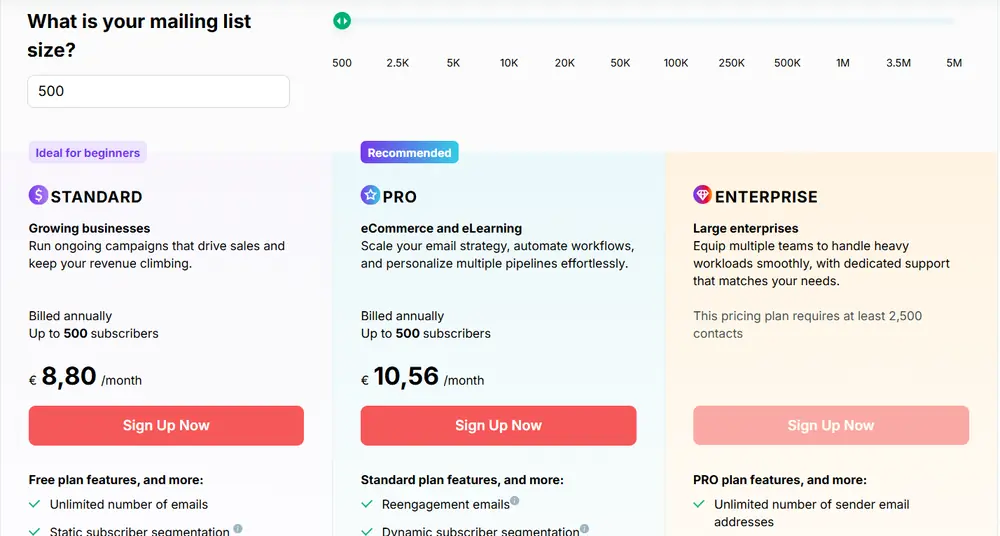
The bulk calculator is a slider with twelve stops, and the three paid plans sit on top of it. All figures below are the monthly list price in euros, read at every one of the twelve slider positions individually rather than interpolated. Enterprise is not sold below 2,500 contacts, so its first cell is empty.
| Contacts | Standard | Pro | Enterprise | Standard per 1,000 contacts |
|---|---|---|---|---|
| 500 | €11 | €13.20 | – | €22.00 |
| 2,500 | €29 | €34.80 | €48.72 | €11.60 |
| 5,000 | €39 | €46.80 | €65.52 | €7.80 |
| 10,000 | €59 | €70.80 | €99.12 | €5.90 |
| 20,000 | €99 | €118.80 | €166.32 | €4.95 |
| 50,000 | €216 | €259.20 | €362.88 | €4.32 |
| 100,000 | €363 | €435.60 | €609.84 | €3.63 |
| 250,000 | €644 | €772.80 | €1,081.92 | €2.58 |
| 500,000 | €944 | €1,132.80 | €1,585.92 | €1.89 |
| 1,000,000 | €2,171 | €2,605.20 | €3,647.28 | €2.17 |
| 3,500,000 | €6,756 | €8,107.20 | €11,350.08 | €1.93 |
| 5,000,000 | €9,318 | €11,181.60 | €15,654.24 | €1.86 |
Annual billing takes exactly 20% off every one of those figures, and a six-month commitment takes 10%. We verified the 20% at 500, 10,000 and 100,000 contacts and it held to the cent each time.
Pro costs exactly 20% more. Enterprise costs exactly 68% more. Always.
This is the cleanest thing we have found on any pricing page this year, and it is not advertised anywhere. Across all twelve slider positions, Pro is Standard multiplied by 1.20 and Enterprise is Standard multiplied by 1.68. Not approximately. Exactly, to the cent, at every tier.
At 5,000 contacts: 39 × 1.2 = 46.80, and 39 × 1.68 = 65.52. At one million: 2,171 × 1.2 = 2,605.20, and 2,171 × 1.68 = 3,647.28. The same two multipliers govern the Pay As You Go table as well.
What you can do with that. You never have to model three ladders. Work out what Standard costs at your list size, then decide whether dynamic segmentation, email verification and ten user seats are worth a flat 20% surcharge, and whether unlimited senders, unlimited automation flows and dedicated support are worth a flat 68%. The answer does not change as you grow, which means the upgrade decision is a feature question and never a volume question.
It also means the higher plans never become relatively cheaper at scale, the way tiered pricing often does elsewhere. If Pro is not worth 20% to you at 5,000 contacts, it will not become worth it at 500,000.
The monthly tab shows a discount, and it makes annual look expensive
Set the billing period to Monthly and the Standard plan at 500 contacts displays €7.70. Set it to Yearly and the same plan displays €8.80. Monthly appears to be the cheaper commitment, which would be remarkable if it were true.
It is not. The real monthly price is €11, shown struck through next to the €7.70. The €7.70 is a site-wide promotion running at the time of writing, banner-advertised as “-30% on the first month for new users”. It applies to the first month only. The €8.80 yearly figure is the honest recurring number: €11 less 20%.
The comparison people actually make. Glancing at the two tabs, monthly reads as €7.70 and yearly as €8.80, so monthly wins. Over twelve months monthly costs €7.70 + (11 × 11) = €128.70, and yearly costs €105.60. Annual is 18% cheaper over the year, not 14% more expensive. The display inverts the answer for anyone who does not notice the struck-through price.
One more wrinkle: the promotion stops applying above 100,000 contacts. At 250,000 and every tier above it, the monthly and promotional figures are identical, €644 and €644. So the inverted-looking comparison only affects smaller lists, which is to say the customers least likely to be reading the fine print.
The 500,000 to 1,000,000 cliff
The per-contact column falls steadily all the way up the ladder, €22 per thousand at 500 contacts, €3.63 at 100,000, €1.89 at 500,000, and then it goes back up. Doubling from 500,000 to 1,000,000 contacts takes the Standard price from €944 to €2,171. That is 2.3 times the money for twice the contacts, and the per-thousand rate worsens from €1.89 to €2.17.
It recovers above that: 3.5 million lands at €1.93 per thousand and 5 million at €1.86, both still worse than the 500,000 rate. In other words 500,000 contacts is the most efficient point on the entire ladder, and crossing it is the one upgrade that costs more than proportionally.
If your list is sitting between 500,000 and roughly 700,000, it is worth running a genuine suppression and re-engagement pass before renewing. Coming back under 500,000 saves €1,227 a month at list price.
Pay As You Go, and when it beats a subscription
The bulk pricing page has a second tab that sells email credits instead of a monthly plan. The meter changes: you are buying a number of emails, not a list size, and the contact limit stops mattering.
| Emails | Standard | Pro | Enterprise | Standard per email |
|---|---|---|---|---|
| 10,000 | €38 | €45.60 | €63.84 | €0.0038 |
| 25,000 | €84 | €100.80 | €141.12 | €0.0034 |
| 50,000 | €147 | €176.40 | €246.96 | €0.0029 |
| 100,000 | €249 | €298.80 | €418.32 | €0.0025 |
| 250,000 | €516 | €619.20 | €866.88 | €0.0021 |
| 500,000 | €951 | €1,141.20 | €1,597.68 | €0.0019 |
The trade is straightforward. A subscription at 10,000 contacts costs €59 a month and lets you send as much as you like. Ten thousand credits cost €38 once. If you mail your 10,000 contacts twice a month, that is 20,000 emails, which as credits costs somewhere between €38 and €84, and the subscription at €59 with no ceiling is the better instrument. If you mail them once a quarter, credits win comfortably.
One thing the page does not tell you. The transactional credit table states plainly that credits are “valid for 12 months after purchase”. The bulk Pay As You Go tab displays no expiry at all. We are not going to assume the two products share a policy, and we are not going to invent one. If you are buying bulk credits, ask support to confirm the validity period in writing before you pay.
Transactional and SMTP pricing, the part that matters most here
SendPulse’s transactional service is a genuine SMTP relay with API sending, SPF, DKIM and DMARC support, custom tracking domains and, from the middle tier upward, a dedicated IP address. It is priced entirely separately from the bulk product, on its own page, and it has the most interesting free tier on the platform.
| Plan | Emails / month | Price (annual billing) | Rate limit | Dedicated IP |
|---|---|---|---|---|
| Basic | 12,000 | Free | 50 / hour | No |
| Basic | 25,000 | €6.28 / month | 50 / hour | No |
| Basic | 50,000 | €11.88 / month | 50 / hour | No |
| Pro | 100,000 | €55.88 / month | 8,000 / hour | Yes |
| Pro | 200,000 | €91.88 / month | 8,000 / hour | Yes |
| Pro | 300,000 | €127.88 / month | 8,000 / hour | Yes |
| Enterprise | 500,000 | €207.88 / month | 20,000 / hour | Yes |
| Enterprise | 1,000,000 | €407.88 / month | 20,000 / hour | Yes |
| Enterprise | 2,000,000 | €727.88 / month | 20,000 / hour | Yes |
| Enterprise | 5,000,000 | €1,447.88 / month | 20,000 / hour | Yes |
Monthly billing costs 25% more than the annual figures above. Pro at 100,000 is €69.85/month monthly against €55.88 annually, and Enterprise at 500,000 is €259.86 against €207.88. Both work out to the same exact 20% annual discount seen on the bulk product.
The free transactional tier, and the number that constrains it
Twelve thousand transactional emails a month for nothing, with SPF, DKIM, DMARC, a custom tracking domain, two sending domains, SMTP relay and API access, is a serious offer. Several well-known transactional providers give you a third of that, or give it to you only for the first month.
The constraint is not the quota. It is 50 messages per hour.
Read this before you build on the free tier. Fifty an hour is fine for a steady trickle of password resets on a small product. It is not fine for anything that bursts. A shop that sends 300 order confirmations in the hour after a campaign lands will have 250 of them queued or rejected. A SaaS that emails every user when a report finishes generating will fall over on any morning where more than fifty reports finish in the same hour. The quota is generous; the throttle is the thing that will break you, and it does not lift until the Pro tier at €55.88/month.
The jump from Basic to Pro is therefore much larger than the price suggests. You are not buying more emails, you are buying a 160-fold increase in rate limit and a dedicated IP. If your sending is bursty, the free tier and the €6.28 and €11.88 Basic tiers are all effectively the same product, and the real entry price for production transactional mail is €55.88/month billed annually.
Transactional credits, and where they beat the subscription
Transactional email also sells as credits, and this table is published in full:
| Emails | Price | Per email |
|---|---|---|
| 10,000 | €15 | €0.00150 |
| 20,000 | €28 | €0.00140 |
| 50,000 | €49 | €0.00098 |
| 100,000 | €89 | €0.00089 |
| 200,000 | €175 | €0.00088 |
| 300,000 | €259 | €0.00086 |
| 500,000 | €419 | €0.00084 |
| 1,000,000 | €780 | €0.00078 |
These credits are stated on the page to be valid for 12 months after purchase, which changes the calculation completely for anyone whose transactional volume is seasonal or unpredictable.
Compare like for like at 100,000 emails: the Pro subscription costs €55.88 a month billed annually, so €670.56 a year for 1.2 million emails. A million credits cost €780 and last a year. The subscription is cheaper per email if you actually use the monthly allowance every month. The moment your real usage is lumpy, heavy in November, quiet in February, credits stop wasting the months you underuse.
The catch with credits. The credit table carries no rate limit or dedicated IP in its description, and the features listed against dedicated IP and higher throughput belong to the Pro and Enterprise subscription tiers. If you need the 8,000-per-hour ceiling or a dedicated IP, confirm with support whether buying credits gets you there, because the page does not say it does.
Seven products, seven meters
The account is one login. The billing is not. SendPulse’s menu lists email marketing, chatbots, transactional emails, CRM, websites, SMS, courses, pop-ups, email verification, web push and Viber, and the ones that cost money are priced independently of each other.
Chatbots are the clearest illustration. The chatbot Pro plan starts at €8.80/month billed annually for 500 subscribers-the same number as email Standard at 500 subscribers, on the same kind of slider, with the same annual discount. They are not the same 500 people. Paying for 500 email contacts gives you nothing on the chatbot side, and the free chatbot tier (3 bots, 500 subscribers, 10,000 messages a month) is a separate allowance from the free email tier.
How to budget for it. Decide which meters you are actually going to run, price each one at your own volume, and add them up. A small business using bulk email for campaigns and SMTP for receipts is looking at two line items, not one. Someone who also wants a WhatsApp bot is looking at three. The single-login convenience is real; the single-invoice simplicity is not.
What the free tiers actually give you
There are two free tiers and they are worth treating separately.
Bulk email free: 15,000 emails a month to a maximum of 500 subscribers, with 140+ templates, the drag-and-drop builder, contact import, subscription forms, basic automation, and open and click analytics. The cost is SendPulse branding in the footer of every email, and three sender addresses. Fifteen thousand emails to 500 people is thirty sends a month to your whole list, which is far more headroom than most free tiers give, so the binding constraint is the 500 subscribers.
Transactional free: 12,000 emails a month, 50 an hour, two sending domains, full authentication and a custom tracking domain, no credit card. Covered in detail above.
They stack. A small product can run its newsletter to 500 subscribers and its password resets through SMTP without paying anything, which is a genuinely unusual position among platforms of this size. The moment either the 500-subscriber ceiling or the 50-per-hour throttle bites, you are into paid tiers on that product only.
Six things that catch people out
1. Enterprise is invisible below 2,500 contacts. Move the slider to 500 and the Enterprise card shows features and a sign-up button but no price, with a line reading “This pricing plan requires at least 2,500 contacts”. The plan is not available to you; the card is not broken.
2. “Unlimited number of emails” means campaigns, not transactional. Covered above, and it is the single most common misreading of this platform.
3. The monthly price you see may be a first-month promotion. Check for a struck-through figure beside it. At the time of writing the site-wide banner offers 30% off the first month for new users, and it applies up to 100,000 contacts.
4. Doubling from 500,000 to 1,000,000 contacts costs 2.3 times as much. The only point on the ladder where the per-contact rate gets worse.
5. The plan multipliers are fixed. Pro is always +20%, Enterprise always +68%. Upgrading never gets relatively cheaper at higher volume.
6. Bulk credit expiry is not published. Transactional credits state 12 months. The bulk Pay As You Go tab says nothing. Get it in writing.
Who SendPulse is priced for
It is priced well for small senders who want a real free tier that is not a trial, businesses that mail a modest list frequently (unlimited sending on every paid bulk tier is genuinely unlimited for campaigns), anyone who needs both marketing and transactional email and is comfortable managing two meters, and teams already using the chatbot or CRM side who get some operational benefit from one vendor.
It is priced badly for anyone whose transactional sending is bursty and who was hoping the free tier would carry them, the 50-per-hour throttle ends that conversation early. It is also poor value for lists between 500,000 and about 700,000 contacts, who sit on the wrong side of the only cliff in the ladder. And it is a difficult platform to budget for if you need four or five of the products, because there is no bundle: the meters simply add.
The 500-contact tier deserves a note. At €11/month for 500 contacts, Standard costs €22 per thousand contacts, six times the rate at 5,000 and twelve times the rate at 100,000. That is normal for entry tiers and not a trap, but if you are at 400 contacts and growing, the free tier at 500 subscribers costs nothing, and the jump to 2,500 contacts costs €29. There is not much reason to sit on the paid 500 tier for long.
How to size SendPulse in four steps
- Split your sending into campaigns and transactional. Campaigns are what you send to your list on your schedule. Transactional is anything a user action triggers. These are two products with two prices; work them out separately.
- For campaigns, take your contact count, not your email count. Find it in the table above, then decide whether Pro’s 20% or Enterprise’s 68% buys you something you need. If you mail less than about twice a month, price the Pay As You Go tab against it before committing.
- For transactional, check your peak hour before your monthly total. Look at your busiest hour in the last quarter. If it exceeds 50 messages, the free tier and both paid Basic tiers are out, and your entry point is Pro at €55.88/month billed annually. If your volume is seasonal, price the credit table against the subscription.
- Commit annually once you are sure. The 20% is exact, applies to both products, and is the only reliable discount on the platform. Six months gets 10% if you want a shorter leash.
Frequently asked questions
How much does SendPulse cost?
Bulk email starts at €11 per month at list price for 500 contacts with unlimited campaign sending, falling to €8.80 per month with annual billing. Transactional email is a separate product and starts free for 12,000 emails a month, with the first paid tier that lifts the rate limit costing €55.88 per month billed annually for 100,000 emails. Both figures are euros read from sendpulse.com on 24 August 2026. Because the two products are metered separately, anyone who needs marketing and transactional email should add the two together rather than quoting one.
Does the SendPulse free plan really allow unlimited emails?
No, and neither number is unlimited on the free tier. Free bulk email allows 15,000 emails a month to a maximum of 500 subscribers, with SendPulse branding in the footer. Free transactional email allows 12,000 emails a month at a maximum of 50 per hour. Unlimited sending appears only on the paid bulk plans, where it means unlimited campaigns to the contacts you are already paying for. It never covers transactional mail.
Why does the monthly price look cheaper than the annual price?
Because the monthly figure on display is discounted. At the time of writing a site-wide promotion takes 30% off the first month for new users, so Standard at 500 contacts shows €7.70 against an annual equivalent of €8.80. The real recurring monthly price is €11, shown struck through beside it. Over a full year, monthly billing costs €128.70 and annual costs €105.60, so annual is about 18% cheaper. The promotion stops applying above 100,000 contacts.
What is the difference between the Standard, Pro and Enterprise plans?
Price-wise the difference is fixed: Pro costs exactly 20% more than Standard and Enterprise exactly 68% more, at every single tier on the ladder. Feature-wise, Standard gives unlimited emails, static segmentation, A/B testing and three users. Pro adds dynamic segmentation, email verification, reengagement emails and ten users. Enterprise adds unlimited sender addresses, unlimited automation flows, the full A/B testing suite, unlimited users and dedicated support, and requires a minimum of 2,500 contacts.
Is SendPulse SMTP included in the email marketing plan?
No. Transactional SMTP is a separate product with its own pricing page, its own free allowance of 12,000 emails a month and its own paid tiers. A bulk email subscription, including its unlimited sending, does not entitle you to transactional sending. If you need both, you buy both.
What is the SendPulse SMTP rate limit?
Fifty messages per hour on the free and Basic transactional tiers, 8,000 per hour on Pro, and 20,000 per hour on Enterprise. The 50 per hour figure on the free tier is the practical constraint on that tier rather than the 12,000 monthly quota, because any bursty sending pattern will hit the hourly ceiling long before it exhausts the month.
When does SendPulse give you a dedicated IP address?
From the Pro transactional tier upward, which starts at 100,000 emails a month for €55.88 billed annually. The free and Basic transactional tiers have no dedicated IP. The bulk email plans do not list a dedicated IP among their features at any tier, so if a dedicated IP is a requirement, the transactional Pro plan is the entry point.
Is Pay As You Go cheaper than a SendPulse subscription?
It depends entirely on sending frequency, not list size. A subscription at 10,000 contacts costs €59 a month at list price with unlimited sending, while 10,000 email credits cost €38 once. If you mail your list more than about twice a month the subscription wins, because the credits are consumed per email while the subscription is not. If you mail quarterly or seasonally, credits win. For transactional email the credits are stated to last 12 months, which makes them well suited to unpredictable volume.
Why does the price jump so much at one million contacts?
Going from 500,000 to 1,000,000 contacts takes the Standard price from €944 to €2,171 a month, which is 2.3 times the cost for twice the contacts. It is the only point on the ladder where the per-thousand rate gets worse rather than better, moving from €1.89 to €2.17 per thousand. That makes 500,000 the most efficient point on the whole ladder, and it is worth a serious list-hygiene pass before crossing it.
Does SendPulse charge separately for chatbots and its other tools?
Yes. Email marketing, chatbots, transactional email, CRM, SMS, courses and the rest are metered independently. The chatbot Pro plan starts at €8.80 a month billed annually for 500 chatbot subscribers, and those are not the same 500 people as your 500 email contacts. There is a free tier on the chatbot side too (3 bots, 500 subscribers, 10,000 messages a month), separate from the free email allowance. One login, one dashboard, but the bills add up rather than bundle.
Continue reading about SendPulse
Pricing is one part of the evaluation. For connection details, ports, authentication and the practical setup of the SMTP relay described above, see the SMTP settings tab. The API tab covers the sending endpoints and the integrations tab covers what connects to what. The alternatives tab compares SendPulse against the other platforms that combine marketing and transactional email under one account.
Sources. All figures were read from sendpulse.com on 24 August 2026, in euros, with every slider position on both the bulk and transactional calculators read individually rather than interpolated, and both billing-period toggles checked. Per-contact and per-email rates, the plan multipliers and the twelve-month cost comparisons are our own arithmetic from the published prices. The currency shown is geolocated and yours may differ; the ratios and the structure will not. Prices change; where a figure here disagrees with the vendor’s page, the vendor’s page is correct and we would be glad to be told.
This review follows our email infrastructure testing methodology. We disclose affiliate relationships in our editorial independence policy.