
How much does Mailjet cost in 2026?
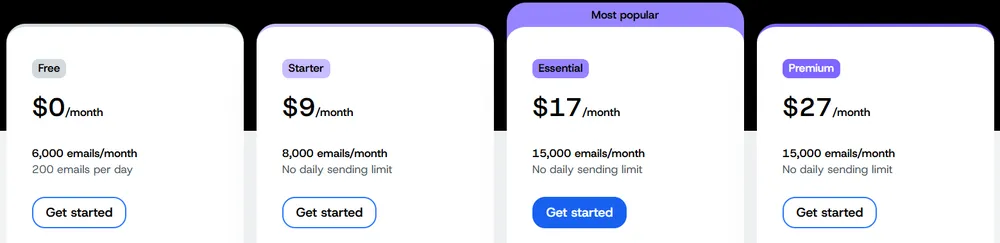
Five tiers: Free (6,000 emails/month, capped at 200/day), Starter $9/mo, Essential from $17/mo, Premium from $27/mo, Custom on quote. Annual billing takes a stated 10% off. Contacts are unlimited from Essential up. Two gates decide everything: the Mailjet logo stays on your emails until Essential, and automations and landing pages are Premium-only. Also worth knowing before you compare: Mailjet and Mailgun are both Sinch products, and Mailgun is cheaper at every volume we checked. Prices exclude VAT and are subject to French VAT.
What Mailjet actually costs in 2026
Mailjet prices on monthly email volume. The pricing page’s slider moves each plan up to its own ceiling rather than pricing every plan at every volume, which is why the table below has gaps, those are real limits, not missing data.
| Emails/month | Free | Starter | Essential | Premium |
|---|---|---|---|---|
| 6,000 | $0 | $9 | $17 | $27 |
| 8,000 | Over limit | $9 | $17 | $27 |
| 15,000 | Over limit | Over limit | $17 | $27 |
| 50,000 | – | – | $37 | $55 |
| 100,000 | – | – | Ceiling reached | $105 |
| 250,000 | – | – | – | $250 |
| 500,000 | – | – | – | $470 |
| Above 500,000 | – | – | – | Custom, on quote |
The plan ceilings matter as much as the prices. Starter tops out at 8,000 emails a month and Essential tops out at 50,000. Neither scales past its cap, you change plan. Only Premium runs the full range to 500,000, after which it becomes a Custom quote.
| Contacts | Free 1,000, Starter 2,000, Essential and above unlimited. |
|---|---|
| Daily sending cap | Free is capped at 200 emails per day. Every paid plan has no daily limit. |
| Annual discount | 10%, stated openly in the billing toggle rather than left for you to calculate. |
| Currency | A real selector: USD, EUR, GBP. Figures here were read with USD selected. |
Mailjet states that unless otherwise mentioned, all prices on its website exclude VAT and are subject to French VAT. European companies can be exempted by supplying an intra-Community VAT number at signup. This is unique in the category, no other provider on this site attaches a specific national VAT regime to its list prices, and it means the number you budget is not the number you are charged unless you handle the VAT registration.
Mailjet bills emails sent, not contacts stored
This is the structural fact that decides whether Mailjet is cheap or expensive for you, and it puts Mailjet in a small group alongside Brevo and the transactional providers.
From Essential upward, contacts are unlimited. You can hold a million addresses and pay nothing extra for storing them. What you pay for is the volume you send each month. Compare that to how the rest of the category works:
| Platform | Billing basis | Who it favours |
|---|---|---|
| Mailjet | Emails sent; contacts unlimited from Essential | Large lists mailed infrequently |
| Brevo | Emails sent; contacts unlimited | Large lists mailed infrequently |
| Mailgun | Emails sent | Transactional traffic |
| GetResponse | Contacts only; sends unlimited | Small lists mailed constantly |
| Mailchimp, ActiveCampaign, Campaign Monitor | Both: contacts and a send multiplier | Neither extreme |
The test is one division. Take your monthly sends and divide by your contact count. A retailer holding 40,000 addresses and mailing them twice a month sends 80,000 emails against 40,000 contacts, a ratio of 2. That profile is punished on a contact-priced platform and rewarded here. A community mailing 3,000 members daily sends 90,000 emails against 3,000 contacts, a ratio of 30, and should be looking at GetResponse’s unlimited sending instead.
Unused emails expire every month and never roll over
Mailjet states plainly that email credits do not roll over from one month to the next, and unused emails expire at the end of each billing cycle. For a seasonal sender this is the whole problem: you buy for your December volume and pay the same in February for capacity you cannot use and cannot bank. Because monthly plans carry no commitment and you can drop to the free plan at any time, the workaround is to move your plan up and down with your season rather than buying for your peak and holding it all year.
The Mailjet logo stays on your emails until you reach Essential
“No Mailjet logo” appears in the Essential feature list, which tells you what Free and Starter do.
Both the Free plan and the $9 Starter plan send with Mailjet branding attached. Removing it costs the step to Essential at $17. That single line reshapes what Starter is actually for.
| What Starter gives you for $9 | 8,000 emails a month, no daily cap, 2,000 contacts, brand kit, anonymous tracking, online support, 1 subaccount, with a Mailjet logo on every message. |
|---|---|
| What Essential adds for $8 more | Unlimited contacts, segmentation, AI-assisted content, 500 email address validations, 500 email previews a month, a custom unsubscribe page, and no Mailjet logo. |
Eight dollars separates it from Essential. For that eight dollars you go from 2,000 contacts to unlimited, gain segmentation, and take the vendor’s logo off your own emails. The only sender for whom Starter makes sense is one who needs to break the free plan’s 200-a-day ceiling, sends under 8,000 a month, holds under 2,000 contacts, and genuinely does not mind the branding. That is a narrow window, and Mailjet has priced the exit from it at less than the cost of the plan itself.
Automations and landing pages are Premium-only
This is the gate that catches people, because Essential looks like a complete marketing plan until you go looking for a workflow builder.
Essential includes segmentation, AI-assisted content, validations and previews. It does not include automations, landing pages or advanced statistics. All three start at Premium.
| Volume | Essential | Premium | Cost of adding automation |
|---|---|---|---|
| 15,000 emails | $17 | $27 | +59% |
| 50,000 emails | $37 | $55 | +49% |
| 100,000 emails | Ceiling reached | $105 | No choice, Premium only |
Above 50,000 emails a month the question disappears, because Essential’s ceiling is 50,000 and Premium is the only plan that goes further. Below that, you are paying roughly half again as much for the automation layer.
Premium also carries the things you would expect at the top: 2,000 email previews a month, team and account management, priority support, up to 20 subaccounts, and, only on plans of 100,000 emails and above, one dedicated IP and 2,000 email address validations included.
Two Premium benefits do not apply to smaller Premium plans
The dedicated IP and the 2,000 validations are marked for 100k+ plans. Buying Premium at $27 or $55 gets you automations and landing pages but neither of those two. Similarly, phone and chat support begins at the 50,000 tier, not at Premium as such. Read the Premium column as three different products depending on the volume you buy it at.
The free plan’s daily cap makes its monthly figure unreachable
Mailjet’s free tier advertises 6,000 emails a month with a 200-a-day ceiling. Multiply those two numbers together and the offer becomes clearer.
200 emails a day across 30 days is exactly 6,000 emails a month. The monthly allowance is not a budget you can spend as you like, it is precisely the daily cap laid end to end. You can only reach 6,000 by sending exactly 200 every single day of the month, and since credits do not roll over, every quiet day is headroom permanently lost.
In practice a free account sending one campaign a week to 500 subscribers uses 2,000 of its 6,000 emails and cannot use the rest, because a single 500-recipient campaign already consumes two and a half days of allowance in one go.
| Platform | Free monthly sends | Daily cap | Branding on free |
|---|---|---|---|
| Mailjet | 6,000 | 200/day | Yes, until Essential |
| Brevo | 9,000 equivalent | 300/day | Logo removal costs $10.80 |
| Mailgun | 3,000 equivalent | 100/day | Not applicable |
| Benchmark | 2,500 | None | Not stated |
| MailerLite | 2,500 | None | Some |
Mailjet’s free allowance is generous on paper and among the most rigid in practice. Benchmark and MailerLite offer less volume but let you spend it in one burst, which for a weekly or monthly newsletter is worth more than a bigger number you cannot reach.
The support comparison lists Online Customer Support on the Free plan as First Month Only. After thirty days a free account keeps the sending allowance and loses the ability to raise a support ticket. Worth knowing before you build anything important on it.
Mailjet and Mailgun are the same company, and Mailgun is cheaper
Mailjet’s own footer links to Mailgun, Email on Acid and Sinch. They are sibling products under one parent, they overlap heavily on transactional sending, and they are not priced the same.
| Monthly emails | Mailjet | Mailgun | Difference |
|---|---|---|---|
| 50,000 | Essential $37 | Foundation $35 | Mailgun $2 cheaper |
| 100,000 | Premium $105 | Foundation $75 | Mailgun 29% cheaper |
| 250,000 | Premium $250 | Scale $215 | Mailgun 14% cheaper |
| 500,000 | Premium $470 | Scale $400 | Mailgun 15% cheaper |
Mailgun is cheaper at every volume above 50,000, and it publishes its overage rates where Mailjet does not. So why would anyone pick Mailjet?
Because they are not actually the same product. Mailgun is sending infrastructure: an API, an SMTP relay, logs and deliverability tooling, with no campaign builder. Mailjet is a marketing platform with an email editor, form builder, segmentation, landing pages and automations sitting on top of the same kind of pipe. If you need a human to compose a newsletter in a browser, Mailgun cannot help you and the price comparison is meaningless. If you are sending from an application, Mailgun does the same job for less.
Choosing between Mailjet and Mailgun is not a price decision, it is a question of who presses send. Developers send from Mailgun. Marketers send from Mailjet. A company doing both is being invited, by the same parent company, to buy two subscriptions, and should at least ask Sinch’s sales team what a combined arrangement looks like before paying two list prices.
Cost per thousand emails, and where the curve flattens
Because Mailjet bills volume, unit cost is the only meaningful way to compare its tiers against each other.
| Plan and volume | Price | Cost per 1,000 emails |
|---|---|---|
| Starter, 8,000 | $9 | $1.13 |
| Essential, 15,000 | $17 | $1.13 |
| Essential, 50,000 | $37 | $0.74 |
| Premium, 15,000 | $27 | $1.80 |
| Premium, 50,000 | $55 | $1.10 |
| Premium, 100,000 | $105 | $1.05 |
| Premium, 250,000 | $250 | $1.00 |
| Premium, 500,000 | $470 | $0.94 |
Two things stand out. Essential at 50,000 emails is the cheapest unit rate Mailjet sells, at $0.74 per thousand, cheaper than any Premium tier including the half-million one. If you do not need automations, the sweet spot on this platform is Essential run right up against its 50,000 ceiling.
And Premium’s volume discount is shallow. From 50,000 to 500,000 emails, a tenfold increase, the unit rate falls only from $1.10 to $0.94, about 15%. Growth is not rewarded much here.
Going over your limit
Mailjet documents the policy and withholds the number.
Their FAQ says that if you run out of email credit you can still send, but the additional emails will be billed, and points you toward a price per additional 1,000 emails beyond the plan limit. That figure does not appear on the pricing page.
For scale, sibling company Mailgun publishes overage at $1.80, $1.30 and $1.10 per thousand depending on plan, and Constant Contact publishes $0.002 per extra send. Mailjet publishes neither a rate nor a range on the page where you choose your plan. Since credits also do not roll over, the combination is worth planning around: you cannot bank a good month, and you cannot price a bad one in advance.
What real accounts pay
Five worked examples at published USD rates, monthly billing, before VAT.
| Profile | Monthly | Composition | The trap avoided |
|---|---|---|---|
| Side project, 200 emails a day, evenly | $0 | Free | One campaign blows the daily cap; support ends after a month |
| Newsletter, 3,000 subscribers, weekly, no branding wanted | $17 | Essential, 12,000 sends against a 15,000 allowance | Starter at $9 caps contacts at 2,000 and keeps the logo |
| Store, 40,000 contacts, two campaigns a month | $37 | Essential at 50,000, unlimited contacts | A contact-priced platform charges for all 40,000 addresses |
| Same store, but running abandoned-cart flows | $55 | Premium at 50,000 | Essential has no automations at any price |
| Publisher, 250,000 emails a month | $250 | Premium, includes 1 dedicated IP and 2,000 validations | Mailgun does the same volume for $215 without the editor |
Where Mailjet sits against the category
| Platform | Entry paid | Billing basis | Automation from | Annual discount |
|---|---|---|---|---|
| Mailjet | $9 | Emails sent | Premium, $27 | 10% |
| Brevo | $9 | Emails sent | Limited on Starter | 10% |
| Mailgun | $15 | Emails sent | Not a marketing tool | None published |
| Benchmark | $19 | Contacts | Not in published feature list | ~15% measured |
| GetResponse | €16 | Contacts; sends unlimited | 1 workflow on Starter | 18% |
Against Brevo, its closest structural match, Mailjet starts at the same $9 and both bill sends with unlimited contacts. Brevo’s free tier is more generous (300 a day against 200) and Brevo includes transactional email on every plan. Mailjet’s advantage is the higher-volume Premium ladder, where $250 buys 250,000 emails against Brevo Professional’s $499 for 150,000.
Who should pay for which plan
| Testing, or an app sending under 200 a day steadily | Free. The daily cap is the real limit, not the monthly figure. Support ends after 30 days. |
|---|---|
| Under 8,000 emails, under 2,000 contacts, branding acceptable | Starter at $9. A narrow window, check the next row first. |
| You want your own branding, or hold more than 2,000 contacts | Essential at $17. Eight dollars removes the logo and the contact cap. |
| Broadcast sender at scale, no flows needed | Essential at $37, run to its 50,000 ceiling. At $0.74 per thousand it is the cheapest rate Mailjet sells. |
| Any store, or anyone needing automations or landing pages | Premium. There is no cheaper route, Essential has no automation at any volume. |
| Above 50,000 emails a month | Premium, by necessity. Essential’s ceiling is 50,000. Dedicated IP and 2,000 validations only arrive at the 100k tier. |
| Sending from an application, no campaign builder needed | Look at Mailgun. Same parent company, cheaper at every volume above 50,000, and its overage rates are published. |
| Seasonal sender | Move plans with your season. Monthly plans carry no commitment and credits never roll over, so holding a peak plan year-round is pure waste. |
What Mailjet does not publish
- The overage rate. The policy is stated, the price per additional 1,000 emails is not shown on the pricing page.
- Custom and Enterprise pricing, and anything above 500,000 emails a month.
- The cost of extra dedicated IPs. Premium at 100k+ includes one with an option to buy more; the price of more is not given.
- Whether Essential’s 50,000 ceiling can be raised without moving to Premium.
- Deliverability Services pricing on the Custom plan, which is described in detail and never costed.
- Any nonprofit discount. None appears on the pricing page, where Mailchimp, Constant Contact and Campaign Monitor publish 15% and GetResponse publishes 50%.
Frequently asked questions
How much does Mailjet cost in 2026?
Five tiers, priced on monthly email volume: Free at $0 for 6,000 emails a month capped at 200 a day, Starter $9 for 8,000, Essential $17 for 15,000 or $37 for 50,000, and Premium from $27 for 15,000 up to $470 for 500,000. Above that it is a Custom quote. Annual billing takes a stated 10% off. All prices exclude VAT and are subject to French VAT.
Does Mailjet charge per contact or per email?
Per email sent. From Essential upward, contacts are unlimited, only Free (1,000) and Starter (2,000) cap them. This makes Mailjet structurally suited to large lists mailed infrequently, and poorly suited to small lists mailed daily. Divide your monthly sends by your contact count: a low ratio favours Mailjet and Brevo, a high ratio favours a contact-priced platform such as GetResponse.
Does Mailjet put its logo on my emails?
Yes, on the Free and Starter plans. “No Mailjet logo” is listed as an Essential feature, which means the two cheapest tiers carry Mailjet branding. Removing it costs the $8 step from Starter ($9) to Essential ($17), which also lifts the contact cap from 2,000 to unlimited and adds segmentation. That makes Starter difficult to justify for most senders.
Does Mailjet Essential include automations?
No. Automations, landing pages and advanced statistics all start at Premium. Essential includes segmentation, AI-assisted content, 500 validations and 500 previews a month, but no workflow builder at any volume. Adding automation costs +59% at 15,000 emails ($17 to $27) and +49% at 50,000 ($37 to $55). Above 50,000 emails the question is moot: Essential’s ceiling is 50,000.
Can I really send 6,000 emails a month on the Mailjet free plan?
Only by sending exactly 200 every single day. The free plan’s 200-a-day cap multiplied by 30 days is precisely 6,000, so the monthly figure is the daily cap laid end to end rather than a budget you can spend as you like. Credits do not roll over, so every quiet day is headroom permanently lost. A weekly campaign to 500 subscribers uses 2,000 of the 6,000 and cannot touch the rest. Free-plan support also ends after the first month.
Do unused Mailjet emails roll over?
No. Mailjet states that email credits do not roll over from one month to another and unused emails expire at the end of each billing cycle. Because monthly plans carry no commitment and you can drop to the free plan at any time, seasonal senders are better off moving their plan up and down with demand than buying for their peak and holding it all year.
What is Mailjet’s overage charge?
Not published on the pricing page. Mailjet’s FAQ confirms that if you run out of email credit you can keep sending and the extra will be billed, and refers to a price per additional 1,000 emails beyond the plan limit, but no figure appears. For scale, sibling company Mailgun publishes $1.80, $1.30 and $1.10 per thousand depending on plan. Any Mailjet overage rate you find elsewhere is unverified.
Is Mailjet cheaper than Mailgun?
No, above 50,000 emails a month. They are both Sinch products and Mailgun undercuts Mailjet at every volume we compared: $75 against $105 at 100,000, $215 against $250 at 250,000, and $400 against $470 at 500,000. But they are different products: Mailgun is sending infrastructure with no campaign builder, Mailjet is a marketing platform with an editor, forms, landing pages and automations. Developers send from Mailgun; marketers send from Mailjet.
Why does Mailjet charge French VAT?
Because Mailjet states that its listed prices exclude VAT and are subject to French VAT. European companies can be exempted by providing an intra-Community VAT number at signup. No other provider we have priced attaches a specific national VAT regime to its list prices, so budget the headline figure as pre-tax and handle the VAT registration if you qualify for the exemption.
What is the cheapest way to send email through Mailjet?
Essential run right up against its 50,000-email ceiling, at $37 a month. That works out to $0.74 per thousand emails, the cheapest unit rate Mailjet sells, cheaper than every Premium tier including the 500,000 one at $0.94. The catch is that Essential has no automations, so this only applies to broadcast senders. Premium’s volume discount is shallow: tenfold more volume from 50,000 to 500,000 lowers the unit rate by only about 15%.
Changelog (recent)
This review follows our email infrastructure testing methodology. We disclose affiliate relationships in our editorial independence policy.