
How much does MailerSend cost in 2026?
MailerSend is one of the few transactional providers that puts a slider on its pricing page and lets you read the whole curve without talking to anyone. This page reproduces that curve in full, in both billing modes, and then covers the four things the slider does not tell you: what the asterisk on “unlimited” means, what the overage rates really are, which of the two mid-tier plans is actually cheaper per email, and the per-minute rate limits that live in a support article rather than on the pricing page.
Every figure below was read directly from mailersend.com/pricing and MailerSend’s own knowledge base on 21 August 2026, in USD. The page also offers EUR and GBP; those prices are set independently and are not conversions, so check your own currency before budgeting.
MailerSend pricing at a glance
Four self-serve plans plus a quote tier. The two paid plans in the middle both start at 50,000 emails and both scale on the same slider, which is where most of the confusion comes from.
| Plan | Entry price /month | Emails included | Overage /1,000 | Built for |
|---|---|---|---|---|
| Free | $0 | 500 | not shown | Testing, with a card on file |
| Hobby | $7.00 (or $6.30 annual) | 5,000 | $1.50 | Side projects, one domain |
| Starter | $35.00 (or $31.50 annual) | 50,000 | $1.30 and down | Most production apps |
| Professional | $110.00 (or $99.00 annual) | 50,000 | $1.30 and down | Agencies, many domains |
| Enterprise | Quote | Negotiated | Negotiated | Dedicated IPs, custom terms |
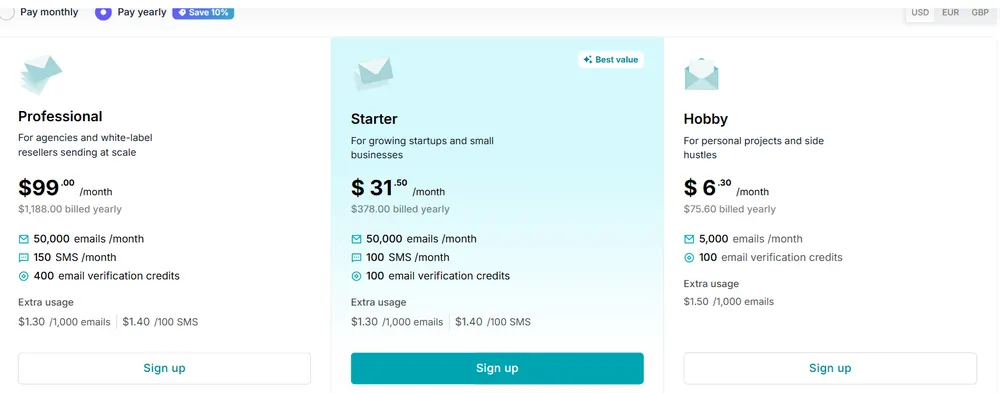
Annual billing saves 10%, and MailerSend displays the annual price as a per-month figure by default. If you land on the page and see $6.30 rather than $7.00, you are looking at the annual view. Both numbers appear on this page so you can tell them apart.
The four plans, line by line
The differences between the plans are not really about volume. Volume is set by the slider and both Starter and Professional cover the same range for most of it. The differences are about how many domains, users and templates you get, and how long MailerSend keeps your logs.
Free
500 emails per month, one sending domain, one template, one API token, one webhook, one user plus one accountant role, and one day of activity data retention. Ten email verification credits. Support is by email only and is described as limited.
A credit card is required for the Free plan. MailerSend states plainly that you will not be charged and that the card is there to prevent abuse of the platform, but it does mean the free tier is not anonymous and not zero-friction. If you want to try MailerSend without giving a card, use the Trial plan instead: 100 emails per month to 2 recipients, on a MailerSend-provided trial domain, with no DNS setup.
Hobby
$7.00 per month, or $6.30 per month on annual billing ($75.60 charged up front). 5,000 emails included, then $1.50 per additional 1,000. This is the first tier with the email API and SMTP relay, the drag-and-drop builder and the bulk endpoint.
Limits: 1 sending domain, 3 templates, 5 users, 5 webhooks, 3 API tokens, 1 inbound route, 1,000 daily API requests, 1 day of activity retention. The MailerSend logo stays on your emails on this tier.
Starter
From $35.00 per month, or $31.50 annual, for 50,000 emails. Adds sender identities, removal of the MailerSend logo, the SMS API (United States and Canada only), and live chat support.
Limits: 10 sending domains, 250 templates, 5 seats, 50 webhooks and API tokens, 5 inbound routes per domain, 50 sender identities, 100,000 daily API requests, 7 days of activity retention. 100 SMS and 100 verification credits included per month.
Professional
From $110.00 per month, or $99.00 annual, for the same 50,000 emails. What you are buying is headroom on everything that is not volume: 30 days of activity retention instead of 7, 7 days of API log retention, 500,000 daily API requests, a dedicated account manager and a deliverability consultation. 150 SMS and 400 verification credits per month.
MailerSend labels the domain, user and template limits on this tier as unlimited with an asterisk. The asterisk matters and is covered below.
What each volume step actually costs
The slider has eight positions. Here is every one of them, in both billing modes, for both scaling plans. Nothing here is interpolated: each row was read off the live pricing page.
| Emails /month | Starter monthly | Starter annual | Professional monthly | Professional annual |
|---|---|---|---|---|
| 5,000 | Hobby territory, $7.00 / $6.30 | $110.00 | $99.00 | |
| 50,000 | $35.00 | $31.50 | $110.00 | $99.00 |
| 100,000 | $68.00 | $61.20 | $140.00 | $126.00 |
| 250,000 | $162.50 | $146.25 | $275.00 | $247.50 |
| 500,000 | $325.00 | $292.50 | $525.00 | $472.50 |
| 1,000,000 | $600.00 | $540.00 | $1,000.00 | $900.00 |
| 1,500,000 | Starter stops here | $1,350.00 | $1,215.00 | |
| 2,000,000 | Starter stops here | $1,600.00 | $1,440.00 | |
Past 1,000,000 emails the Starter card freezes at its ceiling price and stops tracking the slider. Professional keeps going to 2,000,000, which is where the self-serve page ends. Above that you are into a quote.
The same grid as a cost per thousand
Price per month is the number you pay. Cost per thousand emails is the number that tells you whether you are getting a good deal. Both columns below use monthly billing; knock 10% off for annual.
| Emails /month | Starter, per 1,000 | Professional, per 1,000 | Professional premium |
|---|---|---|---|
| 50,000 | $0.70 | $2.20 | 3.1x |
| 100,000 | $0.68 | $1.40 | 2.1x |
| 250,000 | $0.65 | $1.10 | 1.7x |
| 500,000 | $0.65 | $1.05 | 1.6x |
| 1,000,000 | $0.60 | $1.00 | 1.7x |
| 2,000,000 | not available | $0.80 | – |
Two things fall out of that table. Starter’s cost per thousand barely moves: $0.70 down to $0.60 across a twentyfold increase in volume. That is a nearly flat curve, which is unusual and, depending on where you sit, either fair or unrewarding. And Professional is more expensive per email than Starter at every single step, which brings us to the next section.
Starter or Professional? The answer is not what the layout implies
MailerSend puts Professional first on the page and puts a “Best value” flag next to Starter. Read the grid above and the flag is right: Professional is never cheaper per email than Starter. At the shared 50,000 entry point it costs 3.1 times as much for exactly the same allowance.
So Professional is not a volume tier. It is a capability tier that happens to sit on the same slider. You should be on it if one or more of these is true:
- You send for more than 10 domains. Starter’s hard ceiling is 10; Professional’s is 1,000.
- You need more than 5 people in the account. Starter caps at 5 seats regardless of volume.
- You need more than 250 templates, typically because you are running many brands from one account.
- Seven days of activity data is not enough for your support or compliance workflow, and you would rather have 30 than buy the retention add-on.
- You want API log retention at all. It is 7 days on Professional and absent below it.
- You need more than 100,000 API requests per day, or more than 15 bulk API calls per minute.
The practical rule. If you are a single product sending from one or two domains, Starter is the right plan at any volume up to a million a month, and you should not read Professional’s position on the page as a recommendation. If you are an agency or a white-label reseller, the domain and seat ceilings will decide it for you long before the price does.
The one place the choice reverses
Above 1,000,000 emails a month, Starter stops. There is no Starter option at 1.5M or 2M. At that point Professional at $1,000 for a million is not competing with Starter at $600, it is the only self-serve option MailerSend offers, and the comparison becomes Professional against a negotiated Enterprise contract.
Overage: what happens when you go past your allowance
MailerSend does not stop sending when you hit your monthly quota. It keeps delivering and bills the excess in blocks of 1,000. The rate is not flat: it falls as your plan size grows, which means the overage rate you are quoted depends on which step of the slider you bought, not on how far over you go.
| Plan size | Starter overage /1,000 | Professional overage /1,000 |
|---|---|---|
| Hobby, 5,000 | $1.50 | |
| 50,000 | $1.30 | $1.30 |
| 100,000 | $1.30 | $1.30 |
| 250,000 | $1.10 | $1.00 |
| 500,000 | $1.10 | $0.80 |
| 1,000,000 | $1.00 | $0.60 |
| 1,500,000 | – | $0.60 |
| 2,000,000 | – | $0.50 |
Overage always costs more than the plan it overflows. On Starter at 50,000, your included emails work out at $0.70 per thousand and your overage costs $1.30 per thousand, which is 1.9 times as much. Overage is a shock absorber, not a pricing strategy. If you are regularly 20% over, move up a step on the slider, going from 50,000 to 100,000 costs $33 more and buys you 50,000 emails that would have cost $65 as overage.
MailerSend offers a billing limit setting you can turn on to cap what you are willing to spend on overage. It is opt-in, which means that by default an application stuck in a retry loop can run up a bill without anything stopping it. Turn it on before you need it.
The add-ons, and the one that isn’t priced
| Add-on | Price | Notes |
|---|---|---|
| Email verification | $25.00 for 2,500 credits | $0.01 per credit; tiers run up to 1,000,000 credits, available on every plan |
| Domain space | $4.00 per domain | Starter, Professional and Enterprise only |
| Phone number (SMS) | $2.00 per number | United States and Canada only |
| DMARC monitor | $2.00 per domain | For Starter, and Professional accounts past 10 domains |
| Activity data retention | From $5.00 | Extends searchable activity up to 365 days |
| Dedicated IP | Not published | “Contact our support team”; Enterprise accounts sending over 100K emails/week |
The dedicated IP is the one gap in an otherwise transparent page. Most providers that offer dedicated IPs publish a monthly figure for them. MailerSend does not, and it also gates them behind an Enterprise account sending more than 100,000 emails per week, roughly 430,000 a month. If a dedicated IP is a requirement for you, you cannot budget MailerSend from its pricing page at all; you have to open a sales conversation. That is worth knowing before you start a migration.
Two discounts are worth knowing about. Annual billing takes 10% off. Registered nonprofits can request a 30% discount by contacting support with documentation of their status; MailerSend states explicitly that the nonprofit discount does not stack with the annual discount, so you take one or the other.
What “unlimited” means in the asterisk
The Professional card lists unlimited users, unlimited domains and unlimited templates, each with an asterisk. MailerSend’s own knowledge base spells out what the asterisk stands for, and the numbers are high but finite.
| Listed as | Actual ceiling on Professional |
|---|---|
| Unlimited domains | 1,000 sending domains |
| Unlimited templates | 5,000 templates |
| Unlimited users | 1,000 users |
| Unlimited webhooks | 5,000 webhooks |
| API tokens and SMTP users | 1,000, at 20 per domain |
| Inbound routes | 100,000, at 5,000 per domain |
For almost everyone these are effectively unlimited and the asterisk is honest shorthand. The one that can bite is the per-domain sub-limit rather than the total: 20 SMTP users per domain. If your architecture gives every microservice or every tenant its own SMTP credential on a shared domain, twenty is not a large number, and the fix is more domains rather than a bigger plan.
Rate limits that don’t appear on the pricing page
The pricing page lists a daily API request quota per plan. It does not list the per-minute rate limits, which live in a separate support article and which are the ones that actually break a send in production.
Daily request quota, reset at midnight UTC
| Plan | API and SMTP requests per day |
|---|---|
| Trial | 100 |
| Free | 100 |
| Hobby | 1,000 |
| Starter | 100,000 |
| Professional | 500,000 |
| Enterprise | 500,000 |
Note that Enterprise carries the same published daily quota as Professional. Every request counts, not every email, so a bulk call that carries 500 recipients spends one unit of quota.
Per-minute rate limits
| Endpoint | Healthy reputation | Reputation under review |
|---|---|---|
| All API requests except v1/email | 60 per minute | 60 per minute |
| v1/email | 120 per minute | 10 per minute |
| v1/bulk | Free 10, Hobby 10, Starter 15, Professional 30, Enterprise 60 calls per minute | 1 per minute |
This is the single most important line on this page for anyone doing capacity planning. If MailerSend puts your account’s reputation under review, the send endpoint drops from 120 requests a minute to 10. That is a twelvefold throttle applied to your production traffic, triggered by a state you do not directly control and that no amount of plan upgrading buys back. MailerSend also notes that newly upgraded accounts may sit at a lower rate limit until they have established good sending practices, so the 120 figure is not what a brand new account should assume on day one.
The practical implication: sending one email per API request spends one unit of daily quota per email. A Starter plan at its 1,000,000 ceiling averages about 33,000 emails a day, comfortably inside the 100,000 quota, but a campaign-shaped peak day can cross it. Once it does, or once you need more than 120 sends a minute, you are on the bulk endpoint, and the bulk endpoint is plan-tiered at 15 calls a minute on Starter against 30 on Professional. That makes the Starter-to-Professional decision an architectural one for high-throughput senders, not just a question of domains and seats.
Five things that catch people out
- The free tier wants a card. Not a hold, not a charge, but a card on file. If your evaluation process cannot accommodate that, use the Trial plan and its 100 emails to 2 recipients instead.
- One day of activity retention on Free and Hobby. An incident reported on Wednesday about Monday’s emails is not investigable. Starter takes you to 7 days, Professional to 30, and the retention add-on starts at $5.00 for more.
- The prices you see are probably the annual ones. The page defaults to the annual view and expresses it per month. Confirm which toggle is active before you quote a number to anyone.
- SMS is United States and Canada only. The SMS allowance on Starter and Professional is part of the price whether or not you can use it, and if you send from Europe or Asia you are paying for a feature that does not reach your users.
- Overage runs by default. The billing limit exists but you have to switch it on. Do that on the day you set up the account, not the month you discover the invoice.
Who MailerSend is priced for
MailerSend’s curve is flat by transactional-email standards. Between 50,000 and 1,000,000 emails a month on Starter, the cost per thousand only moves from $0.70 to $0.60. Providers that price purely per-email typically drop much harder as you scale, and providers that price on a monthly base plus a low per-email rate usually beat MailerSend at the top of that range.
Where MailerSend does well is the middle of the market with feature needs attached. At 100,000 emails a month for $68 you also get 10 domains, 50 sender identities, inbound routing, DMARC monitoring on one domain, a template builder and live chat, a bundle that at some competitors is several separate line items or a higher tier.
Good fit: product teams sending 50,000 to 500,000 transactional emails a month who want the whole toolchain in one bill; agencies and white-label resellers, for whom Professional’s 1,000 domains is the real product.
Poor fit: very high volume senders past a few million a month, where the flat curve stops rewarding you; anyone who needs a dedicated IP and a budget number before opening a sales conversation; teams outside North America who would be paying for an SMS allowance they cannot use.
How to pick your plan in four steps
- Count domains and seats first, not emails. More than 10 domains or more than 5 people puts you on Professional regardless of volume, and that decision costs more than any slider position.
- Take your peak month, not your average. Overage is roughly twice your included rate, so a plan sized to the average and topped up in December is more expensive than a plan sized to December.
- Check the retention you need. If your support team investigates issues more than a week old, budget either Professional or the retention add-on now.
- Turn on the billing limit. Before your first production send, not after.
Frequently asked questions
How much does MailerSend cost?
MailerSend starts at $0 for 500 emails a month, $7.00 a month for 5,000 emails on Hobby, $35.00 a month for 50,000 on Starter and $110.00 a month for 50,000 on Professional. Annual billing takes 10% off each of those, bringing them to $6.30, $31.50 and $99.00 per month. Starter scales on a slider to $600.00 for 1,000,000 emails a month; Professional goes to $1,600.00 for 2,000,000. All figures are USD, read from MailerSend’s pricing page in August 2026.
Does MailerSend have a genuinely free plan?
Yes, 500 emails a month at no charge, but it requires a credit card on file. MailerSend states the card is there to prevent platform abuse and that you will not be charged. The Free plan is limited to 1 domain, 1 template, 1 user plus an accountant role, 1 day of activity retention and 100 API or SMTP requests per day. If you want to test without giving a card, the Trial plan allows 100 emails a month to 2 recipients on a MailerSend-supplied trial domain.
Is Professional worth the extra money over Starter?
Only if you need its limits, never for the volume. Professional costs more per email than Starter at every step of the slider, 3.1 times as much at the shared 50,000 entry point and 1.7 times as much at 1,000,000. What Professional buys is 1,000 domains instead of 10, 1,000 users instead of 5, 5,000 templates instead of 250, 30 days of activity retention instead of 7, 7 days of API log retention, 500,000 daily API requests instead of 100,000, and a dedicated account manager. Agencies and resellers need those; single-product teams generally do not.
What does MailerSend charge for emails over my plan allowance?
Between $0.50 and $1.50 per 1,000 extra emails, depending on the plan size you bought rather than how far over you go. Hobby is $1.50. At 50,000 and 100,000 both Starter and Professional charge $1.30. From 250,000 the rates diverge: Starter runs $1.10, $1.10 and $1.00 at 250,000, 500,000 and 1,000,000, while Professional runs $1.00, $0.80, $0.60 and $0.50 at 250,000, 500,000, 1,000,000 and 2,000,000. Overage is always dearer than the equivalent included volume, so persistent overage is a signal to move up a step.
Does MailerSend cut me off when I run out of emails?
No. It keeps sending and bills the excess. There is a billing limit setting that caps what you are prepared to spend, but it is opt-in, so a runaway retry loop will not be stopped by default. Enable it when you create the account.
What is the asterisk on MailerSend’s “unlimited” limits?
Professional’s unlimited domains, users and templates are capped at 1,000 sending domains, 1,000 users and 5,000 templates, alongside 5,000 webhooks, 1,000 API tokens and SMTP users, and 100,000 inbound routes. The sub-limit worth watching is per-domain rather than total: 20 SMTP users per domain, which matters if you issue one credential per service or per tenant on a shared domain.
How much does a dedicated IP cost on MailerSend?
MailerSend does not publish a price. The pricing page lists dedicated IPs as an add-on with “Contact our support team” in place of a figure, and restricts them to Enterprise accounts sending over 100,000 emails a week, roughly 430,000 a month. If a dedicated IP is a hard requirement, you cannot budget MailerSend from its published pricing and will need a sales conversation first.
Are there rate limits I should know about before migrating?
Yes, and they are not on the pricing page. The daily request quota is 100 on Trial and Free, 1,000 on Hobby, 100,000 on Starter and 500,000 on Professional and Enterprise, reset at midnight UTC. Per minute, the send endpoint allows 120 requests on a healthy account and the bulk endpoint allows 10 to 60 calls depending on plan. If your sending reputation is placed under review, the send endpoint drops to 10 requests a minute and bulk to 1, a throttle no plan upgrade removes.
Is annual billing worth it, and can I combine discounts?
Annual billing saves 10% and is charged up front: $75.60 for Hobby, $378.00 for entry Starter, $1,188.00 for entry Professional. Registered nonprofits can request 30% off by contacting support with documentation. MailerSend states the nonprofit discount does not stack with the annual discount, so you take whichever is larger, which for nonprofits is the 30%.
Does MailerSend price in currencies other than the dollar?
Yes, the pricing page offers USD, EUR and GBP. Those are separate price lists rather than live conversions, so do not assume the euro figure equals the dollar figure at today’s rate, switch the currency selector and read your own number before budgeting. Taxes may apply on top.
Continue reading about MailerSend
Pricing is only one part of the picture. For connection details, throughput behaviour and integration specifics, see the other tabs on this platform: SMTP settings, API, and integrations. If you are comparing MailerSend against other transactional providers, the alternatives tab sets it against the providers that compete for the same 50,000 to 500,000 a month range.
Sources. All figures on this page were read from mailersend.com/pricing, MailerSend’s “MailerSend Plans and Limits” knowledge base article and its “403, 422 and 429 errors” rate limits article on 21 August 2026, in USD. Prices change; where a figure here disagrees with the vendor’s page, the vendor’s page is correct and we would be glad to be told.
This review follows our email infrastructure testing methodology. We disclose affiliate relationships in our editorial independence policy.