
How much does HubSpot cost in 2026?
HubSpot’s headline price is not what HubSpot costs. The edition price is a base, and on top of it sit marketing contacts on their own ladder, extra seats, AI credits, and, on the two editions that matter for email, a mandatory one-time onboarding fee that is never shown in the monthly figure. This page prices all of it.
The short version. Marketing Hub Professional lists at €792/month on annual billing and carries a required €2,930 one-time onboarding fee. Enterprise lists at €3,300/month with a required €6,830 onboarding fee. Starter is €20/month per seat. Contacts, seats and AI credits are all metered separately on top. Figures below are euros read from hubspot.com on 24 August 2026.
On currency. HubSpot serves pricing by region and gave us euros; its currency switcher would not hold a change. The structure, the ratios and every mechanic described here are identical whatever currency you are shown, but check your own numbers before budgeting.
The fee that is not in the monthly price
At the bottom of the Professional card, in small type, HubSpot writes: “Cost shown does not include the required, one-time Professional Onboarding for a fee of €2,930.” The Enterprise card carries the same sentence with a fee of €6,830.
The word doing the work is required. This is not a professional-services option you can decline in favour of doing it yourself. On Professional it adds the equivalent of nearly four months of subscription to your first year; on Enterprise it is a little over two months.
What this does to a first-year comparison. Professional at €792 a month reads as €9,504 for year one. With onboarding it is €12,434, before a single extra contact, seat or credit. Enterprise reads as €39,600 and is actually €46,430. Any comparison against a competitor that quotes a flat monthly rate has to add that fee to HubSpot’s side or it is not a comparison.
The four editions
| Edition | Price | Seats | Included contacts | Included credits | Onboarding |
|---|---|---|---|---|---|
| Free | €0 | up to 2 users | – | – | none |
| Starter | €20/mo per seat | priced per seat | 1,000 | 500 | none |
| Professional | €792/mo annual €880/mo monthly | 3 included, then €45/mo | 2,000 | 3,000 | €2,930 |
| Enterprise | €3,300/mo | 5 included, then €75/mo | 10,000 | 5,000 | €6,830 |
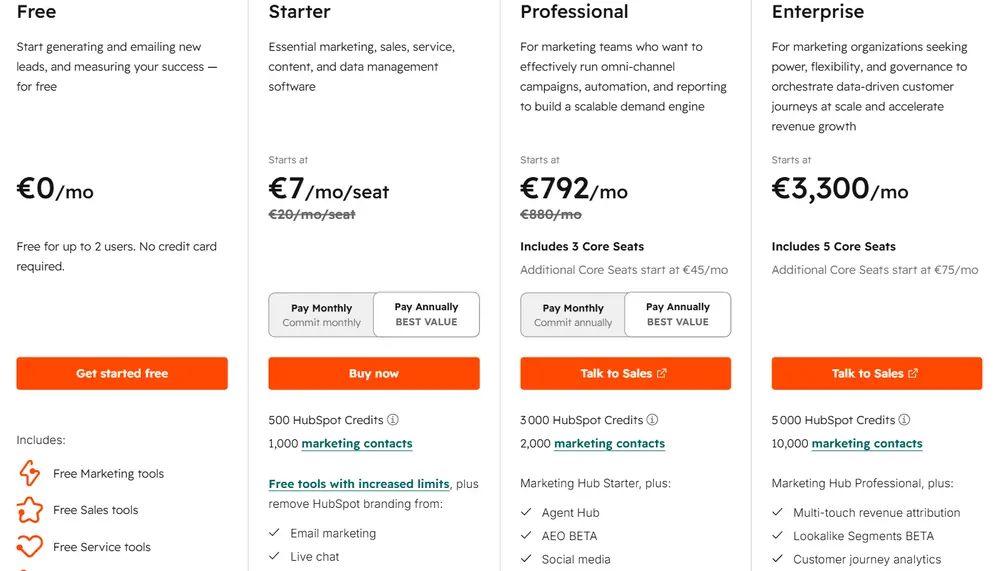
The Starter card also shows €7/mo per seat struck against the €20. That is a promotion advertised on the page as “Save up to 65% on Starter, new customers only, select offers available for a limited time”. Treat €20 as the price and the €7 as an introductory rate that will end.
The Starter-to-Professional step is the largest in this category. A one-seat Starter account is €20 a month. The next edition up is €792 a month plus €2,930 once. That is a forty-fold jump in the monthly figure, and there is nothing between the two. If Starter does not do what you need, HubSpot’s next answer is a four-figure commitment.
Marketing contacts, and why the model is genuinely good
HubSpot bills only what it calls marketing contacts-people you actually target with marketing emails and ads. Everyone else sits in the CRM as a non-marketing contact, free, up to a ceiling of 15 million total contacts.
This is a better model than most of the category. Platforms that bill every row in the database punish you for using the CRM as a CRM. HubSpot separates storage from marketing, and a company with 200,000 records but 8,000 people it actually emails pays for 8,000.
Two conditions on that. Flipping a contact from marketing to non-marketing is allowed at any time, but the status only updates once a month, so the saving is never immediate. And more seriously: “once you select a contact tier, you cannot downgrade until your contract renews.” You can raise your tier mid-contract; you cannot lower it. Cleaning your list saves nothing until renewal day.
What extra contacts cost, edition by edition
Each edition has its own contact ladder, its own free allowance and its own minimum purchase quantity. HubSpot bills these at a blended rate across the bands rather than one overall rate.
| Edition | Free allowance | Bands | Minimum purchase |
|---|---|---|---|
| Starter | first 1,000 | 1,000-3,000: €34.50 per 1,000 4,000-5,000: €30.75 per 1,000 6,000+: €27 per 1,000 | 1,000 |
| Professional | first 2,000 | 2,000-22,000: €225 per 5,000 27,000-42,000: €198 per 5,000 47,000-62,000: €175.50 per 5,000 67,000-82,000: €153 per 5,000 87,000+: €130.50 per 5,000 | 5,000 |
| Enterprise | first 10,000 | 10,000-50,000: €92 per 10,000 60,000-100,000: €83 per 10,000 110,000-200,000: €73 per 10,000 210,000-500,000: €64 per 10,000 510,000+: €55 per 10,000 | 10,000 |
Enterprise contacts cost a fifth of Professional contacts
Convert those bands to a common unit and something odd appears.
| Edition | Entry band, per 1,000 contacts | Best band, per 1,000 contacts |
|---|---|---|
| Starter | €34.50 | €27.00 |
| Professional | €45.00 | €26.10 |
| Enterprise | €9.20 | €5.50 |
Two things fall out of that table. First, Professional’s entry contact rate is more expensive than Starter’s-€45 per thousand against €34.50, and it does not become cheaper per contact than Starter’s floor until you are past 87,000 contacts. Moving up an edition makes your contacts dearer, not cheaper, over most of the realistic range.
Second, Enterprise contacts are roughly a fifth the price of Professional contacts. That gap is large enough to reverse the edition decision on a big list: Enterprise’s base is €2,508 a month more than Professional’s, but it also includes 8,000 more contacts and then charges about a fifth as much for every block after that.
HubSpot’s own worked example. The page states that a Professional account with 27,000 marketing contacts pays €1,098 a month in contact charges alone-the first 2,000 free, then €225 per 5,000 for the next 20,000, then €198 for the next 5,000. Add the €792 base and that account is at roughly €1,890 a month before seats, credits or the onboarding fee. If your list is anywhere near that size, model both editions on HubSpot’s calculator rather than assuming the cheaper base wins.
Your send limit is a multiple of your contact tier
HubSpot does not sell email volume directly. It derives your monthly send allowance from the contact tier you bought, and the multiplier depends on your edition:
| Edition | Multiplier | At the included contact tier |
|---|---|---|
| Starter | 5× contacts / month | 5,000 emails |
| Professional | 10× contacts / month | 20,000 emails |
| Enterprise | 20× contacts / month | 200,000 emails |
Five sends a month to your whole list on Starter, ten on Professional, twenty on Enterprise. For a monthly newsletter that is generous. For a business running several automated sequences against the same people, five is not much headroom at all.
HubSpot’s answer when you hit the ceiling is explicit: “you can purchase more marketing contacts or purchase the Dedicated IP Add-On for unlimited email sends.” Note what that means, the ordinary remedy for needing more emails is buying more contacts you do not have, at €45 per thousand on Professional. The efficient remedy is the dedicated IP.
Transactional email and SMTP: Professional or Enterprise only, price on request
This is the section that matters most on this site, and the answer is unusually restrictive.
HubSpot’s transactional email product exists, supports SMTP relay and a single-send transactional API, and includes a dedicated IP for transactional sending. But it is sold as an optional add-on, and HubSpot’s own FAQ sets the terms: “Transactional email is an optional add-on available to purchase for Marketing Hub Professional or Enterprise, and it includes a dedicated IP specifically for sending transactional emails. To buy the transactional email add-on, contact your account manager or sales representative.”
Three consequences, all of them expensive. There is no transactional sending on Free or Starter at any price. The floor for SMTP relay on HubSpot is therefore Professional, €792 a month plus €2,930 of mandatory onboarding, before the add-on is even quoted. And the add-on itself carries no published price; it goes through sales. Anyone evaluating HubSpot purely as a transactional sender is looking at a five-figure first year against dedicated providers that charge single-digit sums per hundred thousand emails.
HubSpot’s transactional product is designed for companies already committed to the platform who want receipts and account notifications to live beside their marketing data. Judged as that, it is coherent. Judged as an SMTP service, it is the most expensive way to send a password reset that we have priced.
HubSpot Credits, the newest meter
Credits are HubSpot’s unit for AI features, sold at €9.00 per 1,000 credits on annual billing, and consumed per action. The two rates shown on the pricing page are 50 credits per conversation resolved by the Customer Agent and 10 credits per smart-properties run by the Data Agent.
Each edition includes an allowance: 500 credits on Starter, 3,000 on Professional, 5,000 on Enterprise. Converted into work, Professional’s 3,000 credits are 60 resolved conversations before you start buying more, and Enterprise’s 5,000 are 100.
Size this before you rely on it. At 50 credits a conversation, a support desk resolving 40 conversations a day through the agent burns 2,000 credits a day, the entire Professional allowance in under two working days, and roughly €18 a day thereafter. That may well be good value against the cost of a human doing the same work, but it is a consumption meter, not an included feature, and it is not visible in any edition price.
Seats are priced by your highest edition anywhere in the account
Core Seats are how people get access, and HubSpot prices them with a rule that catches multi-hub customers: “All Core Seats in an account are priced based on the highest level across all products of your subscription.” Their own example is a company on Marketing Hub Professional and Sales Hub Enterprise, every Core Seat in that account is billed at the Enterprise rate.
Professional includes 3 seats and charges €45 a month for each additional one. Enterprise includes 5 and charges €75. So a Professional marketing team of eight is paying €792 plus five extra seats at €45, or €1,017 a month, unless someone in sales has an Enterprise licence, in which case those five seats are €75 each and the same team costs €1,167.
What the free tier actually gives you
HubSpot’s free tier is real and it is not a trial. It covers up to two users and includes free tools across marketing, sales, service, content, data and revenue, with the CRM underneath. HubSpot branding appears on what you send, and removing it is the first thing Starter buys you.
For a small team that wants a CRM with some email attached, it is a legitimate permanent home. What it is not is a sending platform: no transactional email, no SMTP, no dedicated IP, and the marketing send limits that apply to paid tiers apply here in a smaller form.
Adding it up: what Professional actually costs
Take a plausible mid-sized case, a Professional account with 27,000 marketing contacts and eight people needing access, using the AI agent lightly, in its first year:
| Line | Cost |
|---|---|
| Marketing Hub Professional base, annual | €792 / month |
| 27,000 marketing contacts (HubSpot’s own figure) | €1,098 / month |
| 5 additional Core Seats at €45 | €225 / month |
| Monthly subtotal | €2,115 / month |
| Twelve months | €25,380 |
| Required Professional onboarding, one time | €2,930 |
| First-year total | €28,310 |
That is before credits beyond the included 3,000, before the transactional add-on if you need SMTP, and before any other hub. The headline on the pricing page for this account is €792 a month. The real number is roughly 2.7 times that, and the gap is entirely made of things the card does not show.
We are not calling this a trick. Every figure above is published by HubSpot, and the contact example is HubSpot’s own. But the published figures live in five different places on the page, and only one of them is in large type. Anyone budgeting from the card alone will be wrong by a wide margin.
Six things that catch people out
1. Onboarding is mandatory and is not in the monthly price. €2,930 on Professional, €6,830 on Enterprise, one time, required.
2. You cannot downgrade a contact tier mid-contract. Up any time, down only at renewal. List hygiene saves nothing until then.
3. Professional contacts cost more per thousand than Starter contacts. €45 against €34.50 at the entry bands, and it stays that way until roughly 87,000 contacts.
4. Your send limit is derived from contacts, not bought directly. Need more emails and HubSpot’s default answer is to sell you contacts you do not need.
5. Transactional email needs Professional or Enterprise and has no published price. No SMTP on Free or Starter at all.
6. Seats are priced at your highest edition anywhere. One Enterprise licence in another hub repricing every Core Seat in the account.
Who HubSpot is priced for
It is priced well for companies buying a platform rather than a mailing tool, organisations that want CRM, sales, service and marketing on shared data and have the budget to treat email as one feature among many. The marketing-versus-non-marketing contact split is genuinely generous for anyone holding a large database they only email a slice of. And on very large lists, Enterprise’s contact rates are competitive with anything in the category.
It is priced badly for anyone who primarily wants to send email. The Starter-to-Professional cliff, the mandatory onboarding, the derived send limits and the sales-gated transactional add-on all point the same way: HubSpot is not competing with email service providers on price and is not trying to. A business that needs 500,000 marketing emails a month and nothing else will pay several times what a dedicated platform charges.
And it is a poor fit for pure transactional sending at any size. The floor is Professional plus onboarding plus an unquoted add-on, which is a five-figure first year to do a job that dedicated relays price in single-digit currency units per hundred thousand emails.
How to size HubSpot in five steps
- Count marketing contacts, not database rows. Only people you actually email or advertise to are billed. Anyone you merely store is free up to 15 million.
- Check the send multiplier against your real volume. Five times your contact tier on Starter, ten on Professional, twenty on Enterprise. If your automations blow through that, you are buying contacts to buy emails, and the dedicated IP add-on is probably cheaper.
- Price Professional and Enterprise side by side on a big list. Enterprise’s contact rate is about a fifth of Professional’s, so the higher base can be the cheaper total. Do not assume the smaller base wins.
- Add onboarding to year one. €2,930 or €6,830, mandatory, on top. Any comparison that omits it is not a comparison.
- If you need SMTP, get the add-on quoted before you sign anything. It is not published, it is Professional-and-above only, and finding out its price after committing to the edition is the wrong order.
Frequently asked questions
How much does HubSpot Marketing Hub cost?
Starter is €20 per month per seat, Professional €792 per month on annual billing or €880 monthly, and Enterprise €3,300 per month. Those are base prices only. Professional carries a required one-time onboarding fee of €2,930 and Enterprise one of €6,830, and marketing contacts, extra seats and AI credits are all metered separately on top. A free tier covers up to two users with HubSpot branding. Figures are euros read from hubspot.com on 24 August 2026.
Is HubSpot onboarding really mandatory?
Yes on Professional and Enterprise. HubSpot’s own pricing page states that the cost shown “does not include the required, one-time Professional Onboarding for a fee of €2,930”, and the equivalent Enterprise line reads €6,830. It is not an optional service. On Professional it adds close to four months of subscription to the first year, taking a €9,504 annual base to €12,434 before anything else is added. Starter and Free carry no onboarding fee.
What is a marketing contact in HubSpot?
A marketing contact is someone you target with marketing emails or ads, and it is the only kind you pay for. Everyone else is a non-marketing contact, stored in the CRM free of charge up to a total of 15 million contacts. You can switch a contact between the two states at any time, but the change only takes effect once a month. This split is one of the better parts of HubSpot’s model: a company with a large database that only emails a fraction of it pays for the fraction.
Can I lower my HubSpot contact tier if I clean my list?
Not until your contract renews. HubSpot states plainly that once you select a contact tier you cannot downgrade until renewal, though you can increase it at any time. You can reclassify individual contacts as non-marketing, but that takes a month to register and does not by itself lower the tier you are contracted to. Practically, any list-hygiene saving is deferred to your renewal date, so plan the cleanup to land before it rather than after.
How many emails can I send with HubSpot?
The allowance is a multiple of your marketing contact tier, not a number you buy directly: five times your contacts per calendar month on Starter, ten times on Professional, twenty times on Enterprise. At the included tiers that is 5,000 emails on Starter, 20,000 on Professional and 200,000 on Enterprise. If you need more, HubSpot offers two routes, buy more marketing contacts, or buy the Dedicated IP add-on, which the company says provides unlimited email sends.
Does HubSpot support transactional email and SMTP?
Yes, but only as a paid add-on on Marketing Hub Professional or Enterprise, and its price is not published. HubSpot’s FAQ states that transactional email is an optional add-on for those two editions, that it includes a dedicated IP for transactional sending, and that buying it means contacting your account manager or sales representative. It supports SMTP relay and a single-send transactional API. There is no transactional sending on Free or Starter at any price, which puts the practical floor for SMTP on HubSpot at Professional plus mandatory onboarding plus an unquoted add-on.
What are HubSpot Credits and what do they cost?
Credits are the meter for HubSpot’s AI features, priced at €9.00 per 1,000 credits when paying annually. They are consumed per action: the pricing page quotes 50 credits per conversation resolved by the Customer Agent and 10 credits per smart-properties run by the Data Agent. Each edition includes an allowance, 500 on Starter, 3,000 on Professional, 5,000 on Enterprise, which works out at 60 resolved conversations on Professional before you begin buying more.
Is HubSpot Enterprise ever cheaper than Professional?
On a large list, yes. Enterprise costs €2,508 more per month in base price but includes 8,000 more marketing contacts and charges roughly a fifth as much for every block beyond that: about €9.20 per thousand contacts at its entry band against €45 on Professional, falling to €5.50 against €26.10. Because contact charges dominate the bill on big accounts, the higher base can produce the lower total. Anyone with a substantial list should price both editions rather than assuming the cheaper base wins.
How much are extra HubSpot seats?
Professional includes 3 Core Seats and charges €45 a month for each additional one; Enterprise includes 5 and charges €75. Starter is priced per seat throughout at €20. One rule catches multi-hub customers: all Core Seats in an account are priced at the highest edition level across your whole subscription, so a single Sales Hub Enterprise licence reprices every Core Seat in the account at the Enterprise rate, including the ones your marketing team uses.
Why is there such a large jump from Starter to Professional?
Because they are aimed at different buyers. Starter at €20 a month per seat is an entry product for small teams; Professional at €792 a month plus €2,930 of onboarding is a platform purchase with campaign tooling, automation and reporting. There is nothing between the two, so the monthly figure rises roughly forty-fold in a single step. If Starter almost covers your needs, it is worth checking whether an add-on or a second tool closes the gap before committing to that step.
Continue reading about HubSpot
Pricing is one part of the evaluation. For connection details, authentication and the practical setup of the transactional relay described above, see the SMTP settings tab. The API tab covers the sending endpoints and the integrations tab covers what connects to what. The alternatives tab compares HubSpot against the platforms that sell email as the product rather than as one module of a larger suite.
Sources. All figures were read from hubspot.com on 24 August 2026, in euros as served to us, with the pricing page, the three per-edition contact ladders, the pricing FAQ and the transactional email product page read in full. The first-year totals, the per-thousand-contact conversions and the credit-to-conversation arithmetic are our own calculations from the published figures; the 27,000-contact contact charge is HubSpot’s own worked example. The transactional add-on price is not published anywhere and we have not estimated it. Prices change; where a figure here disagrees with the vendor’s page, the vendor’s page is correct and we would be glad to be told.
This review follows our email infrastructure testing methodology. We disclose affiliate relationships in our editorial independence policy.
