
How much does Campaign Monitor cost in 2026?
Campaign Monitor sells three self-serve plans plus Enterprise. Read from campaignmonitor.com in August 2026, monthly billing: Lite from €12/mo, Essentials from €29/mo, Premier from €158/mo, Enterprise on quote. Annual billing takes 10% off all three. There is no free plan, only a 30-day trial capped at 500 contacts and 500 emails total. The two things that decide your bill: Lite caps monthly sends at 5× your contact count, the tightest multiplier in the category, and pricing moves in bands, so contact number 501 costs you 267% more than contact number 500.
What Campaign Monitor actually costs in 2026
Campaign Monitor does not publish a static price table. The pricing page renders figures from a contact-count selector, so the number you see depends on the band you pick. Here is the full self-serve ladder, all eight bands, read directly from the selector.
| Contacts | Lite | Essentials | Premier | Lite send cap (5×) |
|---|---|---|---|---|
| 0-500 | €12 | €29 | €158 | 2,500 sends |
| 501-2,500 | €44 | €69 | €168 | 12,500 sends |
| 2,501-5,000 | €70 | €109 | €188 | 25,000 sends |
| 5,001-10,000 | €109 | €168 | €277 | 50,000 sends |
| 10,001-15,000 | €143 | €247 | €406 | 75,000 sends |
| 15,001-25,000 | €223 | €397 | €506 | 125,000 sends |
| 25,001-50,000 | €367 | €596 | €993 | 250,000 sends |
| 50,001+ | Same as 50,000, then Enterprise | Same, then Enterprise | Same, then Enterprise | Quote |
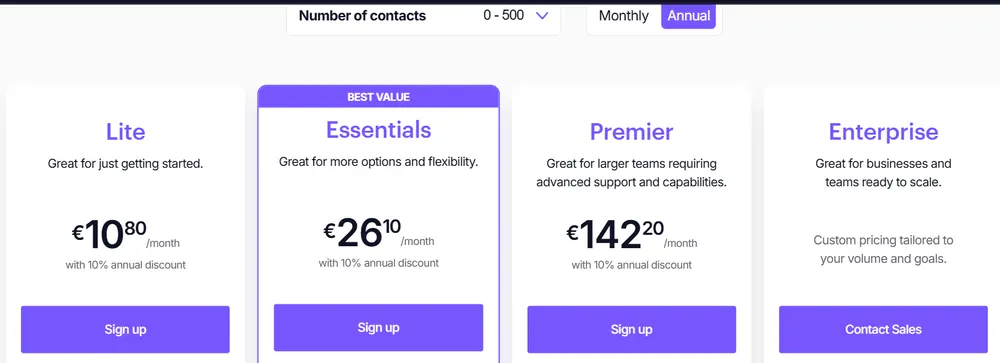
Annual billing removes exactly 10% from every figure above. We verified the discount at two separate bands: €109 becomes €98.10 and €168 becomes €151.20 at 10,000 contacts, both precisely 10%. Essentials and Premier carry unlimited monthly sends; only Lite is metered.
Campaign Monitor’s pricing page serves prices in the visitor’s local currency and offers no currency selector. The figures above are the EUR prices as published. Campaign Monitor’s own FAQ states: the prices shown are in EUR, and other currencies including USD, CAD, GBP, AUD and NZD are arranged with their sales team. We publish the euro figures because those are the ones we can verify. We do not convert them into dollars, because a conversion would be our arithmetic presented as their price list, and Campaign Monitor negotiates non-euro billing case by case.
The band cliff: why contact 501 costs 267% more than contact 500
Campaign Monitor prices by band, not by contact. You pay the full price of the band you fall into, which produces the steepest single-contact price jump we have measured on any platform in this category.
Cross from 500 contacts to 501 and your Lite bill goes from €12 to €44. That is +€32 a month for one additional subscriber, a 267% increase. On Essentials the same single contact takes you from €29 to €69, up 138%.
The first band is a trap for anyone growing
The 0-500 band is priced as a starter offer. Every band after it is priced normally. A list at 480 contacts is one signup form week away from tripling its bill, and nothing on the pricing page signals this. If you are near 500 and growing, budget for €44, not €12, and treat the cheap band as a trial extension rather than a plan.
The later boundaries hurt less in percentage terms but more in absolute money. Crossing 25,000 contacts on Essentials moves you from €397 to €596, an extra €199 a month, or €2,388 a year, triggered by a single subscriber. Cleaning inactive contacts before a boundary is worth real money on this platform in a way it is not on providers that price per contact continuously.
Where growth gets expensive: the marginal rate
Average cost per contact tells you what you pay. Marginal cost tells you what your next thousand contacts will cost. On Campaign Monitor the two diverge, and Essentials has a band where growth is punished.
| Growing from | Lite: cost per extra contact | Essentials: cost per extra contact |
|---|---|---|
| 500 → 2,500 | €0.0160 | €0.0200 |
| 2,500 → 5,000 | €0.0104 | €0.0160 |
| 5,000 → 10,000 | €0.0078 | €0.0118 |
| 10,000 → 15,000 | €0.0068 | €0.0158 |
| 15,000 → 25,000 | €0.0080 | €0.0150 |
| 25,000 → 50,000 | €0.0058 | €0.0080 |
Lite behaves the way you would expect. Each band is cheaper per contact than the one before, with a small bump between 15,000 and 25,000. Volume is rewarded.
Essentials does not. Growing from 10,000 to 15,000 contacts costs €0.0158 per contact, which is more expensive than growing from 5,000 to 10,000 at €0.0118. The curve reverses. A business scaling through that window pays a higher rate for growth than a smaller business did, and the rate does not come back down until 25,000.
In that range Essentials costs roughly €0.015 per additional contact, against €0.008 above 25,000 and €0.012 below 10,000. If you are heading into it, price the 25,001-50,000 band before you commit. Growing straight through the window costs less per contact than sitting in the middle of it.
The 5× send cap on Lite is the tightest in the category
Every contact-priced platform caps how many emails you can send per month as a multiple of your contact count. Campaign Monitor’s entry plan sets that multiple at 5, which is half of what the weakest competitor allows.
| Platform and plan | Monthly send multiplier | What that means at 5,000 contacts |
|---|---|---|
| Campaign Monitor Lite | 5× | 25,000 sends, or 5 campaigns a month |
| Mailchimp Essentials | 10× | 50,000 sends |
| Constant Contact Lite | 10× | 50,000 sends |
| Sender Standard | 12× | 60,000 sends |
| Mailchimp Standard | 12× | 60,000 sends |
| Constant Contact Premium | 24× | 120,000 sends |
| Campaign Monitor Essentials / Premier | Unlimited | No cap |
Five campaigns a month sounds workable until you count what actually sends. A welcome sequence, an abandoned cart flow, a post-purchase follow-up and a monthly newsletter will consume a 5× allowance on a list of engaged subscribers before you send a single promotion. Campaign Monitor makes transactional email available from Lite, and transactional volume lands on the same meter.
Lite is a newsletter plan, and the upgrade is not about features
On most platforms you move up a tier to unlock automation. Here, Lite already includes drip campaigns, transactional emails, AI Writer and pre-built journeys. What you are buying when you move to Essentials is the removal of the send cap. At 5,000 contacts that upgrade costs €39 a month (€70 to €109) and its entire justification is that you send more than five times a month. If you send a monthly newsletter and nothing else, Lite is genuinely enough and Essentials is €468 a year of headroom you will not use.
Premier has a floor, and below 15,000 contacts it makes no sense
Premier’s price barely moves across the first four bands, which tells you it is priced as a service tier rather than a volume tier.
Look at what Premier does across the small bands: €158 at 500 contacts, €168 at 2,500, €188 at 5,000. Ten times the contacts for €30 more. The plan has a hard floor around €158 that you pay whether you have fifty subscribers or five thousand.
Expressed as a premium over Essentials, the picture is unambiguous:
| At 500 contacts | Premier costs €129 more than Essentials, a 445% premium |
|---|---|
| At 2,500 contacts | €99 more, a 143% premium |
| At 5,000 contacts | €79 more, a 72% premium |
| At 15,000 contacts | €159 more, a 64% premium |
| At 25,000 contacts | €109 more, a 27% premium |
| At 50,000 contacts | €397 more, a 67% premium |
The narrowest gap is at 25,000 contacts, where Premier costs 27% more than Essentials and includes phone support, send time optimisation, advanced link tracking, template management for teams, pre-built engagement segments and the drag-and-drop website builder. That is the one band where Premier is arguably the value plan. Everywhere else you are paying a large premium for support response times.
What is included, what costs extra
Campaign Monitor marks several features as paid add-ons inside plans you have already bought. The comparison table on their pricing page flags these with a currency symbol rather than a tick, which is easy to miss.
| Unlimited users | Included on every plan, including the free trial. Genuinely unusual, most competitors meter seats. |
|---|---|
| Transactional emails | Available from Lite. Counts against the Lite send cap. |
| Drag-and-drop website builder | €9/mo add-on on Lite and Essentials. Included on Premier. |
| Non-human click filter | Paid add-on on Lite and Essentials. Included on Premier. |
| Engagement segments | Paid add-on on Essentials. Included on Premier as pre-built advanced segments. |
| Countdown timer, time zone sending | Listed as purchasable additional feature access on Essentials. |
| Automated emails | On Lite, limited to your send volume. Unlimited on Essentials and Premier. |
| Real-time and worldview reporting | Marked Limited on Lite. Full on Essentials and above. |
| Phone support | Premier only. Lite and Essentials get email support, Essentials at priority. |
Of the €109 premium Premier commands at 25,000 contacts, €9 is the website builder you would otherwise buy, and the rest is support tier plus the engagement segments and sending features. Campaign Monitor does not publish prices for the other add-ons, so we cannot tell you what the remaining €100 is worth in components.
The free plan that is not a free plan
Campaign Monitor’s plan comparison lists a Free column, which is easy to read as a permanent free tier. It is not.
The Free column describes a 30-day trial, and the limits are stated as trial limits: 500 contacts for the 30-day free trial and a 500 email limit for the 30-day free trial. The 500 emails are a total for the trial period, not a monthly or daily allowance.
One campaign to a full trial list ends the trial’s sending
Import 500 contacts, send them one campaign, and you have used your entire trial send allowance on day one with 29 days left to explore an account you can no longer send from. If you want to evaluate deliverability, automation timing or how your templates render across real inboxes, import a test segment of 50 and you get ten sends instead of one.
Compared to the category this is restrictive. Brevo gives 300 emails a day permanently, Mailchimp gives 500 a month permanently, MailerLite gives 2,500 a month, and Sender gives 15,000 a month to 2,500 contacts. Campaign Monitor gives 500 emails once. There is no free tier to fall back to when the trial ends.
What happens when you go over
Campaign Monitor publishes a policy but not a price, which is worth stating plainly rather than filling with an estimate.
Their FAQ says that if you send above your limits or your subscriber list grows, they will notify you and you will have the option to upgrade or pay for the additional emails. That is the whole of it. No per-email or per-thousand overage rate is published anywhere on the pricing page.
Constant Contact publishes $0.002 per extra send. Mailgun publishes $1.80, $1.30 and $1.10 per thousand by plan. Campaign Monitor publishes nothing, so any site quoting you a Campaign Monitor overage rate is guessing. What we can tell you is the structural consequence: the exposure only exists on Lite, because Essentials and Premier have unlimited sends. If overage uncertainty is unacceptable to your finance team, that is an argument for Essentials that has nothing to do with features.
Annual billing, nonprofits, and the exclusions
Two discounts are published. Both have conditions that the headline numbers do not mention.
| Annual purchase | 10% off, verified as exactly 10% at multiple bands. Explicitly does not apply to agency or multi-team plans, per Campaign Monitor’s own FAQ. |
|---|---|
| Nonprofit | 15% off. Not self-serve, you contact sales. No published verification requirements. |
| Plan changes | Campaign Monitor states you can switch between monthly Lite, Essentials and Premier without penalty. Unusually explicit, and useful given the band structure. |
The 10% annual discount is the joint-lowest in the category alongside MailerLite. Moosend gives 20%, AWeber effectively 16.7%, iContact and Constant Contact 15%. Committing a year to Campaign Monitor buys less than committing a year almost anywhere else, and it locks you out of the penalty-free plan switching that makes the band structure survivable.
What real accounts pay
Five worked examples at published monthly rates, in euros, with no negotiated discount.
| Profile | Monthly | Composition | The trap avoided |
|---|---|---|---|
| Newsletter, 450 contacts, one send a month | €12 | Lite, 0-500 band | Passing 500 contacts triples this to €44 |
| B2B list, 4,000 contacts, two campaigns a month | €70 | Lite, 25,000 send allowance, using 8,000 | Essentials at €109 buys headroom you would not use |
| Store, 8,000 contacts, cart and post-purchase flows | €168 | Essentials, unlimited sends | Lite at €109 caps at 40,000 sends; flows breach it |
| Media brand, 25,000 contacts, needs phone support | €506 | Premier, the one band where its premium is 27% | Essentials plus website builder is €406 without support |
| Agency, 30,000 contacts across clients, annual | €596 | Essentials at the 25,001-50,000 band | The 10% annual discount does not apply to agency plans |
How Campaign Monitor compares on structure
Price comparison across currencies would be arithmetic dressed up as fact, so here is the structural comparison instead, the things that decide your bill regardless of which currency you are billed in.
| Platform | Permanent free tier | Entry send multiplier | Seats on entry plan | Annual discount | Overage rate published |
|---|---|---|---|---|---|
| Campaign Monitor | None, 30-day trial only | 5× | Unlimited | 10% | No |
| Mailchimp | 500/month | 10× | 3 on Essentials | None published | No |
| Constant Contact | Trial capped at 100 sends | 10× | Varies | 15% | $0.002/send |
| MailerLite | 2,500/month, 250 subs | 10× on Comfort | 2 on free | 10% | No |
| Brevo | 300/day, unlimited contacts | Billed on sends, not contacts | Varies | 10% | No |
| Sender | 15,000/month, 2,500 subs | 12× | Varies | Varies | No |
Campaign Monitor is the only platform in that list with no permanent free tier at all, and it has the tightest entry send multiplier. Against that, it is the only one giving unlimited user seats on every plan, which is a real cost avoided for any team. Mailchimp charges its way up to unlimited seats through a $350/mo Premium tier.
The honest summary: Campaign Monitor prices like a product for organisations that already know they need it and have a team, not like a product competing for self-serve signups. The absence of a free tier and the 5× entry cap both point the same way. If you are comparing on trial generosity, it loses before it starts. If you are comparing on what a five-person marketing team pays to all be in the tool at once, it wins.
Who should pay for which plan
| Under 500 contacts, one send a month | Lite at €12. Cheapest entry in the category. Watch the 500 boundary. |
|---|---|
| Any list size, five or fewer sends a month, no automation running continuously | Lite. The 5× cap is the only thing Essentials fixes, and you are not hitting it. |
| Automated flows, or any store | Essentials. Flows fire continuously and will breach 5×. Unlimited sends is the whole product here. |
| Growing through 10,000 to 25,000 contacts | Essentials, but price the destination band first. That window carries the worst marginal rate on the platform. |
| Around 25,000 contacts and support matters | Premier at €506. Its only band where the premium over Essentials falls to 27%. |
| Under 15,000 contacts and tempted by Premier | Don’t. Premier’s floor means you pay for volume headroom you do not have. Buy Essentials and the €9 website builder. |
| Agency or multi-team | Contact sales. The published annual discount is explicitly excluded for you, so the list price is the starting point of a negotiation, not the price. |
What Campaign Monitor does not publish
Stated so that the gaps are visible rather than filled with estimates.
- Overage rates. The policy exists, the price does not. Only relevant on Lite.
- Add-on prices. Only the website builder (€9/mo) is priced. The non-human click filter, engagement segments, countdown timer and time zone sending are marked as purchasable with no figure attached.
- USD, GBP and other currency rates. Officially arranged through sales. The pricing page has no currency selector, so the figure you see depends on where you browse from.
- Enterprise pricing, and anything above 50,000 contacts. The selector stops moving at the 25,001-50,000 band; beyond that it is a quote.
- Agency and multi-team pricing. Referenced in the annual discount exclusion but never priced.
- Nonprofit verification requirements. The 15% is published; what proves you qualify is not.
Frequently asked questions
How much does Campaign Monitor cost in 2026?
Read from campaignmonitor.com in August 2026, monthly billing: Lite from €12/mo at up to 500 contacts, Essentials from €29/mo, Premier from €158/mo, Enterprise on quote. Prices rise by contact band, reaching €367, €596 and €993 respectively at 25,001 to 50,000 contacts. Annual billing takes exactly 10% off. The pricing page has no currency selector and serves local currency; Campaign Monitor states that USD and other currencies are arranged through sales.
Does Campaign Monitor have a free plan?
No. What the comparison table labels Free is a 30-day trial limited to 500 contacts and 500 emails in total-not per day, not per month. One campaign to a full 500-contact list exhausts the entire trial allowance immediately. There is no permanent free tier to fall back on, unlike Brevo (300/day), Mailchimp (500/month), MailerLite (2,500/month) or Sender (15,000/month).
How many emails can I send on Campaign Monitor Lite?
5× your contact count per month. At 5,000 contacts that is 25,000 sends, or roughly five campaigns. This is the tightest multiplier in the category. Mailchimp Essentials and Constant Contact Lite both give 10×, Sender gives 12×, Constant Contact Premium gives 24×. Transactional emails count against the same meter. Essentials and Premier have unlimited sends, which is the actual reason to upgrade.
Why did my Campaign Monitor bill jump when I added one subscriber?
Because pricing moves in bands and you pay the full price of your band. Crossing from 500 to 501 contacts takes Lite from €12 to €44, a 267% increase for one contact, and Essentials from €29 to €69. The same effect happens at every boundary: crossing 25,000 on Essentials adds €199 a month. Cleaning inactive contacts before a boundary saves real money here.
Is Campaign Monitor Premier worth it?
Only around 25,000 contacts, where it costs 27% more than Essentials. Premier has a floor near €158 that you pay regardless of list size, so at 500 contacts it costs 445% more than Essentials for the same sending. What the premium buys is phone support, pre-built engagement segments, send time optimisation, advanced link tracking, template management for teams and the website builder that otherwise costs €9/mo.
What is Campaign Monitor’s overage charge?
Not published. Campaign Monitor states only that if you exceed your limits they will notify you and you can upgrade or pay for additional emails, with no rate attached. Any figure you find elsewhere is an estimate. Note that the exposure only exists on Lite-Essentials and Premier include unlimited sends, so there is nothing to overrun.
How many users can I add to Campaign Monitor?
Unlimited on every plan, including the free trial, with user roles and permissions and two-factor authentication available throughout. This is genuinely unusual: Mailchimp gives 1, 3, 5 and unlimited seats by tier, and most competitors meter seats in some way. For a team of any size, Campaign Monitor removes a cost that competitors charge for.
Does Campaign Monitor offer an annual discount?
Yes, 10%, and we verified it is exactly 10% at multiple contact bands. Two caveats: it is the joint-lowest annual discount in the category (Moosend gives 20%, AWeber 16.7%, Constant Contact and iContact 15%), and Campaign Monitor’s FAQ states explicitly that it does not apply to agency or multi-team plans. Monthly plans can be switched between Lite, Essentials and Premier without penalty, which an annual commitment gives up.
Can I get Campaign Monitor pricing in US dollars?
Not from the pricing page. Campaign Monitor serves prices in the visitor’s local currency with no currency selector, and its own FAQ states that the displayed prices are in EUR while USD, CAD, GBP, AUD and NZD are supported by arrangement with their sales team. Practically, that means the dollar figure you are quoted is negotiated rather than listed, and any US price you find published elsewhere should be treated as unverified.
Does Campaign Monitor include transactional email?
Yes, from the Lite plan upward, alongside the marketing product. On Lite this matters more than it looks: transactional volume counts against the 5× monthly send cap, so password resets and order confirmations eat into your campaign allowance. On Essentials and Premier, sends are unlimited and the distinction stops mattering. Providers built purely for transactional traffic, such as Postmark or Amazon SES, price it per thousand instead.
Changelog (recent)
This review follows our email infrastructure testing methodology. We disclose affiliate relationships in our editorial independence policy.