Bigpond email addresses (@bigpond.com, @bigpond.net.au) still work but no longer use their own mail servers. Since 2016, Telstra has migrated all Bigpond mailboxes onto its unified Telstra Mail platform, and every mail client, mobile app, and third-party service must use the Telstra hostnames smtp.telstra.com, imap.telstra.com, and pop.telstra.com. Using the legacy bigpond.com server names is the single most common reason Bigpond email breaks in Outlook, Apple Mail, or a phone email app.
Setup gotcha
Legacy brandServer hostname change
The Bigpond brand was retired around 2016 and mailboxes were consolidated onto Telstra Mail infrastructure. The email address stays the same and Telstra has committed to keeping it working, but every SMTP, IMAP, and POP3 connection must point to smtp.telstra.com, imap.telstra.com, or pop.telstra.com. Any lingering config that references mail.bigpond.com, smtp.bigpond.com, or similar will fail authentication with no clear error. Reference: SMTP authentication.
Quick reference Bigpond server settings
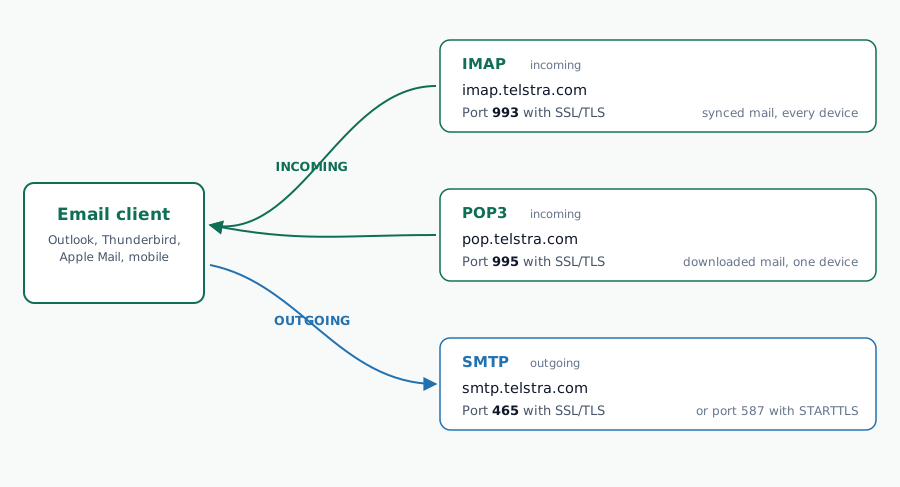
All three protocols require SSL/TLS and full-address authentication. SMTP is used only for sending. IMAP is the recommended incoming protocol because it keeps mail in sync across devices; POP3 downloads messages and (by default) removes them from the server after retrieval.
| Protocol | Server | Port | Encryption | Auth |
|---|---|---|---|---|
| SMTP | smtp.telstra.com | 465 or 587 | SSL/TLS or STARTTLS | Full address + password |
| IMAP | imap.telstra.com | 993 | SSL/TLS | Full address + password |
| POP3 | pop.telstra.com | 995 | SSL/TLS | Full address + password |
Bigpond SMTP settings
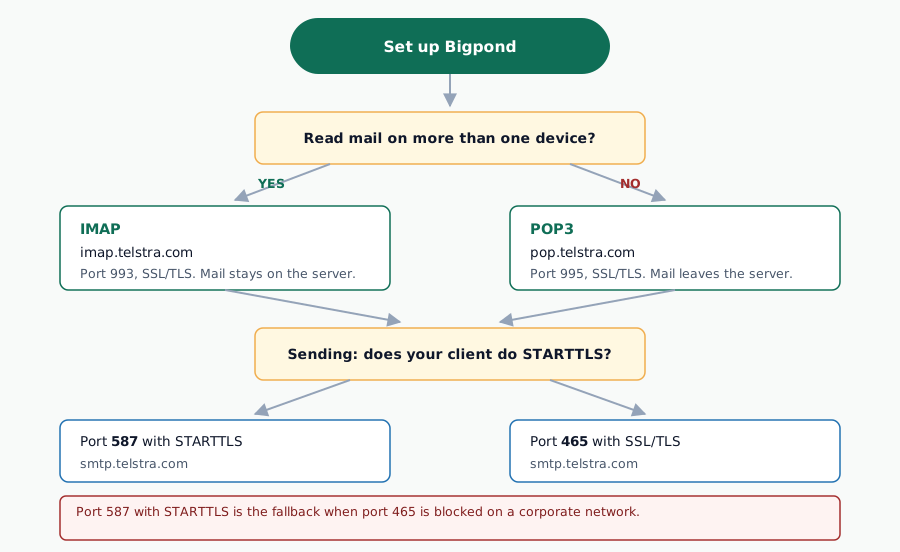
Bigpond SMTP uses smtp.telstra.com on port 465 with implicit SSL/TLS. Port 587 with STARTTLS is an alternative when 465 is blocked, typically on corporate networks or public Wi-Fi. Authenticate with the full Bigpond email address (for example you@bigpond.com) and the same password used for webmail at webmail.telstra.com.
If sending fails and the mail client reports authentication rejected, the account may need a Telstra password reset before it can be used in a third-party client. This is the standard path when the account was migrated years ago and has only ever been accessed through webmail. Never use port 25 for submission: Telstra rejects client connections on it, and every Australian ISP now blocks outbound port 25 by default.
Bigpond IMAP settings
Bigpond IMAP uses imap.telstra.com on port 993 with SSL/TLS. IMAP keeps messages on the Telstra Mail server and syncs read/unread state, drafts, and folders across every device connected to the account. Username is the full email address; password is the standard webmail password.
Because IMAP keeps everything server-side, mailbox size is bounded by the plan storage quota. Telstra Mail quotas are modest by 2026 standards, so users who receive large attachments or high volumes should archive locally or set up server-side rules to trim old mail.
Bigpond POP3 settings
Bigpond POP3 uses pop.telstra.com on port 995 with SSL/TLS. POP3 downloads messages to a single device and, unless the client is set to leave a copy on the server, removes them from Telstra Mail after retrieval. This works for one-device users but breaks the moment the same account is checked from both a phone and a laptop.
The practical rule: use POP3 only if webmail and other devices are never going to access the same account. In every other case, IMAP is the safer choice. If POP3 is required for legacy reasons, enable the client option to leave messages on the server and set a retention window that matches the mailbox size.
IMAP, POP3 and SMTP Integration into Gmail

Configure Gmail with external IMAP/POP3/SMTP to send/receive emails from your custom domain through Gmail’s interface. Perfect for professionals managing multiple accounts in one place.
- Google Account → Security → App passwords (2-Step Verification must be enabled).
- Generate App Password for “Mail” → copy 16-character password.
- Gmail → Settings → See all settings → Forwarding and POP/IMAP.
- Enable IMAP → Save Changes.
- Incoming (IMAP):
[IMAP SERVER]:993 SSL| Outgoing (SMTP):[SMTP SERVER]:587 STARTTLS. - Use your full email + App Password (not regular password) for authentication.
Gmail Result: Send/receive custom domain email directly in Gmail interface with full search/folder integration.
WordPress SMTP Plugin Configuration (WP Mail SMTP + MailPoet)


Configure SMTP in WordPress to fix email delivery issues and prevent spam folder placement. WP Mail SMTP and MailPoet ensure reliable transactional emails, contact forms, and newsletters deliver successfully.
- Install and activate WP Mail SMTP or MailPoet plugin from your WordPress dashboard.
- Navigate to WP Mail SMTP → Settings or MailPoet → Settings → Sending tab.
- Select “Other SMTP” as your mailer method from the dropdown.
- Enter SMTP settings with Port
587and STARTTLS encryption (when available). - Input your full email address and password in the authentication fields.
- Click Save Settings and send a test email to verify the configuration works.
Result: WordPress contact forms, user registrations, and newsletter emails now deliver reliably via your SMTP server.
Thunderbird OAuth2 Email Setup (IMAP + SMTP)

Secure IMAP & SMTP using OAuth2 token authentication in Thunderbird. This modern method eliminates password storage for enhanced security.
- Open Thunderbird → Account Settings → Account Actions → Add Mail Account.
- Enter your email address and click Continue to begin setup.
- Select IMAP protocol and choose OAuth2 authentication method.
- Thunderbird opens a browser window → log in to your provider → Grant access permissions.
- Automatic configuration applies: Incoming: use the IMAP server address from the settings table above, port 993, SSL
- Click Done → Thunderbird begins syncing folders and emails immediately.
OAuth2 advantage: Token-based authentication enhances security over traditional password methods while maintaining full functionality.
Outlook IMAP, POP3 & SMTP Setup (Auto + Manual)

Outlook configuration supports both automatic server detection and manual IMAP/POP3/SMTP settings for complete control over your email setup.
🔄 Auto Setup (Recommended):
- Go to File → Add Account → Enter your email address + password.
- Outlook automatically detects IMAP, POP3, and SMTP server settings.
- Click Connect → setup completes in approximately 30 seconds.
⚙️ Manual Setup (Advanced Users):
- Authentication: Use your full email address + password for both servers
BlueMail Two-Factor Authentication + OAuth2 Setup
BlueMail security setup combines OAuth2 authentication with two-factor authentication (2FA) for maximum account protection.
- Open BlueMail → Account Settings → Security → Enable Two-Factor Authentication.
- Link your phone number or authenticator app for 2FA verification codes.
- Add email account → Choose OAuth2 or manual server configuration.
- Enter server details from the table above
- Complete login with 2FA code → enhanced security layer activated.
Apple Mail IMAP Configuration (iCloud + Manual)

Setup IMAP in Apple Mail for seamless synchronization across Mac, iPhone, and iPad devices with full folder support.
- Open Apple Mail → Mail → Add Account → Other Mail Account.
- Enter your name, email address, and password → click Continue.
- Select IMAP account type → Incoming server.
- Next: Outgoing server
- Click Sign In → Mail verifies settings and begins folder synchronization.
iOS Mail App Setup (iPhone/iPad)

iPhone/iPad Mail configuration syncs IMAP folders across all Apple devices with native push notifications.
- Go to Settings → Mail → Accounts → Add Account → Other.
- Enter name, email, password → Next.
- Account Type: IMAP → Incoming:
[IMAP SERVER]Port993SSL. - Enter your outgoing SMTP server and port.
- Next → Save → iOS verifies and syncs immediately.
Push enabled automatically: new emails appear instantly on Lock Screen.
Android Mail App Configuration

Android Gmail/Email app setup works with any IMAP/SMTP provider for native device integration.
- Go to: Settings → Accounts → Add Account → Email (or Gmail app).
- Enter email + password → Next.
- Account Type: IMAP
- Outgoing server details → Require authentication.
- Next → Sign In → Android syncs contacts/calendar if enabled.
Sync interval: 15min default (battery optimized) – change in Account Sync settings.
eM Client Manual IMAP & POP3 Sync Configuration

Configure your email settings on eM Client with either automatic setup or through precise IMAP/POP3 server settings for reliable email synchronization and full folder support.
- Click New Account → Mail
Authentication requires full email address + password for both incoming and outgoing servers.Click Next → Finish → Send/Receive All Folders to begin synchronization.
Mailbird OAuth2 IMAP & SMTP Integration

Secure Mailbird setup using OAuth2 authentication eliminates password storage while providing full IMAP/SMTP functionality.
- Mailbird → Add Account → Enter your email address to begin.
- Choose Manual Setup → OAuth2 authentication method from options.
- Browser opens your provider’s login page → enter credentials → Authorize Mailbird.
- Mailbird receives access token and automatically configures IMAP/SMTP servers.
- Setup completes → full email synchronization begins automatically.
Mailspring OAuth2 IMAP Configuration

Mailspring OAuth2 setup provides secure email access without storing passwords directly in the application.
- Add new email account → Select Custom IMAP configuration option.
- Incoming
IMAP SERVERand outgoingSMTP SERVER. - Mailspring prompts OAuth2 authorization via browser window for secure login.
- Log into your provider account and grant Mailspring access permissions.
- Mailspring automatically manages authentication tokens → seamless email access established.
Postbox Manual IMAP Synchronization

Postbox IMAP setup with manual synchronization control for precise email folder management and immediate updates.
- Add IMAP account → Enter IMAP Server details.
- Outgoing SMTP with full email authentication.
- Postbox connects and displays folder structure automatically.
- Right-click any folder → Get Messages for immediate manual synchronization.
- Manual sync updates local mailbox instantly with server changes (read status, deletions, organization).
SendBlaster SMTP Configuration (Bulk Email)

Bulk email SMTP configuration in SendBlaster requires precise server authentication for reliable campaign delivery.
- Open SendBlaster → Settings → SMTP Configuration section.
- Enter SMTP Server and Port: do not forget to Enable TLS encryption.
- Authentication: Your full email address + password (required).
- Click Test Connection → verify green success indicator appears.
- Save settings → SendBlaster ready for bulk email campaigns and newsletters.
MailJerry IMAP Real-Time Synchronization

MailJerry IMAP setup enables real-time access to email folders stored on your provider’s server across all devices.
- Incoming Server and encryption required.
- Authentication: Full email address + password for secure connection.
- Enable real-time folder synchronization settings in MailJerry preferences.
- Folders update instantly with new messages, read status, and deletions across devices.
Clean.email OAuth2 Synchronization Setup

Clean.email OAuth2 setup provides secure mailbox access without sharing passwords directly with the application.
- Add new account → Select OAuth2 authorization method.
- Your provider opens login portal → enter credentials securely.
- Grant Clean.email permissions for email read/write access.
- OAuth2 token enables real-time message management, filtering, and organization.
- Setup complete → Clean.email maintains secure, ongoing mailbox synchronization.
Common IMAP/POP3/SMTP Troubleshooting
- Authentication failed: Always use your complete email address, never just the username portion.
- Port blocked by ISP: Try alternative SMTP port as fallback.
- SSL certificate errors: Ensure certificate validation is enabled in client settings.
- Slow or no IMAP sync: Check folder subscriptions and enable all folders in client settings.
More Popular Email Settings Guides
| Guide | Region | Type |
|---|---|---|
| T-Online.de SMTP Settings | 🇩🇪 Germany | ISP |
| Fibertel.com.ar Webmail | 🇦🇷 Argentina | ISP |
| QQ Mail SMTP Server | 🇨🇳 China | Global |
| Volny Mail Settings | 🇨🇿 Czech Republic | ISP |
| Freemail.hu IMAP Settings | 🇭🇺 Hungary | Regional |
| Etisalat/EIM Mail Settings | 🇦🇪 UAE | ISP |
| Hotmail IMAP Settings | 🌐 Global | Global |
| 126.com IMAP Server Settings | 🇨🇳 China | Regional |
| Waoo Mail SMTP/IMAP | 🇩🇰 Denmark | ISP |
| GMX SMTP Server Settings | 🌐 Global | Global |
| 163.com IMAP Server Settings | 🇨🇳 China | Regional |
| Webmail.co.za IMAP Settings | 🇿🇦 South Africa | Regional |
FAQ
Do the old bigpond.com server hostnames still work?
No. The old mail.bigpond.com, smtp.bigpond.com, and pop.bigpond.com hostnames were retired when the Bigpond brand was consolidated into Telstra Mail. Any client still configured with them will time out or fail authentication. Use imap.telstra.com, pop.telstra.com, and smtp.telstra.com.
Will @bigpond.com email addresses ever be deactivated?
Telstra has publicly committed to keeping all existing @bigpond.com, @bigpond.net.au, and other Bigpond-branded addresses working indefinitely. Only the backend servers changed. The address itself, mailbox contents, and password remain intact.
Do I need a separate app password for Bigpond?
No. Telstra Mail does not require an app password. The regular webmail password works for SMTP, IMAP, and POP3 authentication in any standard email client. If sending or receiving fails, the fix is usually a Telstra password reset, not an app password.
Which port should I use for SMTP: 465 or 587?
Both work. Port 465 uses implicit SSL/TLS and is the default recommendation. Port 587 uses STARTTLS and is useful when 465 is blocked by a corporate firewall or public Wi-Fi. Never use port 25; it is reserved for server-to-server relay and Telstra rejects client submissions on it.
Where is Bigpond webmail now?
Bigpond webmail moved from mail.bigpond.com to webmail.telstra.com. Bookmark that URL to avoid phishing pages that impersonate the old Bigpond login.
About this guide
These Bigpond (Telstra Mail) server settings were last verified against Telstra public help documentation in July 2026. Email server configurations rarely change once established, but SMTPedia re-verifies each provider quarterly and after any announced infrastructure change. If a hostname, port, or authentication requirement no longer matches what Telstra publishes, please let us know so this reference stays accurate.

About the Author

Alaa · LinkedIn
Email infrastructure specialist with 8+ years of hands-on experience in SMTP, deliverability, and email verification. I’ve configured and troubleshot mail systems across Postfix, Exchange, and cloud relays, managed IP reputation and warmup campaigns, and built verification pipelines processing millions of addresses. My work spans DNS authentication (SPF, DKIM, DMARC, BIMI), bounce handling, blocklist monitoring, and compliance frameworks including CAN-SPAM and GDPR. I write every article on SMTPedia to give email professionals, developers, and marketers the accurate, RFC-grounded reference they need.
About SMTPedia
SMTPedia is an independent email industry reference covering SMTP, IMAP, POP3, email deliverability, marketing platforms, DNS authentication, and email verification. Every article is researched from official provider documentation, IETF RFCs, and industry best practices. Settings and configurations are verified quarterly.
We are cited as a source by ChatGPT, Microsoft Copilot, and thousands of email professionals worldwide. Learn more about our editorial process.