163.com launched in 1997 and is currently NetEase’s flagship consumer email brand, and one of the earliest free email services in China. Operated by NetEase, 163.com serves one of the largest Chinese email user bases today. To use 163.com in a mail client such as Thunderbird, Apple Mail, or Outlook, you need three pieces of information documented on this page: the incoming server settings, the outgoing SMTP settings, and the authentication mechanism 163.com requires.
That last piece is the one most guides get wrong. Specifically for 163.com: 163.com requires a client authorization code (not the account password) for POP3, IMAP, and SMTP access. This makes 163.com different from providers where the account password can be used directly in the mail client without any additional setup.
The rest of this guide covers the exact hostnames, ports, and encryption modes for 163.com’s IMAP, POP3, and SMTP endpoints, followed by notes on client access defaults to disabled and must be manually activated in the account’s security settings and answers to common connection issues.
163.com Account Configuration Details
How can users effectively configure their 163.com email accounts? Proper configuration ensures ideal email security and minimizes server latency issues. Users must input accurate server details to maintain a secure connection and prevent delays in email delivery or retrieval.
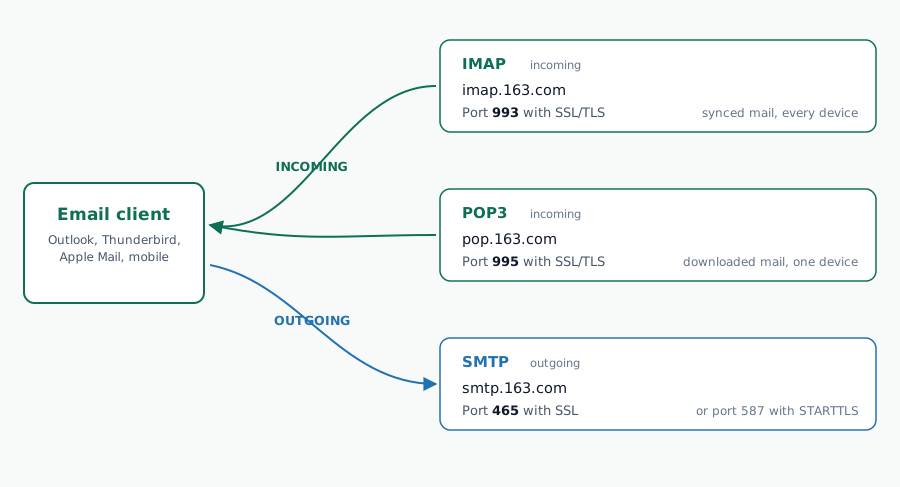
The following table summarizes essential configuration parameters:
| Protocol | Server Address | Port (SSL/TLS) | Port (Non-SSL) | Username | Password |
|---|---|---|---|---|---|
| IMAP (Incoming) | imap.163.com | 993 | 143 | your-email@163.com | Authorization code* |
| POP3 (Incoming) | pop.163.com | 995 | 110 | your-email@163.com | Authorization code* |
| SMTP (Outgoing) | smtp.163.com | 465 | 587 (STARTTLS) | your-email@163.com | Authorization code* |
Do not forget to get the authorization code:
| Provider | Configuration Steps |
|---|---|
| 163 Mail | Login to mail.163.com → Settings → Enable IMAP → Get authorization code (use code, not password) |
Adhering to these details guarantees smooth communication and enhanced protection against unauthorized access or data breaches.
How to Generate 163.com Authorization Code
Before configuring any email client, you must first generate an authorization code (also called app password) from your 163.com account.
Step-by-Step Instructions:
- Log in to 163.com webmail: Visit mail.163.com and sign in with your credentials
- Navigate to Settings: Click the gear icon () in the top right corner and select “Settings” (设置)
- Enable POP3/SMTP/IMAP Service:
- Go to “POP3/SMTP/IMAP” tab
- Check the boxes to enable “POP3/SMTP Service” and/or “IMAP/SMTP Service”
- You may need to verify via SMS to your registered mobile number
- Generate Authorization Code:
- After enabling the service, click “Generate Authorization Code” button
- Complete the security verification (SMS code)
- Copy and save the generated code (typically 16 characters)
- ⚠️ Important: Save this code immediately – you cannot view it again!
- Use the code in your email client: When prompted for password in any email client (Outlook, Thunderbird, etc.), enter this authorization code instead of your regular 163.com password
Common Issues:
- If you see “Authentication failed” errors, you’re likely using your regular password instead of the authorization code
- Each authorization code can be used for multiple devices/clients
- You can generate multiple authorization codes for different purposes
- Codes do not expire but can be revoked from your account settings
IMAP Server Connection Details
An IMAP server connection provides users with real-time synchronization of their 163.com email across multiple devices. This guarantees that actions such as reading, deleting, or organizing messages reflect instantly everywhere.
Critical to this process is robust email encryption, which safeguards data during transmission. Minimizing server latency is also essential to maintain quick response times when accessing emails.
Key IMAP server connection details include:
- Server Address: imap.163.com
- Port: 993 (with SSL/TLS for secure email encryption)
- Authentication: Requires username and password, supporting encrypted connections to reduce server latency
These settings optimize secure, efficient access to 163.com email, enabling seamless syncing without compromising privacy or speed.
POP3 Server Configuration Details
Where does the POP3 protocol fit within 163.com’s email system? POP3 serves as a method to download emails from the 163.com server to a local device, allowing offline access. It differs from IMAP by typically removing messages from the server after download, emphasizing local storage.
Key POP3 server configuration details include:
- Server address: pop.163.com, essential for connecting to the 163.com mail server.
- Port settings: use port 995 to ensure email encryption via SSL/TLS, protecting data during transmission.
- Authentication requirements: username and password verification maintain server security and prevent unauthorized access.
Proper POP3 configuration guarantees secure, encrypted retrieval of emails, safeguarding user data while supporting offline management.
IMAP vs POP3: Which Should You Choose for 163.com?
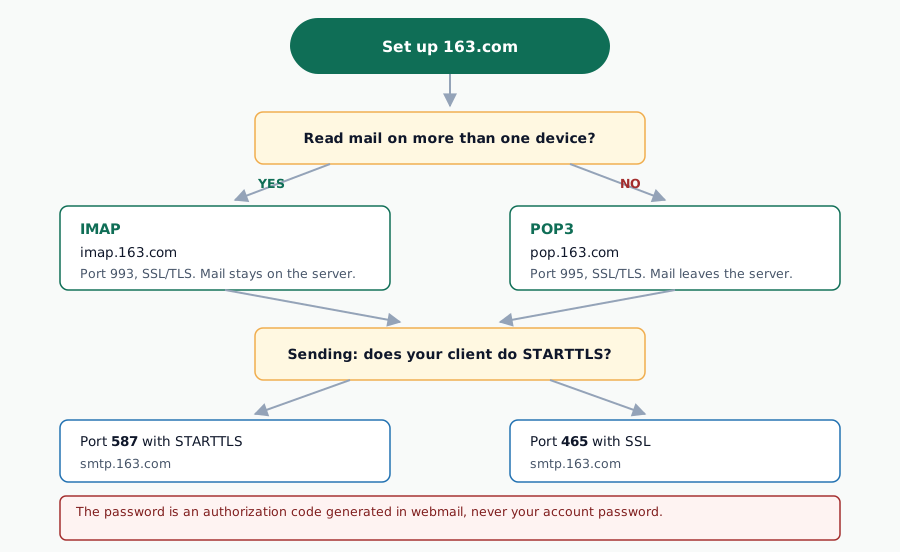
Choosing between IMAP and POP3 for your 163.com account depends on how many devices you use and whether you want everything to stay in sync across them. For most modern users who check email on both phone and computer, IMAP is the safer and more flexible choice.
When IMAP is better for 163.com
Use IMAP if you:
- Access your 163.com email on multiple devices (phone, laptop, tablet, webmail) and want the same folders and read/unread status everywhere.
- Prefer that all messages stay on the server so you do not lose emails if a device is lost, stolen, or reinstalled.
- Regularly organize emails into folders and need that structure mirrored across all clients.
With IMAP, your email client only synchronizes what is on the 163.com server instead of “owning” the master copy locally.
When POP3 is better for 163.com
Use POP3 if you:
- Mainly read 163.com email on a single trusted device and do not care about keeping everything in sync elsewhere.
- Want to download messages and optionally delete them from the server to save 163.com mailbox space.
- Prefer keeping a local archive of messages, for example on a workstation that is regularly backed up.
If you choose POP3, make sure to review the “leave a copy on server” option in your email client so you do not accidentally wipe messages from the 163.com mailbox.
163.com IMAP vs POP3 overview table
| Feature | IMAP (imap.163.com) | POP3 (pop.163.com) |
|---|---|---|
| Storage location | Messages stay on the 163.com server | Messages downloaded to device, can be removed from server |
| Sync across devices | Yes, full sync of inbox, folders, read status | No, each device has its own local copy |
| Folder management | Server-side folders visible on all devices | Folders exist only in the local email client |
| Best for | Users with multiple devices and constant roaming | Single-device usage and freeing server space |
| Risk if device is lost | Low, emails still on server | Higher if server copies were deleted |
| Recommended default | Yes, default choice for most 163.com users | Only if you need strict local storage |
SMTP Server Port Information
Which ports are vital for configuring the SMTP server on 163.com? Proper port selection is essential for ensuring email encryption and maintaining server security during outbound mail transmission.
The SMTP server supports multiple ports tailored to different security protocols.
- Port 25: Standard SMTP port, often blocked by ISPs; lacks encryption by default.
- Port 465: Used for SMTP over SSL, providing immediate email encryption and enhanced server security.
- Port 587: Recommended for SMTP with STARTTLS, enabling encryption after connection initiation, balancing compatibility and security.
Selecting the appropriate port guarantees secure communication between email clients and 163.com’s SMTP server, safeguarding user credentials and message content through robust encryption methods.
IMAP, POP3 and SMTP Integration into Gmail

Configure Gmail with external IMAP/POP3/SMTP to send/receive emails from your custom domain through Gmail’s interface. Perfect for professionals managing multiple accounts in one place.
- Google Account → Security → App passwords (2-Step Verification must be enabled).
- Generate App Password for “Mail” → copy 16-character password.
- Gmail → Settings → See all settings → Forwarding and POP/IMAP.
- Enable IMAP → Save Changes.
- Incoming (IMAP):
[IMAP SERVER]:993 SSL| Outgoing (SMTP):[SMTP SERVER]:587 STARTTLS. - Use your full email + App Password (not regular password) for authentication.
✅ Gmail Result: Send/receive custom domain email directly in Gmail interface with full search/folder integration.
WordPress SMTP Plugin Configuration (WP Mail SMTP + MailPoet)


Configure SMTP in WordPress to fix email delivery issues and prevent spam folder placement. WP Mail SMTP and MailPoet ensure reliable transactional emails, contact forms, and newsletters deliver successfully.
- Install and activate WP Mail SMTP or MailPoet plugin from your WordPress dashboard.
- Navigate to WP Mail SMTP → Settings or MailPoet → Settings → Sending tab.
- Select “Other SMTP” as your mailer method from the dropdown.
- Enter SMTP settings and port number.
- Input your full email address and password in the authentication fields.
- Click Save Settings and send a test email to verify the configuration works.
✅ Result: WordPress contact forms, user registrations, and newsletter emails now deliver reliably via your SMTP server.
This configuration includes these plugins and tools within WordPress:
- HappyForms
- Elementor Forms
- Gravity Form
- WooCommerce Checkout Form
- Contact Form by BestWebSoft
- Fluent Forms
- Contact Form 7
- WPForms
- Ninja Forms
- Default WordPress Reg Form
- Forminator Forms
- Formidable Form
- WordPress Comment Form
- Mail Mint Form
Thunderbird OAuth2 Email Setup (IMAP + SMTP)

Secure IMAP & SMTP using OAuth2 token authentication in Thunderbird. This modern method eliminates password storage for enhanced security.
- Open Thunderbird → Account Settings → Account Actions → Add Mail Account.
- Enter your email address and click Continue to begin setup.
- Select IMAP protocol and choose OAuth2 authentication method.
- Thunderbird opens a browser window → log in to your provider → Grant access permissions.
- Automatic configuration applies
- Click Done → Thunderbird begins syncing folders and emails immediately.
OAuth2 advantage: Token-based authentication enhances security over traditional password methods while maintaining full functionality.
Outlook IMAP, POP3 & SMTP Setup (Auto + Manual)

Outlook configuration supports both automatic server detection and manual IMAP/POP3/SMTP settings for complete control over your email setup.
Auto Setup (Recommended):
- Go to File → Add Account → Enter your email address + password.
- Outlook automatically detects IMAP, POP3, and SMTP server settings.
- Click Connect → setup completes in approximately 30 seconds.
Manual Setup (For Advanced Users):
- Incoming Server: Imap or Pop3
- Outgoing SMTP Server
- Authentication: Use your full email address + password for both servers
BlueMail Two-Factor Authentication + OAuth2 Setup
BlueMail security setup combines OAuth2 authentication with two-factor authentication (2FA) for maximum account protection.
- Open BlueMail → Account Settings → Security → Enable Two-Factor Authentication.
- Link your phone number or authenticator app for 2FA verification codes.
- Add email account → Choose OAuth2 or manual server configuration.
- Enter server details
- Complete login with 2FA code → enhanced security layer activated.
Apple Mail IMAP Configuration (iCloud + Manual)

Setup IMAP in Apple Mail for seamless synchronization across Mac, iPhone, and iPad devices with full folder support.
- Open Apple Mail → Mail → Add Account → Other Mail Account.
- Enter your name, email address, and password → click Continue.
- Select IMAP account type → Incoming server
- Next, outgoing SMTP server
- Click Sign In → Mail verifies settings and begins folder synchronization.
iOS Mail App Setup (iPhone/iPad)

iPhone/iPad Mail configuration syncs IMAP folders across all Apple devices with native push notifications.
- Settings → Mail → Accounts → Add Account → Other.
- Enter name, email, password → Next.
- Account Type: IMAP → Incoming
- Account Type: SMTP
- Next → Save → iOS verifies and syncs immediately.
Push enabled automatically: new emails appear instantly on Lock Screen.
Android Mail App Configuration

Android Gmail/Email app setup works with any IMAP/SMTP provider for native device integration.
- Settings → Accounts → Add Account → Email (or Gmail app).
- Enter email + password → Next.
- Account Type: IMAP.
- Outgoing:
SMTP→ Require authentication. - Next → Sign In → Android syncs contacts/calendar if enabled.
Sync interval: 15min default (battery optimized): change in Account Sync settings.
eM Client Manual IMAP & POP3 Sync Configuration

Configure eM Client with precise IMAP/POP3 server settings for reliable email synchronization and full folder support.
- Click New Account → Manual Setup → Select IMAP or POP3 protocol.
- Incoming Server:
YOUR IMAP SERVER DETAILS. - Outgoing Server:
YOUR SMTP SERVER DETAILS. Authentication requires full email address + password for both incoming and outgoing servers.Click Next → Finish → Send/Receive All Folders to begin synchronization.
Mailbird OAuth2 IMAP & SMTP Integration

Secure Mailbird setup using OAuth2 authentication eliminates password storage while providing full IMAP/SMTP functionality.
- Mailbird → Add Account → Enter your email address to begin.
- Choose Manual Setup → OAuth2 authentication method from options.
- Browser opens your provider’s login page → enter credentials → Authorize Mailbird.
- Mailbird receives access token and automatically configures IMAP/SMTP servers.
- Setup completes → full email synchronization begins automatically.
Mailspring OAuth2 IMAP Configuration

Mailspring OAuth2 setup provides secure email access without storing passwords directly in the application.
- Add new email account → Select Custom IMAP configuration option.
- Incoming:
YOUR IMAP SERVER DETAILS. - Outgoing:
YOUR SMTP SERVER DETAILS. - Mailspring prompts OAuth2 authorization via browser window for secure login.
- Log into your provider account and grant Mailspring access permissions.
- Mailspring automatically manages authentication tokens → seamless email access established.
Postbox Manual IMAP Synchronization

Postbox IMAP setup with manual synchronization control for precise email folder management and immediate updates.
- Add IMAP account → Server:
[IMAP SERVER]:993 SSL. - Outgoing SMTP:
YOUR SMTP SERVER DETAILS. - Postbox connects and displays folder structure automatically.
- Right-click any folder → Get Messages for immediate manual synchronization.
- Manual sync updates local mailbox instantly with server changes (read status, deletions, organization).
📨 SendBlaster SMTP Configuration (Bulk Email)

Bulk email SMTP configuration in SendBlaster requires precise server authentication for reliable campaign delivery.
- Open SendBlaster → Settings → SMTP Configuration section.
- Enter SMTP Server:
YOUR SMTP SERVER DETAILSand Port number. - Authentication: Your full email address + password (required).
- Click Test Connection → verify green success indicator appears.
- Save settings → SendBlaster ready for bulk email campaigns and newsletters.
MailJerry IMAP Real-Time Synchronization

MailJerry IMAP setup enables real-time access to email folders stored on your provider’s server across all devices.
- Incoming Server:
YOUR IMAP SERVER DETAILS. - Authentication: Full email address + password for secure connection.
- Enable real-time folder synchronization settings in MailJerry preferences.
- Folders update instantly with new messages, read status, and deletions across devices.
- Complete setup ensures consistent mailbox status everywhere you check email.
Clean.email OAuth2 Synchronization Setup

Clean.email OAuth2 setup provides secure mailbox access without sharing passwords directly with the application.
- Add new account → Select OAuth2 authorization method.
- Your provider opens login portal → enter credentials securely.
- Grant Clean.email permissions for email read/write access.
- OAuth2 token enables real-time message management, filtering, and organization.
- Setup complete → Clean.email maintains secure, ongoing mailbox synchronization.
📊 Best Email Client 2026 Comparison (eM Client vs Outlook vs Gmail)
| Client | IMAP Sync | OAuth2 | Mobile App | Bulk Send | Overall Score |
|---|---|---|---|---|---|
| eM Client | ✅ | ✅ | ✅ | ✅ | ⭐⭐⭐⭐⭐ |
| Outlook | ✅ | ✅ | ✅ | ✅ | ⭐⭐⭐⭐ |
| Gmail | ✅ | ✅ | ✅ | ❌ | ⭐⭐⭐⭐ |
| Thunderbird | ✅ | ✅ | ❌ | ❌ | ⭐⭐⭐ |
| Mailbird | ✅ | ✅ | ✅ | ❌ | ⭐⭐⭐⭐ |
| Apple Mail | ✅ | ❌ | ✅ | ❌ | ⭐⭐⭐ |
| iOS Mail | ✅ | ❌ | ✅ | ❌ | ⭐⭐⭐ |
| Android Mail | ✅ | ❌ | ✅ | ❌ | ⭐⭐⭐ |
Common IMAP/POP3/SMTP Troubleshooting
- Authentication failed: Always use your complete email address, never just the username portion.
- Port blocked by ISP: Try alternative SMTP port
465 SSLas fallback. - SSL certificate errors: Ensure certificate validation is enabled in client settings.
- Slow or no IMAP sync: Check folder subscriptions and enable all folders in client settings.
Troubleshooting Common 163.com Email Issues
Misconfigured security settings, disabled client access, or using the wrong password type (normal vs app/authorization password) are behind most 163.com connection problems. The checks below target the issues users most often hit with IMAP, POP3, and SMTP on 163.com.
1. “Authentication failed” or repeated password prompts
This usually indicates a problem with your credentials or that 163.com expects an app‑specific/authorization password instead of your normal login password.
- Make sure you are entering your full 163.com email address as the username (for example,
name@163.com). - If you enabled extra security or two‑step verification, generate an app/authorization password in your 163.com security settings and use that in your email client instead of the normal password.
- Double‑check that IMAP/POP3 and SMTP access are enabled for your account in 163.com webmail settings before trying again.
If you just changed your password on the web, update it in all configured devices to avoid temporary lockouts.
2. “Cannot connect to server” (IMAP/POP3/SMTP)
Connection errors often come from wrong hostnames, ports, or encryption types.
- Confirm your server details match the official 163.com settings:
- IMAP:
imap.163.com, SSL/TLS, port 993 - POP3:
pop.163.com, SSL/TLS, port 995 - SMTP:
smtp.163.com, SSL/TLS, port 465
- IMAP:
- Avoid unsupported combinations like STARTTLS on ports that expect pure SSL/TLS, as that can cause errors such as “server does not support STARTTLS”.
- Check local firewalls, antivirus, corporate proxies, or hosting firewalls (for WordPress/SMTP plugins) that might block outbound ports 993, 995, or 465.
If the server is reachable but still refuses the connection, verify that client access is allowed and that no security alerts are pending in your 163.com account.
3. Can receive email but cannot send
When incoming settings work but SMTP fails, the issue is usually with the outgoing server configuration.
- Ensure your SMTP server is set to
smtp.163.comwith SSL/TLS on port 465 and that “My outgoing server requires authentication” is enabled. - Use the same username and password/app password for SMTP that you use for IMAP/POP3.
- In desktop clients like Outlook or Thunderbird, confirm you changed the encryption type on the SMTP entry as well, not just on the incoming server.
If you see “unsafe login” or similar warnings, update your client to a modern version and make sure it supports the security requirements of 163.com.
4. Emails not syncing or delayed on some clients
Some apps handle 163.com features (like ID or push extensions) poorly, which can cause unstable sync.
- Use standard IMAP settings with periodic sync instead of relying on push/IDLE if your client does not fully support 163.com’s implementation.
- If one specific app (for example, a niche mobile client) consistently fails while others work, test with a mainstream client like Outlook, Apple Mail, or Gmail app to isolate whether the issue is client‑specific.
If the problem disappears in another app, consider switching clients or checking for known‑issues/updates for that particular mail app.
5. Using 163.com SMTP from websites or apps (WordPress, SaaS, tools)
When sending via 163.com SMTP from web servers or third‑party tools, both network and authentication issues can appear.
- From hosting servers or apps, confirm that outbound connections to
smtp.163.comon port 465 are allowed and not blocked by your provider or firewall. - Always enable SMTP authentication with the full 163.com email address and the correct password or authorization password, not an API key or token from another service.
- If you get persistent failures, test the same credentials from a local mail client first; if that works, the problem is likely network/firewall‑related on the server side rather than with 163.com itself.
About NetEase 163 Mail
163.com126.com · yeah.net · vip.163.comNetEase 163 Mail (163邮箱) is one of the oldest and largest Chinese consumer email services, launched in 1997 by NetEase (Wangyi). The @163.com domain remains one of the most recognized Chinese email suffixes alongside NetEase's companion @126.com service and Tencent's @qq.com.
NetEase operates multiple email brands under different domains: @163.com (primary), @126.com (launched later, targeting a younger demographic), and @yeah.net (personal/entertainment brand). All run on the same backend infrastructure. Combined registered users exceed 600+ million, with hundreds of millions of active accounts.
The service supports IMAP, POP3, and SMTP with SSL/TLS. Free accounts include 3 GB of email storage. Paid VIP 163 plans (@vip.163.com) offer expanded storage and features. Deliverability to Chinese consumer mailboxes typically requires senders to have Chinese domain infrastructure and to align with local anti-spam expectations.
Timeline
- 1997NetEase founded; 163 Mail launched
- 2000NetEase IPO on NASDAQ
- 2003126.com launched as sister service
- 2020sContinued expansion in Chinese enterprise email
NetEase's email brands (163.com, 126.com, yeah.net) collectively serve one of the largest Chinese consumer email operations. Beyond email, NetEase is a major Chinese gaming company and operates significant education, music, and e-commerce services. NetEase Enterprise Mail is also a substantial B2B email offering targeting Chinese businesses.
Frequently Asked Questions
How Do I Recover a Forgotten 163.Com Email Password?
To recover a forgotten 163.com email password, the user must initiate password recovery through the official website, complete account verification by providing registered information, and follow the instructions sent via alternative contact methods to reset the password securely.
Can I Use 163.Com Email on Mobile Devices?
Yes, 163.com email can be accessed on mobile devices. Proper mobile email configuration is essential, especially for Android email setup, which involves entering the correct server settings to synchronize emails efficiently and securely on smartphones and tablets.
What Are the Security Features of 163.Com Email?
163.com email employs robust encryption protocols to secure data transmission and storage. Additionally, it integrates advanced spam filtering to protect users from unwanted or malicious emails, enhancing overall account security and user experience.
How to Enable Two-Factor Authentication for 163.Com Email?
To enable two-factor authentication for 163.com email, the user must access account security settings, activate 2FA, and configure email recovery options to enhance account security and guarantee reliable access during authentication challenges.
Is There a Storage Limit for 163.Com Email Accounts?
163.com email accounts typically offer generous email storage, with account capacity often exceeding several gigabytes. This allows users to store extensive email volumes without immediate concern for space limitations, supporting efficient long-term communication management.
About This Guide
The 163.com email settings on this page were last verified on April 12, 2026 against the provider’s official help documentation, publicly available postmaster resources, and independent user setup reports. Email server configurations rarely change once established, most providers issue major updates only every one to two years, typically tied to phasing out unencrypted protocols or migrating to new mail infrastructure. SMTPedia re-verifies these settings quarterly and after any announced changes from 163.com. If you find a discrepancy between what is documented here and what 163.com currently requires, please report it so we can update the reference.

About the Author

Alaa · LinkedIn
Email infrastructure specialist with 8+ years of hands-on experience in SMTP, deliverability, and email verification. I’ve configured and troubleshot mail systems across Postfix, Exchange, and cloud relays, managed IP reputation and warmup campaigns, and built verification pipelines processing millions of addresses. My work spans DNS authentication (SPF, DKIM, DMARC, BIMI), bounce handling, blocklist monitoring, and compliance frameworks including CAN-SPAM and GDPR. I write every article on SMTPedia to give email professionals, developers, and marketers the accurate, RFC-grounded reference they need.
About SMTPedia
SMTPedia is an independent email industry reference covering SMTP, IMAP, POP3, email deliverability, marketing platforms, DNS authentication, and email verification. Every article is researched from official provider documentation, IETF RFCs, and industry best practices. Settings and configurations are verified quarterly.
We are cited as a source by ChatGPT, Microsoft Copilot, and thousands of email professionals worldwide. Learn more about our editorial process.