
How much does SendX cost in 2026?
SendX has the simplest pricing on this site. One plan, every feature, unlimited email sends, and a single slider that sets the price from your contact count. There are no tiers to compare and nothing is gated. What there is instead is a price curve with two conspicuous kinks in it, a 48-hour grace period that is shorter than most, and a money-back guarantee whose conditions are worth reading before you rely on it.
Every figure below was read from sendx.io/pricing on 24 August 2026, in USD, with each of the 31 slider positions read individually.
SendX pricing at a glance
| What SendX does | |
|---|---|
| Plans | One, for everybody |
| Priced on | Active contacts only |
| Email sends | Unlimited on every plan |
| Entry price | $9.99 /month for 1,000 contacts |
| Top published price | $2,999.99 /month for 1,000,000 contacts |
| Annual billing | 25% off, exactly |
| Free tier | None, free trial, no card required |
| Feature gating | None |
| Paid add-ons | One: Elevated Support at $225 /month |
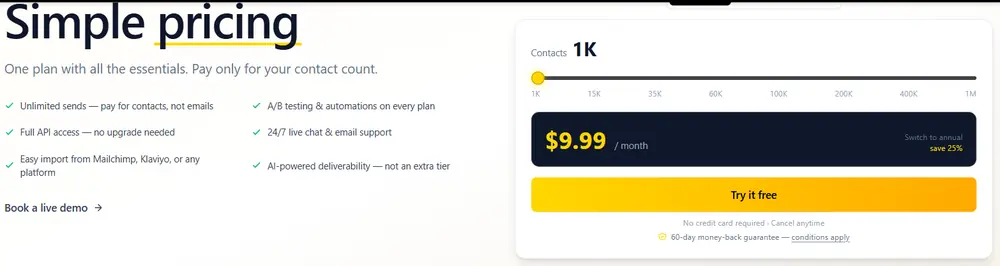
The 25% annual discount is unusually large, most platforms on this site offer 10 to 17%, and it is applied exactly, with every annual price working out at precisely three quarters of the monthly one.
The complete price ladder
Twenty-seven of the thirty-one slider positions, with the annual equivalent and our own cost-per-thousand calculation.
| Contacts | Monthly | Annual, per month | Per 1,000 contacts |
|---|---|---|---|
| 1,000 | $9.99 | $7.49 | $9.99 |
| 2,500 | $19.99 | $14.99 | $8.00 |
| 5,000 | $39.99 | $29.99 | $8.00 |
| 10,000 | $59.99 | $44.99 | $6.00 |
| 15,000 | $79.99 | $59.99 | $5.33 |
| 20,000 | $119.99 | $89.99 | $6.00 |
| 25,000 | $149.99 | $112.49 | $6.00 |
| 30,000 | $179.99 | $134.99 | $6.00 |
| 35,000 | $189.99 | $142.49 | $5.43 |
| 40,000 | $199.99 | $149.99 | $5.00 |
| 45,000 | $209.99 | $157.49 | $4.67 |
| 50,000 | $229.99 | $172.49 | $4.60 |
| 60,000 | $279.99 | $209.99 | $4.67 |
| 70,000 | $299.99 | $224.99 | $4.29 |
| 80,000 | $319.99 | $239.99 | $4.00 |
| 90,000 | $359.99 | $269.99 | $4.00 |
| 100,000 | $399.99 | $299.99 | $4.00 |
| 120,000 | $449.99 | $337.49 | $3.75 |
| 140,000 | $499.99 | $374.99 | $3.57 |
| 160,000 | $549.99 | $412.49 | $3.44 |
| 180,000 | $599.99 | $449.99 | $3.33 |
| 200,000 | $649.99 | $487.49 | $3.25 |
| 300,000 | $899.99 | $674.99 | $3.00 |
| 400,000 | $1,199.99 | $899.99 | $3.00 |
| 500,000 | $1,599.99 | $1,199.99 | $3.20 |
| 800,000 | $2,499.99 | $1,874.99 | $3.12 |
| 1,000,000 | $2,999.99 | $2,249.99 | $3.00 |
The published ladder ends at 1,000,000 contacts. SendX’s FAQ says custom pricing is available “for high-volume senders above 500,000 contacts”, which is slightly at odds with the slider publishing prices at 800,000 and 1,000,000, read it as custom pricing being available from 500,000 rather than required.
The 15,000 anomaly, and the 20,000 cliff
The curve falls from $9.99 per thousand contacts to $3.00, which is a proper volume discount. It does not fall smoothly.
| Contacts | Monthly | Per 1,000 | What is happening |
|---|---|---|---|
| 10,000 | $59.99 | $6.00 | |
| 15,000 | $79.99 | $5.33 | A local low, better than the next three steps |
| 20,000 | $119.99 | $6.00 | +$40 for 5,000 contacts, double the previous step |
| 25,000 | $149.99 | $6.00 | Still worse per contact than 15,000 |
| 30,000 | $179.99 | $6.00 | Still worse than 15,000 |
| 35,000 | $189.99 | $5.43 | Back near the 15,000 rate |
| 40,000 | $199.99 | $5.00 | The curve resumes falling properly |
The step from 15,000 to 20,000 contacts costs $40 a month. Every other 5,000-contact step in that region costs $10 to $30. Crossing 15,000 is the single most expensive threshold on SendX’s ladder, and it lands exactly where a growing list tends to sit. If you are at 14,000 contacts, a list-cleaning exercise that keeps you under 15,000 is worth $480 a year. If you are at 16,000, note that 35,000 costs only $10 a month more than 30,000, the pain is concentrated in a narrow band.
There is a second, smaller inversion at the top: 500,000 contacts works out at $3.20 per thousand against $3.00 at both 300,000 and 400,000. Everything above 500,000 is negotiable anyway, which is probably the point.
What “unlimited emails” actually means here
Several platforms on this site advertise unlimited sending and then attach a ceiling to it. Drip’s unlimited stops at roughly 30,000 subscribers and becomes twelve emails per person. Omnisend reserves it for the Pro tier. SendX’s version is the plainest we have found.
SendX’s own wording: “Every SendX plan comes with unlimited email sends to your opted-in contacts. We only charge you for your contacts. There are no hidden email limits whatsoever.” There is one plan, so there is no tier at which this changes, and we found no send cap at any of the 31 slider positions. The qualifier that does exist is “opted-in contacts”, unlimited sending, to people who asked for it.
That makes SendX unusually well suited to high-frequency sending. A daily newsletter to 15,000 subscribers is 450,000 emails a month for $79.99, which works out at about $0.18 per thousand emails. For comparison, that is cheaper per email than most of the transactional relays covered on this site, though it is not a transactional product and should not be treated as one.
How contacts are counted
SendX’s counting rules are at the generous end of the market, and it publishes them clearly.
| Situation | Billed? |
|---|---|
| Same contact in five segments | Counted once |
| Same contact on several lists | Counted once |
| Contact who unsubscribed | Not counted |
| Contact who marked you as spam | Not counted |
| Active, opted-in contact | Counted, once |
SendX states it counts “unique active contacts (subscribers) only once, regardless of how many segments or lists they’re in” and does “not charge for unsubscribes or contacts that mark you as spam as they are no longer ‘active'”.
That deduplication clause is worth pausing on. EmailOctopus, the cheapest platform on this site, does the opposite: each of its lists is independent and a contact on two lists is billed twice. If your audience naturally splits across several lists, SendX’s rule can close a price gap that looks large on the headline numbers.
The 48-hour grace period
SendX gives you two days, not a billing cycle. Its published answer is that when you exceed your contact limit, “your account continues functioning normally for up to 48 hours to prevent campaign disruption. We’ll notify you immediately to either upgrade your plan or reduce your contact count.” Compare that with Flodesk, which simply upgrades you at the next billing date, or Omnisend, which warns at 90%, 95% and 100% first. SendX’s window is short, and the notification arrives when you have already crossed the line rather than as you approach it.
What happens after the 48 hours is not stated. The two documented options are upgrading or cutting your list, and neither is instant if you are away from your desk. If you run a form or an integration that can add contacts in volume, a lead magnet that goes viral, a Shopify sync, an import, that is a two-day fuse on a change you did not necessarily initiate.
Elevated Support, the only add-on
SendX sells exactly one paid extra, and at $225 a month it costs more than the platform does for anyone under about 45,000 contacts.
| SendX Elevated Support, $225 /month |
|---|
| 3 expert calls a month, product or deliverability, with recordings kept |
| Warm-up strategy, bounce issues, delistings, inbox placement |
| Campaign setup, workflow design, segmentation strategy, team training |
| Proactive campaign monitoring by a human |
| Full support team with shared context on your account |
Available on paid plans only. Whether it is worth it depends entirely on whether you would otherwise hire a deliverability consultant, but note the shape of the offer: it is consultancy sold at a flat rate, not a support-tier upgrade. Three calls a month at $225 is $75 a call with a specialist who already knows your account, which is inexpensive by consultancy standards and expensive next to a $79.99 platform bill.
Free migration exists but is conditional. SendX states there are no setup fees, and that “qualified high-volume senders receive free migration assistance to transfer campaigns, lists, and automations from their previous provider. Everyone else gets access to migration guides and self-service import tools.” It does not define “qualified” or “high-volume”, so treat migration help as something to negotiate rather than something included.
The 60-day money-back guarantee, and its conditions
SendX leads with a 60-day money-back guarantee and then attaches a condition to it, in smaller type, twice on the same page.
The guarantee applies only to accounts with fewer than 100,000 contacts and fewer than 100,000 emails sent during the period. The first condition is generous. The second is not: 100,000 emails is what a 15,000-contact list burns through in seven campaigns, or a 3,000-contact daily newsletter uses in a month. On a platform whose central promise is unlimited sending, the refund window is the one place where sending is very much limited, and the two limits are cumulative, not alternative.
Read plainly, this means the guarantee covers you while you evaluate and stops covering you once you actually use the product at scale. That is a defensible commercial position and it is disclosed on the page, but “60-day money-back guarantee” and “no questions asked” in the headline do not convey it. If a refund matters to your decision, count your first sixty days of sending before you commit.
SendPost, the sibling product with no published price
SendX runs a second product called SendPost, hosted on the same domain at sendx.io/sendpost. It is not a plan inside SendX and it is not sold on the pricing page above. It is a separate deliverability platform and cloud MTA, positioned for companies and ESPs that send at volume, with an AI layer that flags reputation problems before they turn into inbox drops. The page’s own example alert reads: “Soft bounces from Gmail up 340% in the last 6 hours. Recommend throttling Gmail traffic to 50% and verifying SPF alignment on sending domain.”
The connection to SendX is stated openly on the page: SendPost “was built by the team of engineers and deliverability experts at SendX, which processes over 300 million emails/month”. So the same company, the same infrastructure heritage, two different products aimed at two different buyers. SendX at marketers who send campaigns to a contact list, SendPost at teams who need to see and control what mailbox providers are doing to their traffic.
There is no price to report. We read the SendPost page on 24 August 2026 and it publishes no plan, no tier, no per-email rate and no free allowance. It has no pricing page of its own. Every call-to-action on the page, seven of them, points to the same destination: /sendpost/demo. Pricing is quoted after a sales conversation, and the vendor’s own material describes billing as tied to the volume you actually send rather than to a subscriber count.
What that means in practice: you cannot budget for SendPost the way you can budget for SendX. The SendX numbers on this page are published, sliderable and checkable in thirty seconds. SendPost is a quote. If you are comparing the two, you are comparing a known figure against an unknown one, and the honest answer is that we cannot tell you what SendPost costs because SendX does not say.
Practical read. If your need is campaign sending to a list you own, SendX’s published pricing is the relevant number and SendPost is not for you. If your need is transactional or relay volume with deliverability instrumentation, multi-tenant traffic, IP and domain reputation signals, ISP responses. SendPost is the product to ask about, and the first step is a demo, not a checkout. Ask for the rate per thousand and the minimum commitment in that first call, because neither is published anywhere.
Six things that catch people out
- Crossing 15,000 contacts costs $40 a month, double any comparable step nearby, and 15,000 is better value per contact than 20,000, 25,000 or 30,000.
- The grace period is 48 hours, not a billing cycle, and the notification comes after you cross the limit rather than before.
- The refund guarantee caps sending at 100,000 emails, which is a small number on a platform selling unlimited email.
- Elevated Support costs more than the platform for anyone under roughly 45,000 contacts.
- Free migration is for “qualified high-volume senders” only, with neither term defined.
- There is no free tier, only a trial, so unlike EmailOctopus, Flodesk or Omnisend there is no permanent zero-cost option.
Who SendX is priced for
SendX competes on two things: not gating features, and not charging for volume of email. Everything the platform can do is available at $9.99 a month, which removes an entire category of decision, and there is no scenario where sending more email costs more money. For a newsletter operator that combination is close to ideal.
On raw cost per contact it sits in the middle of the market. At 100,000 contacts, $399.99 a month is well above EmailOctopus and well below Klaviyo or Customer.io. Where it wins is when you send often: at four campaigns a month the price difference against a cheaper platform is real, and at daily sending it disappears entirely.
Good fit: daily and high-frequency newsletters, where unlimited sending on every plan is worth more than a low headline price; anyone who wants automations, A/B testing and landing pages without buying a tier to unlock them; lists that sit naturally at or just under 15,000 contacts; teams whose audience spans multiple lists, given the deduplication rule.
Poor fit: large lists mailed rarely, where per-contact pricing dominates and cheaper platforms win; anyone needing a permanent free tier; teams that need a long refund window while genuinely testing at volume; lists sitting between 15,000 and 30,000 contacts, the worst-value band on the ladder.
How to size SendX in four steps
- Count active, deduplicated contacts. Unsubscribes and spam complaints do not count, and a contact on three lists counts once, so your billable number is smaller than your database.
- Check where you sit against 15,000. Just under it is the best value on the ladder; just over it is the most expensive step. This is worth a list-cleaning exercise.
- Take the annual discount if you can. At an exact 25% it is the largest on this site, and it turns $399.99 at 100,000 contacts into $299.99.
- Budget the add-on separately, or not at all. Elevated Support at $225 is a consultancy retainer, not a support upgrade, and most accounts will not need it.
Frequently asked questions
How much does SendX cost?
One plan, priced on contacts, from $9.99 a month for 1,000 contacts to $2,999.99 for 1,000,000. Sample points on monthly billing: $39.99 at 5,000 contacts, $79.99 at 15,000, $229.99 at 50,000, $399.99 at 100,000 and $649.99 at 200,000. Annual billing takes exactly 25% off every one of those. Every plan includes unlimited email sends and every feature; there are no tiers and nothing is gated.
Are SendX’s unlimited emails genuinely unlimited?
As far as we can tell, yes. SendX states that “Every SendX plan comes with unlimited email sends to your opted-in contacts… There are no hidden email limits whatsoever”, and because there is only one plan there is no tier at which this changes. We found no send cap at any of the 31 slider positions. That is a stronger promise than several competitors: Drip’s unlimited stops around 30,000 subscribers and becomes twelve emails per person, and Omnisend reserves unlimited sending for its Pro tier.
Why does 20,000 contacts cost so much more than 15,000?
Because the 15,000 threshold is the steepest step on SendX’s ladder. Going from 10,000 to 15,000 contacts costs $20 more a month; going from 15,000 to 20,000 costs $40. At 15,000 you pay $5.33 per thousand contacts, which is better value than 20,000, 25,000 and 30,000, all of which sit at $6.00. If your list is close to 15,000, staying under it saves $480 a year. If you are past it, note that 35,000 costs only $10 a month more than 30,000, so the expensive band is narrow.
How does SendX count contacts?
Unique active contacts, counted once. SendX states it counts subscribers “only once, regardless of how many segments or lists they’re in”, and does not charge for unsubscribes or for contacts who mark you as spam, because those are no longer active. This is at the generous end of the market and is the opposite of EmailOctopus, where each list is independent and a contact on two lists is billed twice. If your audience spans several lists, that rule closes part of the price gap between the two.
What happens if I go over my contact limit?
You get 48 hours. SendX states that “your account continues functioning normally for up to 48 hours to prevent campaign disruption” and that it will notify you immediately to upgrade or reduce your contact count. What happens after that window is not published. This is a shorter runway than most competitors: Flodesk simply upgrades you at the next billing date, and Omnisend warns at 90%, 95% and 100% of the limit before you cross it. If an integration or a viral signup form can add contacts in bulk, that is a two-day fuse.
Is the annual discount worth taking?
It is the largest on this site. SendX applies exactly 25%, and every annual figure we checked was precisely three quarters of the monthly one: $9.99 becomes $7.49, $79.99 becomes $59.99, $399.99 becomes $299.99. Most platforms covered here offer 8 to 17%. SendX also states you can switch between monthly and annual at any time, with the change taking effect at your next renewal date.
What are the conditions on the 60-day money-back guarantee?
Two, and they are cumulative. The guarantee applies to accounts with fewer than 100,000 contacts and fewer than 100,000 emails sent during the period. The contact condition is generous; the email one is not, since 100,000 emails is roughly seven campaigns to a 15,000-contact list. On a platform whose central promise is unlimited sending, the refund window is the one place where sending is capped. It is disclosed twice on the pricing page, but the headline phrase “no questions asked” does not convey it.
Does SendX have a free plan?
No, only a free trial, which requires no credit card and can be cancelled at any time. That distinguishes it from EmailOctopus, Flodesk and Omnisend, all of which offer a permanent free tier. If a zero-cost option matters, for a dormant project or a very small list. SendX does not have one, and the entry price is $9.99 a month or $7.49 on annual billing.
What does SendX Elevated Support cost and what is in it?
$225 a month, available on paid plans. It buys three expert calls a month on product or deliverability with recordings kept, help with warm-up strategy, bounces, delistings and inbox placement, campaign and workflow setup, segmentation strategy, team training, proactive human monitoring of campaigns, and a support team with shared context on your account. It is a consultancy retainer rather than a support tier, and it costs more than the platform itself for any account under roughly 45,000 contacts.
Does SendX charge setup or migration fees?
No setup fee. Migration is conditional: SendX states that “qualified high-volume senders receive free migration assistance to transfer campaigns, lists, and automations from their previous provider”, while “everyone else gets access to migration guides and self-service import tools”. Neither “qualified” nor “high-volume” is defined, so if migration help matters, treat it as something to negotiate before signing rather than something included.
Is SendPost included in a SendX plan?
No. SendPost is a separate product from the same company, hosted at sendx.io/sendpost, sold separately and priced separately. Nothing on the SendX pricing page covers it, and no SendX plan grants access to it. It publishes no price at all: as of 24 August 2026 the page carries no plans, no per-email rate and no free tier, and every button on it leads to a demo request form. If you want SendPost you contact sales and receive a quote.
Continue reading about SendX
Pricing is one part of the evaluation. For connection details, authentication, deliverability behaviour and integration specifics, see the SMTP settings, API and integrations tabs on this platform. The alternatives tab compares SendX against the other single-plan and unlimited-sending platforms, and against the cheaper per-contact options that beat it on headline price but not on sending frequency.
Sources. All figures were read from sendx.io/pricing on 24 August 2026, in USD, with every slider position read individually rather than interpolated, and the FAQ text taken from the page’s own structured data (marked there as last updated June 2026). Cost-per-thousand figures and the annual column are our own arithmetic from the published monthly prices and the stated 25% discount. Prices change; where a figure here disagrees with the vendor’s page, the vendor’s page is correct and we would be glad to be told.
This review follows our email infrastructure testing methodology. We disclose affiliate relationships in our editorial independence policy.