
How much does Sender cost in 2026?
Sender.net prices on two axes at once. You pick a subscriber tier, and that tier sets both how many contacts you may hold and how many emails you may send in a month. The plan you choose. Standard or Professional, decides which multiplier applies to the second number. Campaigns and transactional email come out of the same allowance, which is unusual and, for most people, simpler.
The short version. Free gives you 2,500 subscribers and 15,000 emails a month with Sender branding. Standard starts at $10/month for 1,000 subscribers and 12,000 emails. Professional doubles the send allowance for roughly double the price. Annual billing saves nothing at all; the only discount on the site is 30% off the first year for first-time users. Figures below are US dollars read from sender.net on 24 August 2026 with the promotion switched off.
A correction to what we published before. An earlier version of this page said Standard and Professional came with unlimited subscribers and a 12x or 24x send multiplier. The multiplier part is still broadly right. The unlimited subscribers part is not: both paid plans are capped by subscriber tier today, and the price moves with that tier. We have rebuilt the page from the live calculator.
How the two numbers work together
Every paid tier is a pair. At 10,000 subscribers, Standard costs $57 a month and allows 120,000 emails; Professional costs $120 and allows 240,000. The subscriber cap is identical on both plans at a given tier. What you are buying when you move from Standard to Professional is not more contacts, it is more sends, plus the feature list.
That makes Sender.net easy to size if you know two things: how many contacts you hold, and how many emails you send a month. Most platforms only make you answer the first. Here the second can be the binding constraint, and it catches people who run heavy automation sequences against a modest list.
The full price ladder
Every figure below was read at its own slider position on monthly billing with the first-year promotion off. The final column is the Standard cost per thousand emails, which is our arithmetic and the number worth watching.
| Subscribers | Standard | Standard emails | Professional | Pro emails | Standard per 1,000 emails |
|---|---|---|---|---|---|
| 1,000 | $10 | 12,000 | $20 | 24,000 | $0.833 |
| 5,000 | $33 | 60,000 | $60 | 120,000 | $0.550 |
| 10,000 | $57 | 120,000 | $120 | 240,000 | $0.475 |
| 20,000 | $107 | 240,000 | $250 | 480,000 | $0.446 |
| 30,000 | $147 | 360,000 | $320 | 720,000 | $0.408 |
| 40,000 | $197 | 480,000 | $380 | 960,000 | $0.410 |
| 50,000 | $227 | 600,000 | $460 | 1.20M | $0.378 |
| 70,000 | $297 | 840,000 | $620 | 1.68M | $0.354 |
| 100,000 | $367 | 1.20M | $860 | 2.40M | $0.306 |
| 115,000 | $457 | 1.50M | $980 | 2.76M | $0.305 |
| 130,000 | $497 | 1.80M | $1,100 | 3.12M | $0.276 |
| 145,000 | $497 | 1.80M | $1,220 | 3.48M | $0.276 |
| 160,000 | $597 | 2.10M | $1,340 | 3.84M | $0.284 |
| 200,000 | $697 | 2.40M | $1,660 | 4.80M | $0.290 |
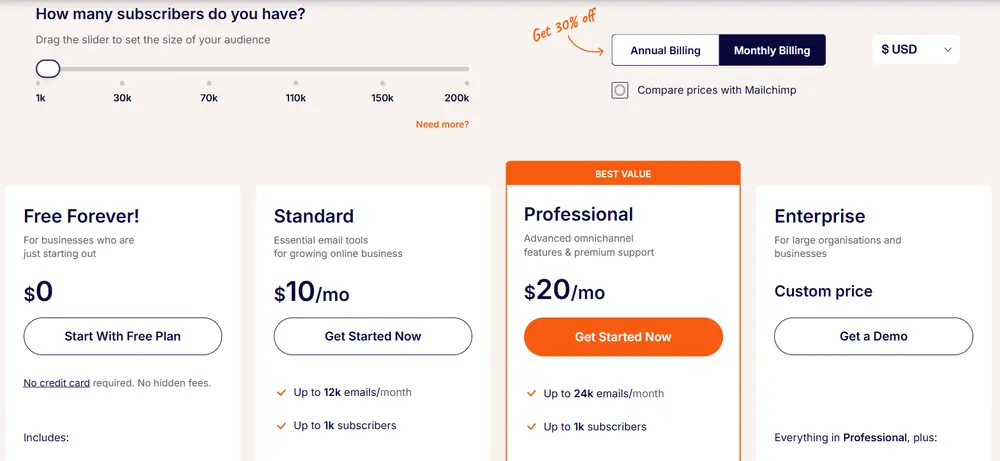
Above 200,000 subscribers the calculator stops and points at a high-volume plan quoted by sales. Enterprise is a custom price at any size and adds unlimited emails, SSO, an SLA, audit logs and phone support.
Annual billing saves you nothing
This is the finding that surprised us most, and it is easy to verify. At 1,000 subscribers, Standard on monthly billing is $10 a month. Switch the toggle to annual and the page quotes $120 for the first year. Twelve months at $10 is $120. The annual commitment buys no discount whatsoever.
What the annual tab actually shows by default is $84, struck through against the $120, described as $7 a month. That $84 is the 30% off that the page states plainly is “valid for first-time users”. It is a new-customer, first-year discount, not an annual-billing discount, and it does not repeat.
What to do with that. If you are a new customer, take the 30% and take it on the annual plan, because that is where it is offered, $84 instead of $120 in year one. But understand that you are locking twelve months to save on year one only, and that from year two the annual and monthly prices are the same number. If you value the flexibility to leave, monthly billing costs you nothing extra. That is genuinely rare and it is a point in Sender.net’s favour, not against it.
Professional gets worse per email the bigger you get
At 1,000 subscribers Professional is exactly twice the price of Standard for exactly twice the emails. The cost per email is identical on both plans: $0.833 per thousand. You are paying purely for features.
That symmetry does not hold. By 20,000 subscribers, Professional costs 2.34 times Standard for the same doubling of sends. By 200,000 it costs 2.38 times. The send allowance always exactly doubles; the price does not.
| Subscribers | Standard per 1,000 emails | Professional per 1,000 emails | Pro premium |
|---|---|---|---|
| 1,000 | $0.833 | $0.833 | none |
| 10,000 | $0.475 | $0.500 | +5% |
| 20,000 | $0.446 | $0.521 | +17% |
| 100,000 | $0.306 | $0.358 | +17% |
| 200,000 | $0.290 | $0.346 | +19% |
None of that is scandalous, higher plans carry more support and more features, and someone has to pay for them. But it does mean Professional should be bought for what is on its feature list, never as a way to get cheaper sending. It never is.
If you need more sends, buy more subscribers
Here is the practical consequence, and it is worth real money. Suppose you hold 10,000 contacts and you need 240,000 emails a month, which is twice what Standard allows at your tier. The obvious move is Professional at 10,000 subscribers: $120 a month for exactly 240,000 emails.
The cheaper move is Standard at the 20,000-subscriber tier: $107 a month, also 240,000 emails, and 10,000 subscribers of headroom you did not have before.
You save $13 a month and double your contact ceiling. The only thing you give up is the Professional feature list, the extra seats, advanced automation, priority support, and access to dedicated IPs. If none of those matter to you, buying a larger Standard tier is the better instrument for buying send volume. Check this at your own numbers before upgrading plan; the arithmetic favours the sideways move more often than not.
The 130,000 to 145,000 plateau
Standard costs $497 a month with a 1.80M email allowance at 130,000 subscribers. It costs $497 a month with a 1.80M email allowance at 145,000 subscribers too. Fifteen thousand subscribers of capacity, free, if you happen to land on the right side of it.
Professional does not do this, it moves from $1,100 to $1,220 across the same range. The plateau is a Standard-only quirk, and it is the single best value point on the whole ladder: $0.276 per thousand emails, the cheapest rate Sender.net publishes.
Above it the rate gets worse, not better: $0.284 at 160,000 and $0.290 at 200,000. Together with a smaller wobble between 30,000 and 40,000 subscribers, where the rate ticks up from $0.408 to $0.410, this means the curve is not monotonic and the largest plan is not the best value per email. The sweet spot sits at 130,000 to 145,000 subscribers.
One meter for campaigns and transactional email
Sender.net does not sell transactional email as a separate product. There is no second pricing page, no separate free allowance and no separate quota. Transactional email appears as a feature on every plan including Free, delivered over SMTP or a REST API, with domain authentication and delivery logs.
In practice that means your password resets, one-time passcodes and order confirmations draw down the same monthly email allowance as your newsletters. On Free that is 15,000 emails a month covering everything. On Standard at 10,000 subscribers it is 120,000 a month covering everything.
Why this is worth noticing. Several competitors split these into two products with two meters, two free tiers and two invoices, and the split is the single most common source of unexpected bills on those platforms. Sender.net’s single allowance is easier to budget and easier to reason about. The trade is that a spike in transactional volume eats into your campaign headroom, so if your product sends a lot of triggered mail, size the plan on total volume rather than on newsletter volume.
Dedicated IPs start at 20,000 subscribers
Dedicated IPs are listed as available on Professional, with a footnote that narrows it considerably: “On 20 000 subscriber plans and above”. Professional at 20,000 subscribers costs $250 a month, and that is the entry price for a dedicated IP on this platform.
If a dedicated IP is a hard requirement for you, because a partner demands it, or because you are warming a reputation you control, then the whole ladder below $250 a month is irrelevant and you should price this against dedicated-IP options elsewhere rather than against Sender.net’s cheaper tiers.
Pay As You Go, and why it is expensive
There is a credit plan for people who send rarely: $29 for 5,000 emails, which the page itself reduces to $5.80 per 1,000 emails, with no recurring fee and no subscriber limit.
Set that against the subscription rates in the table above. Standard’s worst rate, at the smallest tier, is $0.833 per thousand. Its best is $0.276. Pay As You Go is therefore roughly 7 times the cost of the cheapest subscription tier and 21 times the cost of the best one, per email.
When it still makes sense. Only when your sending is genuinely occasional. If you mail 3,000 people twice a year, credits at $29 for 5,000 emails cost less than twelve months of any subscription, and you keep unlimited subscribers. The moment you send monthly, the subscription wins by a wide margin. Treat Pay As You Go as insurance against irregularity, not as a cheaper way to send.
The page prices only the 5,000-email bundle. Larger credit volumes are not published, so if you need them, ask before assuming the per-thousand rate improves.
What the free plan actually gives you
Free allows 2,500 subscribers and 15,000 emails a month, with one seat and Sender branding in the footer. What is notable is what is not withheld: email automation, landing pages, signup forms and popups, and transactional email are all on the free tier.
Fifteen thousand emails against 2,500 subscribers is six full sends to your whole list per month, or fewer sends plus a working automation sequence. That is a real free tier rather than a trial, and for a business under 2,500 contacts that does not mind the branding, it is a plausible permanent home.
The step off it is gentle. Standard at 1,000 subscribers is $10 a month, but if you are already at 2,500 on Free you will be pricing the 5,000-subscriber tier at $33 a month, since there is no 2,500 step on the paid ladder. That is the real cost of leaving Free, and it is worth knowing before you outgrow it.
SMS is separate, and country-priced
SMS is not included in the email allowance. Standard requires buying SMS credits; Professional includes a monthly SMS allowance. Rates depend on destination country, the calculator quotes $0.40 per message to France, for example, so anyone planning serious SMS volume needs to price their own destinations rather than assume a flat rate.
Six things that catch people out
1. Paid plans are not unlimited-subscriber. Both Standard and Professional are capped by tier, and the price moves with the tier. Older write-ups of this platform, ours included, described unlimited subscribers on paid plans. That is not the model today.
2. The email cap can bind before the subscriber cap. A 5,000-contact list on Standard gets 60,000 emails a month. Run three automation sequences plus a weekly newsletter and you will meet that ceiling with room to spare on contacts.
3. Annual billing carries no discount. $120 a year at 1,000 subscribers is exactly twelve months of $10. Only the first-year new-user 30% is a real saving.
4. Professional is never cheaper per email. Equal at the smallest tier, up to 19% worse at the largest. Buy it for features.
5. 145,000 subscribers costs the same as 130,000 on Standard. Same price, same allowance. Above it the per-email rate gets worse, not better.
6. Dedicated IPs need a 20,000-subscriber Professional plan. That is $250 a month, not the $20 the Professional headline suggests.
Who Sender.net is priced for
It is priced well for small senders who want a free tier with automation rather than a crippled trial; businesses that want campaigns and transactional email on one meter and one invoice; anyone who wants to avoid an annual lock-in, since monthly costs no more; and lists in the 100,000 to 145,000 range, where the per-email rate is the best on the ladder.
It is priced badly for anyone who sends a very high email-to-contact ratio, because the send cap is tied to a subscriber tier they do not need; anyone who needs a dedicated IP on a small list, since that requires the 20,000-subscriber Professional plan; and occasional senders tempted by Pay As You Go, which is several times the subscription rate per email.
A note on the entry tier. $10 a month for 1,000 subscribers works out at $10 per thousand contacts, against $3.49 at 200,000. That is a steep entry premium, though a normal one. Combined with the fact that Free covers 2,500 subscribers, there is little reason to buy the 1,000-subscriber tier unless you specifically need the branding removed or the extra seats.
How to size Sender.net in four steps
- Count both numbers. Your contact count and your total monthly email volume, campaigns and transactional together. The tier you need is whichever of the two demands more.
- Check whether Free covers you. Under 2,500 contacts and under 15,000 emails a month, and comfortable with the footer branding, the answer is yes and it stays yes.
- Before upgrading to Professional, price the next Standard tier up. If you only need more sends, a larger Standard tier often costs less and gives you contact headroom as well. Only buy Professional for its feature list, dedicated IPs included.
- Take the 30% if you are new, then bill monthly afterwards. The discount lives on the annual plan in year one. From year two annual and monthly cost the same, so there is no reason to keep the commitment unless you want it.
Frequently asked questions
How much does Sender.net cost?
Standard starts at $10 a month for 1,000 subscribers and 12,000 emails, and Professional at $20 a month for the same 1,000 subscribers with 24,000 emails. Prices rise with the subscriber tier: $57 and $120 at 10,000 subscribers, $367 and $860 at 100,000. A free plan covers 2,500 subscribers and 15,000 emails a month. First-time users get 30% off the first year. All figures are US dollars read from sender.net on 24 August 2026.
Does Sender.net have unlimited subscribers on paid plans?
No, not today. Both Standard and Professional are capped by subscriber tier, and the monthly price moves with that tier. Only the Pay As You Go credit plan carries unlimited subscribers, and it charges $5.80 per 1,000 emails, which is far more expensive per email than any subscription. Older descriptions of this platform, including an earlier version of this page, described unlimited subscribers on paid plans; that is not how the calculator prices today.
Is annual billing cheaper on Sender.net?
No. At 1,000 subscribers the annual plan is billed at $120 for the year, which is exactly twelve months of the $10 monthly price. The only genuine discount on the site is 30% off the first year for first-time users, which is offered on the annual plan and brings that first year to $84. From the second year onward, annual and monthly cost the same, so monthly billing costs nothing extra in flexibility terms.
What is the difference between Standard and Professional?
The subscriber cap is identical at any given tier. Professional doubles the monthly email allowance and adds ten role-based seats instead of three, advanced automation, advanced reports, priority support, an SMS allowance, unlimited email editor features, and access to dedicated IPs. On price it is exactly double Standard at the smallest tier and up to about 2.4 times at the largest, so its cost per email is equal at the bottom of the ladder and gets progressively worse further up.
Does Sender.net charge separately for transactional emails?
No. Transactional email is a plan feature rather than a separate product, listed even on the free plan, and it draws down the same monthly email allowance as your campaigns. There is no separate transactional pricing page and no separate free tier for it. Sending is over SMTP or a REST API with domain authentication and delivery logs. The practical consequence is that heavy triggered sending eats into your campaign headroom, so size your plan on total volume.
How do I get a dedicated IP with Sender.net?
Dedicated IPs are available on Professional, but the site adds a condition: on 20,000 subscriber plans and above. Professional at 20,000 subscribers costs $250 a month, so that is the effective entry price for a dedicated IP. No plan below that tier offers one, regardless of how much you send.
Is Pay As You Go cheaper than a Sender.net subscription?
Only if you send very rarely. Pay As You Go is $29 for 5,000 emails, which the site states as $5.80 per 1,000. The cheapest subscription rate is $0.276 per 1,000 emails and the most expensive is $0.833, so credits cost roughly 7 to 21 times as much per email. Credits make sense for a business that mails a couple of times a year and wants no recurring fee and no subscriber limit; for anything sent monthly, a subscription is dramatically cheaper.
Why does 145,000 subscribers cost the same as 130,000?
On the Standard plan both tiers are priced at $497 a month with the same 1.80M monthly email allowance, so the extra 15,000 subscribers are effectively free. Professional does not behave this way and rises from $1,100 to $1,220 across the same range. That plateau is the best value point on the Standard ladder at $0.276 per thousand emails, and the rate gets worse above it, reaching $0.290 at 200,000 subscribers.
What does the Sender.net free plan include?
Up to 2,500 subscribers and 15,000 emails a month, one seat, and Sender branding in the email footer. Unusually for a free tier it includes email automation, landing pages, signup forms and popups, and transactional email. It is a permanent plan rather than a trial, and no credit card is required. The step off it is to the 5,000-subscriber Standard tier at $33 a month, since the paid ladder has no 2,500 step.
Should I upgrade to Professional or move up a Standard tier?
If all you need is more sending capacity, check the next Standard tier first. At 10,000 subscribers, Professional costs $120 a month for 240,000 emails, while Standard at the 20,000-subscriber tier costs $107 for the same 240,000 emails and doubles your contact ceiling as well. Professional is worth buying for its feature list, the extra seats, advanced automation, priority support and dedicated IP access, but it is never the cheaper route to volume.
Continue reading about Sender.net
Pricing is one part of the evaluation. For connection details, ports and authentication for the SMTP relay described above, see the SMTP settings tab. The API tab covers the sending endpoints, and the integrations tab covers what connects to what. The alternatives tab compares Sender.net against the other platforms that combine campaigns and transactional email on a single meter.
Sources. All figures were read from sender.net on 24 August 2026, in US dollars selected from the site’s own currency switcher, on monthly billing with the first-year promotion switched off, and with every slider position read individually rather than interpolated. Cost-per-thousand rates, the Professional premium column and the twelve-month comparisons are our own arithmetic from the published prices. Prices change; where a figure here disagrees with the vendor’s page, the vendor’s page is correct and we would be glad to be told.
This review follows our email infrastructure testing methodology. We disclose affiliate relationships in our editorial independence policy.