
How much does Kit cost in 2026?
Kit prices one thing and one thing only: how many subscribers you hold. There is no email allowance, no send multiplier, no overage and no credit system. The company states it plainly in its own FAQ, “There are no sending limits on any of our plans at Kit”, and everything else about the pricing follows from that one decision.
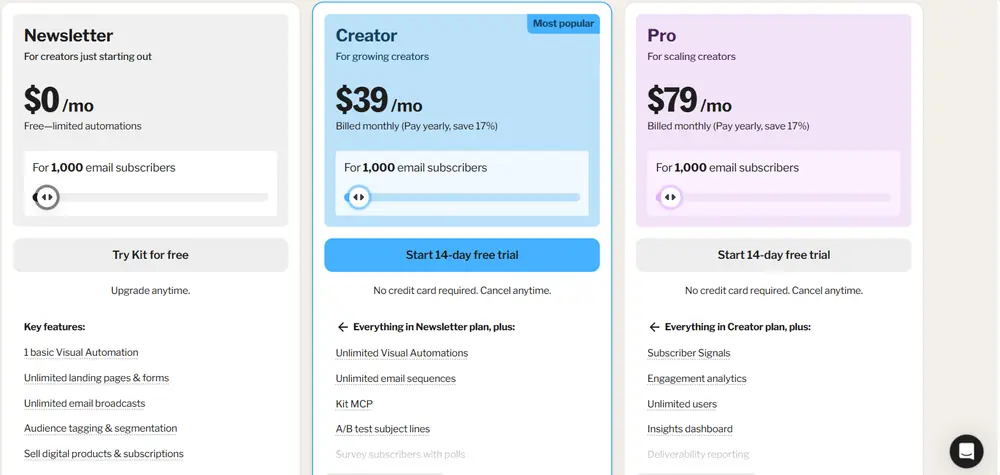
The short version. The free Newsletter plan carries up to 10,000 subscribers with unlimited sending, which is the most generous free tier in this category by a wide margin. Creator starts at $39/month for 1,000 subscribers, Pro at $79. Annual billing takes off about 17%, which is two months free. Figures below are US dollars read from kit.com on 24 August 2026, at every one of the 44 slider positions.
Two corrections to what we published before. Our earlier page quoted Creator at $29/month and Creator Pro at $59/month. The plans are now called Creator and Pro and cost $39 and $79 on monthly billing, $33 and $66 on annual. The free tier is still 10,000 subscribers, but it is now explicitly limited to one basic automation, and it carries a condition we had not documented. See the free-plan section below.
One axis, and what that buys you
Most platforms in this category meter two things: the size of your list and the volume you send. Kit meters only the first. A 5,000-subscriber account on Creator costs $89 a month whether you mail once a quarter or every single day.
That is worth real money to a specific kind of sender. A daily newsletter to 10,000 people is 300,000 emails a month, which on a volume-metered platform is a serious line item and on Kit is $139. The same account mailing monthly pays exactly the same $139, which is the flip side: infrequent senders subsidise frequent ones, and if you mail rarely you are paying for headroom you never touch.
The immediate consequence. Do not compare Kit’s monthly price against a competitor’s monthly price without checking what the competitor’s send allowance is at that tier. Kit looks expensive per contact next to platforms that cap your sending, and cheap next to them once you send more than a few times a month. The comparison is only honest at your own real frequency.
The full price ladder
Read at every slider position on monthly billing. The last column is our arithmetic.
| Subscribers | Creator | Pro | Creator per 1,000 contacts | Pro premium |
|---|---|---|---|---|
| 1,000 | $39 | $79 | $39.00 | +$40 |
| 3,000 | $59 | $99 | $19.67 | +$40 |
| 5,000 | $89 | $139 | $17.80 | +$50 |
| 8,000 | $119 | $169 | $14.88 | +$50 |
| 10,000 | $139 | $189 | $13.90 | +$50 |
| 15,000 | $169 | $249 | $11.27 | +$80 |
| 20,000 | $189 | $269 | $9.45 | +$80 |
| 25,000 | $199 | $279 | $7.96 | +$80 |
| 35,000 | $259 | $363 | $7.40 | +$104 |
| 45,000 | $319 | $447 | $7.09 | +$128 |
| 55,000 | $379 | $519 | $6.89 | +$140 |
| 75,000 | $499 | $663 | $6.65 | +$164 |
| 105,000 | $679 | $879 | $6.47 | +$200 |
| 195,000 | $1,219 | $1,419 | $6.25 | +$200 |
| 205,000 | $1,279 | $1,579 | $6.24 | +$300 |
| 400,000 | $2,299 | $2,599 | $5.75 | +$300 |
| 500,000+ | quote | quote | – | – |
The ladder has 44 stops in total; the table samples the shape. Between 45,000 and 400,000 subscribers the steps are perfectly regular, which is the subject of the next section.
Above 45,000 subscribers, every 10,000 costs exactly $60
From the 45,000-subscriber tier upward, the Creator plan moves in perfectly flat steps: $319, $379, $439, $499, $559, $619, $679 and onward, adding $60 for every additional 10,000 subscribers without deviation, all the way to 400,000. On annual billing the same step is exactly $50.
That means Kit’s marginal price is a flat $6 per thousand subscribers per month ($5 on annual), and it never improves. The average rate in the table keeps falling, $7.09 at 45,000, $6.47 at 105,000, $5.75 at 400,000, but only because the cheap early tiers are being averaged in. The next thousand subscribers always costs the same $6.
Why this is useful. You can forecast Kit exactly. Take your current tier price and add $6 a month for every thousand subscribers you expect to add. There is no volume break to wait for and no cliff to plan around. Very few platforms in this category are this predictable, and it is a genuine point in Kit’s favour when you are budgeting a year ahead.
The cheap stretch between 15,000 and 25,000
The early ladder is not regular, and there is one stretch worth knowing about. Creator costs $169 at 15,000 subscribers, $189 at 20,000, and $199 at 25,000. That last step buys 5,000 subscribers for $10, a rate of $2 per thousand against the $6 that applies everywhere above 45,000.
Then it snaps back: 25,000 to 35,000 costs $60, the standard rate. So the 25,000-subscriber tier is a local sweet spot, and if you are sitting at 20,000 or 21,000 you are paying nearly as much as someone with 25,000.
The same shape appears on Pro, where 15,000 to 25,000 moves only from $249 to $279.
The Pro premium jumps at 205,000 subscribers
Pro’s surcharge over Creator is not a percentage, it is a fixed dollar amount that steps up as you grow: $40 at the smallest tiers, $80 from 15,000, $200 from around 105,000. It holds at $200 all the way to 195,000 subscribers.
At 205,000 it becomes $300, and stays there. Creator moves $1,219 to $1,279, its usual $60 step. Pro moves $1,419 to $1,579, a $160 step.
What that costs you. Crossing 200,000 subscribers on Pro adds $100 a month over and above the normal growth step, or $1,200 a year, for no stated change in what the plan does. If you are approaching that line on Pro, it is worth asking sales whether the jump is negotiable, and worth checking whether Creator plus whatever you actually use Pro for comes out cheaper.
Annual billing is two months free
The toggle advertises 17% and delivers it consistently: $39 becomes $33, $139 becomes $116, $679 becomes $566, $2,299 becomes $1,916. Each of those is within a rounding cent of a 16.67% reduction, which is the same thing as paying for ten months and getting twelve.
It applies at every tier and on both paid plans, with no first-year condition and no new-customer restriction. Unlike several competitors we have priced recently, this is a real recurring discount rather than an introductory offer dressed up as one.
| Subscribers | Creator monthly | Creator annual (per month) | Pro monthly | Pro annual (per month) |
|---|---|---|---|---|
| 1,000 | $39 | $33 | $79 | $66 |
| 10,000 | $139 | $116 | $189 | $158 |
| 25,000 | $199 | $166 | $279 | $233 |
| 105,000 | $679 | $566 | $879 | $733 |
| 205,000 | $1,279 | $1,066 | $1,579 | $1,316 |
| 400,000 | $2,299 | $1,916 | $2,599 | $2,166 |
The free plan, and the condition attached to it
Kit’s Newsletter plan is free for up to 10,000 subscribers with unlimited sending, unlimited landing pages and forms, unlimited broadcasts, audience tagging and segmentation, and the ability to sell digital products and subscriptions. On volume alone it is the most generous free tier we have priced in this category, by a factor of several.
Two things narrow it. The first is stated on the card: one basic Visual Automation. Everything else about automation, sequences, multiple flows, anything conditional, requires Creator. For a newsletter that is fine. For anything with a welcome sequence and a launch funnel it is not.
The second is easy to miss. In Kit’s own plan comparison table, the row for Free Recommendations, the network that promotes other creators’ newsletters through your signup flow, is marked “Required” in the Newsletter column, while Creator and Pro simply get a checkmark. Participation in the recommendation network is a condition of the free plan, not an option on it. That is the price of those 10,000 free subscribers: your signup flow promotes other people’s newsletters, and you cannot turn it off without paying.
Whether that matters depends entirely on your business. For a hobby newsletter it costs nothing that you value. For a creator whose signup page is a carefully built conversion asset, or anyone in a competitive niche where the network might recommend a direct rival, it is a real consideration and it deserves to be weighed before “free” is treated as free.
How Kit counts subscribers, and it counts them kindly
The plan comparison table defines the metered number precisely: “Subscribers are only counted if they are unique and active.”
Both halves matter. Unique means the same address appearing on several forms or tags is billed once, not several times, which is not true everywhere; we have priced platforms that bill a duplicate across two lists twice. Active means people who have unsubscribed stop counting, rather than sitting on your bill as dead weight until you manually purge them, which again is not true everywhere.
This is one of the cleaner billing definitions in the category. Combined with unlimited sending, it means the only number that can push your Kit bill up is the number of real, live, distinct people who want your email. That is the number you actually want to be paying for.
Upgrades are automatic. Downgrades require an email.
This is the asymmetry to watch, and Kit documents both halves openly.
When you exceed your tier, Kit says it “will never interrupt your growing business” and will automatically upgrade you to the next subscriber tier. Nothing stops, nothing bounces, and the bill goes up on its own.
When you go the other way, the FAQ is equally direct: “At this time, our team has to manually downgrade plans. If you plan to delete subscribers, please email help@kit.com so we can adjust your subscription.”
What this means in practice. Growth costs you money automatically; list hygiene saves you money only if you remember to ask. Someone who runs a re-engagement campaign, cuts 12,000 dead subscribers and assumes the bill will follow will keep paying the higher tier indefinitely. Put a reminder in the calendar: any time you prune the list meaningfully, email support the same day. On a large account this asymmetry is worth hundreds of dollars a month.
There is no transactional email here at all
Kit’s pricing page does not mention transactional email, SMTP relay or an equivalent anywhere, we searched it. Kit is a marketing platform for creators: broadcasts, sequences, automations, landing pages, forms, commerce. It is not a sending service for password resets, receipts or one-time passcodes.
If you need both, you need two vendors, and Kit’s price should be compared only against the marketing half of whatever alternative you are considering. Platforms that bundle both under one account, on one meter or two, are solving a different problem, and if that problem is yours then Kit is not on the shortlist regardless of what its ladder looks like.
Trial, refund and migration terms
The Creator and Pro trials run 14 days with no credit card, and if you do nothing at the end you drop to the free Newsletter plan rather than losing the account. That is a materially friendlier default than a trial that expires into a lockout.
The refund policy covers 30 days from signup on either monthly or annual billing, which is unusual: annual plans elsewhere frequently carry no refund at all. Kit also advertises free migrations, with an in-house team rebuilding forms, templates and automations from your previous platform.
Six things that catch people out
1. The free plan requires you to promote other creators. Free Recommendations is marked Required on Newsletter and optional on the paid plans.
2. The free plan allows exactly one basic automation. Unlimited sending, one flow. Any real sequence means Creator.
3. Downgrades are manual. Prune your list and email help@kit.com the same day, or you keep paying for subscribers you deleted.
4. Upgrades are automatic. Crossing a tier raises your bill without asking. Not hidden, but not opt-in either.
5. The Pro premium jumps $100 at 205,000 subscribers. $200 a month becomes $300 a month with no stated change in the plan.
6. There is no transactional sending. Wrong tool entirely if that is what you came for.
Who Kit is priced for
It is priced well for anyone who mails often. Daily and multi-weekly newsletters are the case Kit is built around, and unlimited sending on every tier including free makes it dramatically cheaper than volume-metered competitors at high frequency. It is also priced well for anyone under 10,000 subscribers who can live with one automation and the recommendation requirement, because that is a real business running at zero.
It is priced badly for infrequent senders with large lists, who pay for capacity they never use, a 100,000-contact list mailed quarterly costs $679 a month on Creator and would cost a fraction of that on a volume-metered platform. It is also poor value for anyone who needs transactional email, since that means a second vendor, and for accounts just above 200,000 on Pro, who pay the premium jump.
The 1,000-subscriber tier deserves a note. At $39 a month for 1,000 contacts, Creator costs $39 per thousand, nearly seven times the $5.75 rate at 400,000. But since the free plan carries 10,000 subscribers, almost nobody should be buying the 1,000-subscriber tier for capacity. You buy it for automations, for removing Kit branding, or to escape the recommendation requirement, never for the list size.
How to size Kit in four steps
- Count only unique, active subscribers. That is the billed number. Unsubscribes and duplicates do not count, so use a clean figure rather than a raw import total.
- Ask whether the free plan genuinely covers you. Under 10,000 subscribers, one automation, and comfortable promoting other creators? Then Kit costs nothing, permanently.
- Decide between Creator and Pro on features, then check the tier. Pro’s surcharge is a fixed dollar amount, not a percentage, so it hurts most at small tiers and least at large ones, and it jumps $100 above 200,000 subscribers.
- Take annual if you are staying. A flat 17% at every tier with no first-year catch, and a 30-day refund window that covers annual plans too, so the commitment carries less risk than most.
Frequently asked questions
How much does Kit cost?
The Newsletter plan is free for up to 10,000 subscribers. Creator starts at $39 a month for 1,000 subscribers and Pro at $79, both on monthly billing; annual billing brings those to $33 and $66. Prices rise with subscriber count only: $139 and $189 at 10,000, $679 and $879 at 105,000, $2,299 and $2,599 at 400,000. Above 500,000 subscribers Kit quotes a custom plan. All figures are US dollars read from kit.com on 24 August 2026.
Does Kit limit how many emails you can send?
No. Kit’s own FAQ states there are no sending limits on any plan, including the free Newsletter plan. Pricing is based entirely on the number of subscribers you hold, so a daily newsletter and a quarterly one cost exactly the same at the same list size. That makes Kit unusually cheap for high-frequency senders and comparatively poor value for anyone with a large list who mails rarely.
Is the Kit free plan really free for 10,000 subscribers?
Yes, with two conditions. The plan allows one basic Visual Automation, so anything involving sequences or multiple flows requires the Creator plan. More significantly, Kit’s own plan comparison marks Free Recommendations as “Required” on the Newsletter plan while it is optional on the paid plans, which means participating in the network that promotes other creators’ newsletters is a condition of the free tier rather than a choice. Within those limits, sending is unlimited and the plan is permanent rather than a trial.
How does Kit count subscribers for billing?
Kit’s plan comparison states that subscribers are only counted if they are unique and active. Someone who appears on several forms or carries several tags is billed once, and people who have unsubscribed stop counting rather than remaining on the bill. This is a more favourable definition than several competitors use, where duplicates across lists are billed twice or unsubscribed contacts stay billable until manually deleted.
What happens if I go over my Kit subscriber limit?
Kit automatically upgrades you to the next subscriber tier and nothing is interrupted; the company states it will never stop a growing account. Your bill rises on its own without a confirmation step. The reverse is not automatic: if you clean your list and drop below your tier, Kit’s FAQ says the team has to downgrade plans manually and asks you to email help@kit.com. Cleaning your list does not reduce your bill until you ask.
How much does Kit annual billing save?
About 17%, which works out as two months free. It is consistent at every tier and on both paid plans: $39 becomes $33, $139 becomes $116, $679 becomes $566, $2,299 becomes $1,916. Unlike several competitors, this is a permanent recurring discount rather than a first-year introductory offer, and Kit’s 30-day refund policy covers annual plans as well as monthly ones.
What is the difference between Kit Creator and Pro?
Creator adds unlimited automations and sequences, A/B testing on subject lines, polls, SMS marketing, RSS campaigns, integrations, removal of Kit branding and 24/7 support. Pro adds Subscriber Signals, engagement scoring and analytics, an insights dashboard, deliverability reporting, unlimited users, collaborative editing, A/B testing on content as well as subject lines, Facebook custom audiences, a referral system, the ability to edit links in already-sent broadcasts, and priority support. On price, Pro’s surcharge is a fixed amount rather than a percentage: $40 a month at the smallest tiers, $80 from 15,000 subscribers, $200 from around 105,000, and $300 above 205,000.
Does Kit support transactional email or SMTP?
No. Kit’s pricing page makes no mention of transactional email, SMTP relay or an equivalent service anywhere. Kit is a marketing platform for creators covering broadcasts, sequences, automations, landing pages, forms and commerce. Password resets, receipts, order confirmations and one-time passcodes need a separate provider, so anyone needing both should budget for two vendors and compare Kit only against the marketing half of any alternative.
How much does each additional subscriber cost on Kit?
Above the 45,000-subscriber tier, exactly $60 a month for every additional 10,000 subscribers on Creator, or $50 on annual billing. That step is perfectly consistent all the way to 400,000, so the marginal rate is a flat $6 per thousand subscribers per month and it never improves with volume. The average rate in a price table keeps falling as you grow, but only because the cheaper early tiers are being averaged in.
Is there a cheaper point on the Kit price ladder?
Yes, between 15,000 and 25,000 subscribers. Creator costs $169 at 15,000, $189 at 20,000 and $199 at 25,000, so the last step buys 5,000 subscribers for $10, a rate of $2 per thousand against the $6 that applies above 45,000. The 25,000 tier is a local sweet spot, and an account sitting at 20,000 is paying nearly as much as one with 25,000. Above 25,000 the ladder returns to its standard $60 per 10,000 step.
Continue reading about Kit
Pricing is one part of the evaluation. For the sending mechanics, authentication and integration specifics, see the SMTP settings, API and integrations tabs on this platform. The alternatives tab compares Kit against the other creator-focused platforms and against the volume-metered options that price the same list very differently.
Sources. All figures were read from kit.com on 24 August 2026, in US dollars, at every one of the 44 positions on the subscriber slider and on both billing periods, with the plan comparison table and pricing FAQ read in full. Per-thousand rates, the Pro premium column, the marginal-step arithmetic and the twelve-month comparisons are our own calculations from the published prices. Prices change; where a figure here disagrees with the vendor’s page, the vendor’s page is correct and we would be glad to be told.
This review follows our email infrastructure testing methodology. We disclose affiliate relationships in our editorial independence policy.
