
How much does Drip cost in 2026?
Drip sells one plan. There are no tiers to compare, no feature matrix to decode, and the whole price list is a single slider. That simplicity is real and it is the main reason to like Drip’s pricing. What the slider does not tell you is that “unlimited email sends” quietly stops being true partway up the curve, that the cost per contact goes up before it goes down, and that unsubscribing someone does not stop you paying for them. This page covers all three.
Every figure below was read from drip.com/pricing and Drip’s own help centre on 21 August 2026, in USD. Each price point was read individually from the live slider.
Drip pricing at a glance
| What Drip does | |
|---|---|
| Plans | One, for everybody |
| Priced on | Active people, plus email volume above about 30,000 people |
| Entry price | $39 /month for 1-2,500 people |
| Top self-serve price | $1,849 /month for 165,000 people |
| Above that | Custom quote |
| Free tier | None, 14-day trial only |
| Card required to trial | No |
| Billing model | High watermark, billed in arrears |
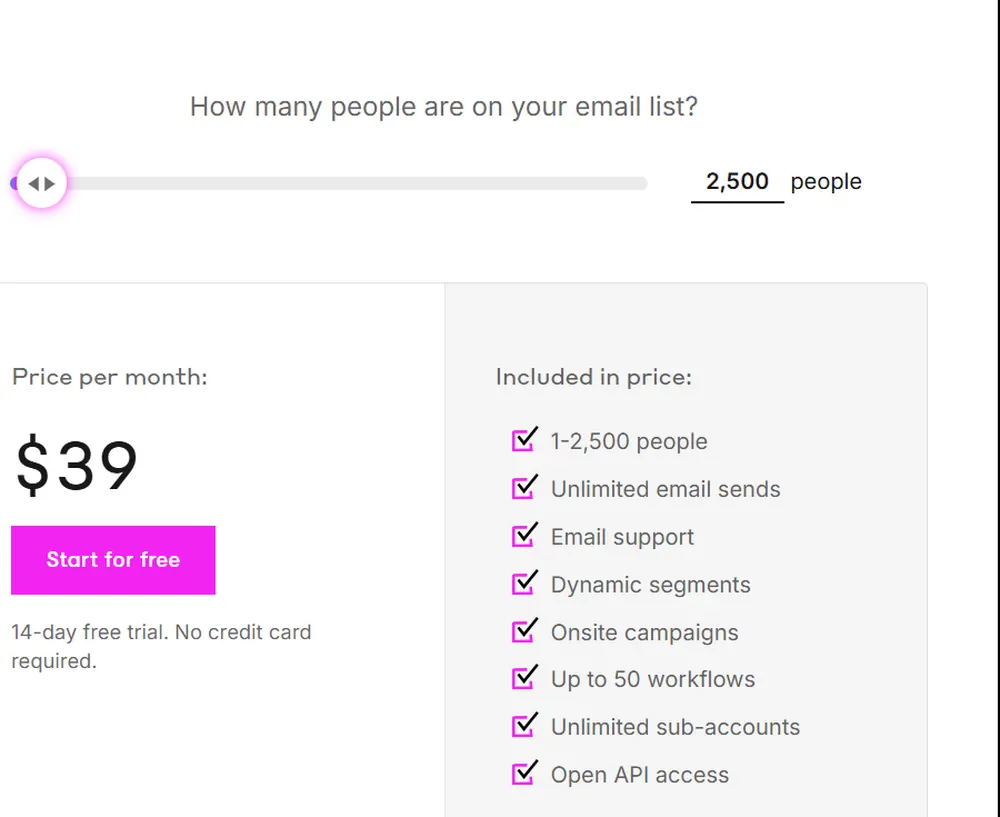
There is no annual discount, no separate marketing and transactional product, and no plan name to choose. You move a slider and that is your price. Among the platforms on this site, only Drip is this simple on the surface.
The complete price curve
Twenty-seven points from the live slider. The email send column is what Drip states is included at that tier, and the last column is our own arithmetic.
| Active people | Price /month | Email sends included | Per 1,000 people |
|---|---|---|---|
| 2,500 | $39 | Unlimited | $15.60 |
| 3,000 | $49 | Unlimited | $16.33 |
| 3,500 | $59 | Unlimited | $16.86 |
| 4,000 | $69 | Unlimited | $17.25 |
| 4,500 | $79 | Unlimited | $17.56 |
| 5,000 | $89 | Unlimited | $17.80 |
| 6,000 | $99 | Unlimited | $16.50 |
| 7,000 | $109 | Unlimited | $15.57 |
| 8,000 | $124 | Unlimited | $15.50 |
| 10,000 | $154 | Unlimited | $15.40 |
| 12,500 | $169 | Unlimited | $13.52 |
| 15,000 | $209 | Unlimited | $13.93 |
| 17,500 | $249 | Unlimited | $14.23 |
| 20,000 | $289 | Unlimited | $14.45 |
| 22,500 | $329 | Unlimited | $14.62 |
| 25,000 | $369 | Unlimited | $14.76 |
| 27,500 | $409 | Unlimited | $14.87 |
| 32,500 | $489 | 390,000 | $15.05 |
| 35,000 | $529 | 420,000 | $15.11 |
| 37,500 | $569 | 450,000 | $15.17 |
| 45,000 | $649 | 540,000 | $14.42 |
| 50,000 | $699 | 600,000 | $13.98 |
| 60,000 | $799 | 720,000 | $13.32 |
| 75,000 | $949 | 900,000 | $12.65 |
| 110,000 | $1,299 | 1,320,000 | $11.81 |
| 130,000 | $1,499 | 1,560,000 | $11.53 |
| 165,000 | $1,849 | 1,980,000 | $11.21 |
At 250,000 people the slider stops quoting a price and returns “Let’s chat”, with 3,000,000 email sends indicated. Everything above 165,000 is a sales conversation.
“Unlimited email sends” has a ceiling
Drip’s headline promise on the pricing page is unlimited email. That is true at the bottom of the curve and false at the top, and the page does not draw attention to the transition.
Unlimited holds up to at least 27,500 people. By 32,500 it is gone, replaced by a hard number: 390,000 sends. From that point the allowance is exactly twelve emails per person per month, at every single tier we sampled, 45,000 people gets 540,000 sends, 75,000 gets 900,000, 165,000 gets 1,980,000. The slider’s granularity would not let us pin the exact crossover between 27,500 and 32,500, so treat 30,000 people as the approximate line and confirm it with Drip before committing if you sit near it.
Twelve sends per person per month is not tight for most ecommerce programmes, but it is a real constraint if you run daily digests, high-frequency abandoned browse flows, or a large transactional volume through the same account. And the transition is abrupt: the customer at 27,500 people has no send limit at all, the customer at 32,500 has one.
Drip’s help centre explains what happens when you cross it. On what it calls High Volume plans, exceeding the monthly send limit auto-upgrades your subscription to the next tier that fits, for that current billing period. You are notified by email after the fact. There is no per-email overage rate and no blocked send; the mechanism is a silent plan change.
The curve goes up before it comes down
Most contact-priced platforms get cheaper per contact as you grow. Drip’s curve does that overall, but not monotonically, and the wobbles are large enough to plan around.
| Point on the curve | Cost per 1,000 people | What is happening |
|---|---|---|
| 2,500 | $15.60 | Entry point |
| 5,000 | $17.80 | Worst value on the entire curve |
| 10,000 | $15.40 | Back to roughly the entry rate |
| 12,500 | $13.52 | A sharp drop, best value below 50,000 |
| 27,500 | $14.87 | Creeping back up |
| 37,500 | $15.17 | Second local peak |
| 75,000 | $12.65 | Genuine volume discount begins |
| 165,000 | $11.21 | Cheapest published rate |
The 12,500 step is the standout. Going from 10,000 people to 12,500 costs $15 more and buys 2,500 more contacts, the unit rate drops from $15.40 to $13.52 per thousand, and nothing between 12,500 and 50,000 beats it. Going the next step up, from 12,500 to 15,000, costs $40 for the same 2,500 people. If your list is anywhere between 10,000 and 12,500, that tier is the sweet spot on Drip’s curve and worth holding.
The 5,000 mark is the mirror image. At $89 for 5,000 people you are paying $17.80 per thousand, the highest rate Drip charges anywhere, more than a list of 165,000 pays and more than a list of 2,500 pays. Between roughly 4,000 and 6,000 people, Drip is at its least competitive.
What counts as a billable person
Drip bills on Active people, and its definition of active is broader than most people expect.
Unsubscribing someone does not stop you paying for them. Drip’s help centre lists “unsubscribed people” as a filter within the Active tab, and describes them as people who have opted out of commercial marketing but “can still receive transactional emails, trigger workflows, receive Facebook and Instagram advertising”. They remain Active, and Active is what you are billed for. To stop paying for an unsubscriber you must explicitly move them from Active to Inactive, which is a separate operation.
This is the opposite of how several competitors work, and it is the most consequential difference in Drip’s billing. On Omnisend, for instance, unsubscribers drop out of the billable count automatically. On Drip they do not. A store that has been running for three years and has never deactivated anybody is paying for every person who ever opted out.
Drip does provide the tooling: it publishes a “Deactivate People who are Unsubscribed or Undeliverable” workflow that moves people to Inactive automatically when they unsubscribe from everything, and it recommends running regular pruning operations. But it is opt-in, and the default is that you keep paying.
Note what you lose when you deactivate someone. Drip states that an Inactive person cannot be emailed at all, not even transactionally, cannot record new events, orders or lifetime value, cannot be added to Facebook Custom Audiences, and cannot trigger rules or workflows. So deactivation is a real decision about a customer record, not just a billing switch. For a past purchaser who might return, that is a genuine trade-off between $0.014 a month and keeping their order history live.
High watermark billing, and paying a month behind
Drip uses the same high watermark model as Customer.io, and describes it with its own metaphor: a bucket where the line marks the highest water level reached, not the current one.
| Rule | What it means in practice |
|---|---|
| Highest count wins | Your tier is set by the peak number of Active people during the period, not the number at the end |
| Billed in arrears | An invoice on 25 August for service to 25 September is priced on usage from 25 July to 25 August |
| Deleting does not help this month | Removing or deactivating people mid-period still leaves you on the peak tier; the downgrade lands next period |
| Send volume counts too | Above the unlimited ceiling, peak email sends can also push the tier |
| Multiple accounts aggregate | Drip charges on the total people count across every account under one subscription |
| Auto-upgrade is automatic | Drip moves you to “the most cost-effective tier” for the next cycle without asking |
The arrears model has an odd consequence at the start. Drip sets your initial plan from the highest number of Active people reached during the 14-day free trial. If you spend the trial importing your full list to test segmentation properly, which is exactly what you should do, you are placed on the tier that import created. Trialling with a representative sample rather than the whole database is cheaper, and testing with the whole database is more useful. Know that you are making that choice.
What comes with the price, and at which point
Because there is only one plan, Drip’s feature gating happens by price level rather than by tier name. Three things switch on as you move up the slider.
| Included at every price | Switches on later |
|---|---|
| Dynamic segments | Chat support-from $99 /month, which is 6,000 people. Below that, email support only. |
| Onsite campaigns | Free migration-from $249 /month, which is 17,500 people. Not offered at 15,000. |
| Up to 50 workflows | Personalized onboarding-same threshold, $249 /month. |
| Unlimited sub-accounts | |
| Open API access |
Two observations. “Up to 50 workflows” is a cap that never rises, a customer paying $1,849 a month gets the same 50 as one paying $39. And the free migration threshold at $249 is high by market standards: several competitors covered on this site migrate you for nothing at any tier.
SMS exists but is not on the pricing page
Drip’s pricing page makes no mention of SMS. Its billing documentation does, listing two additional inputs to your bill: the number of SMS subscribers in your account, and the number of SMS message segments you send.
SMS is enabled by request, and unpriced in public. Drip’s instruction is to “enable SMS for your account by reaching out to our Support team”. There is no published per-message rate, no subscriber rate and no calculator. SMS subscribers also appear to be counted on their own high watermark, separately from email. If SMS is part of your plan, none of it can be budgeted from public information, ask before you migrate.
The trial, and what it does not include
Fourteen days, no credit card, and Drip is clear that the card is not taken at any point unless you choose to upgrade. If the trial lapses without upgrading, the account goes inactive and active forms and campaigns are paused rather than deleted.
One restriction is worth flagging because it is easy to miss: unlimited email sends are not available during the trial. Drip states this plainly in its own FAQ. Everything else is unrestricted, but you cannot use the trial to test whether unlimited sending behaves as you need it to. That capability arrives only after you enter a card.
Six things that catch people out
- Unsubscribers stay billable. They remain Active until you explicitly deactivate them, and Active is the billing unit. Set up Drip’s deactivation workflow on day one.
- “Unlimited” ends around 30,000 people and becomes twelve sends per person per month, with no announcement on the pricing page.
- Your trial sets your first bill. The opening tier is the highest Active count reached during the 14 days, so a full-list import to test properly prices you at full list.
- High watermark means mid-month cleanup saves nothing now. The peak sets the tier; the reduction lands next cycle.
- Exceeding the send limit auto-upgrades you without prior approval, for the current period, with an email afterwards.
- Fifty workflows is the cap at every price. It does not scale with what you pay.
Who Drip is priced for
Drip is built for ecommerce and priced like a product that expects you to send a lot to a moderate list. The single-plan model removes a whole class of decision fatigue, and at the bottom of the curve $39 for 2,500 people with genuinely unlimited sending is competitive with anything in this category.
The weakness is in the middle. Between roughly 4,000 and 6,000 people the rate peaks at $17.80 per thousand, and between 15,000 and 40,000 it drifts back up to around $15. Those are exactly the ranges where a growing store sits longest, and where competitors that tier more aggressively will come out ahead. The real volume discount only arrives past 50,000 people.
Good fit: ecommerce stores under about 30,000 contacts that send frequently, where unlimited sending is worth real money; anyone who wants one price and no plan comparison; teams landing near 12,500 contacts, the best-value point on the curve.
Poor fit: lists around 5,000 people, the most expensive point per contact; anyone with a large dormant unsubscriber base they are unwilling to deactivate; teams needing more than 50 workflows; anyone who needs SMS costed before signing, since none of it is published.
How to size Drip in four steps
- Count Active people, not subscribers. Include everyone who has unsubscribed but not been deactivated, because that is what the bill will reflect.
- Deactivate before you migrate, not after. Prune the unsubscribed and undeliverable on your current platform so the import does not set a high watermark you then pay for.
- Trial with a sample if you are near a tier boundary. Your first bill is set by the trial’s peak, so a full import during the trial is a pricing decision as well as a testing one.
- Check whether you cross the unlimited line. If you are near 30,000 people and send more than twelve emails per person a month, get Drip to confirm the exact threshold in writing before committing.
Frequently asked questions
How much does Drip cost?
Drip has a single plan starting at $39 a month for up to 2,500 people, rising on a slider to $1,849 a month for 165,000 people. Sample points: $89 at 5,000, $154 at 10,000, $169 at 12,500, $369 at 25,000, $699 at 50,000 and $949 at 75,000. Above 165,000 people the price becomes a custom quote. There is no free tier and no annual discount, but the 14-day trial requires no credit card. All prices are USD.
Does Drip really include unlimited emails?
Only below roughly 30,000 people. Unlimited sending is stated up to at least 27,500, but by 32,500 the allowance becomes a fixed 390,000 sends, and from there it is consistently twelve emails per person per month at every tier, 540,000 at 45,000 people, 900,000 at 75,000, 1,980,000 at 165,000. The slider’s granularity does not reveal the exact crossover, so confirm it with Drip if you sit near 30,000. Note also that unlimited sending is not available during the free trial.
Am I billed for people who unsubscribed from Drip?
Yes, unless you deactivate them. Drip bills on Active people, and its documentation lists unsubscribed people as a category within Active, they can still receive transactional emails, trigger workflows and be targeted on Facebook and Instagram. To stop paying for them you must move them from Active to Inactive, which Drip provides a ready-made workflow for. Be aware that an Inactive person cannot be emailed at all, cannot record orders or lifetime value, and cannot trigger automations, so deactivation is a substantive decision rather than a billing toggle.
What is Drip’s high watermark billing?
You are charged on the highest number of Active people your account reached during the previous billing period, not the number you have now. Drip’s own metaphor is a bucket marked at the highest water level rather than the current one. Billing is also in arrears: an invoice dated 25 August covering service to 25 September is priced on usage between 25 July and 25 August. Deleting or deactivating people mid-period does not reduce the current bill; the downgrade applies to the following cycle.
What happens if I exceed Drip’s email send limit?
Your subscription auto-upgrades. Drip states that on High Volume plans, exceeding the monthly send limit moves you to the next most cost-effective plan type for that current billing period, with an email notification after the fact. There is no per-message overage charge and no blocked send. You can adjust how often Drip updates you about your bill under Settings, Billing, Billing Info.
Which is the best-value point on Drip’s price curve?
12,500 people at $169 a month, which works out at $13.52 per thousand. Nothing between there and 50,000 people beats it, and the step up from 10,000 costs only $15 for 2,500 extra contacts. The worst-value point is 5,000 people at $89, or $17.80 per thousand, a higher unit rate than either a 2,500-person list or a 165,000-person one. The genuine volume discount only starts past 50,000, reaching $11.21 per thousand at 165,000.
Does Drip charge for migration and onboarding?
It depends on your tier. Free migration and personalized onboarding appear as included features from $249 a month, which is the 17,500-person tier. At 15,000 people and $209 a month they are not listed. That threshold is high compared with several competitors covered on this site, which migrate accounts at no charge regardless of size.
How much does SMS cost on Drip?
Drip does not publish it. The pricing page does not mention SMS at all, while the billing documentation confirms that your bill is affected by the number of SMS subscribers in your account and the number of SMS message segments you send. Enabling SMS requires contacting Drip’s support team. There is no published per-message rate or subscriber rate, so SMS cannot be budgeted from public information.
Is there a limit on Drip workflows?
Yes, and it does not change with price. “Up to 50 workflows” appears in the included list at every point on the slider we sampled, from the $39 entry tier to the $1,849 top tier. If your automation programme needs more than fifty distinct workflows, that is a constraint to raise with Drip before committing, because paying more does not lift it.
Does Drip have a free plan?
No. There is a 14-day free trial that requires no credit card, and Drip confirms your card is never charged unless you actively upgrade. If the trial expires without upgrading, the account becomes inactive and any live forms and campaigns are paused rather than deleted, so you can return later. During the trial every feature is available except unlimited email sends.
Continue reading about Drip
Pricing is one part of the evaluation, and with an ecommerce automation platform the integration surface and workflow model usually matter more. For connection details, authentication and sending behaviour, see the SMTP settings, API and integrations tabs on this platform. The alternatives tab sets Drip against the other ecommerce-focused platforms competing for the same Shopify and BigCommerce audience.
Sources. All figures on this page were read from drip.com/pricing and from Drip’s help centre articles “How We Calculate Your Bill” and “Active People” on 21 August 2026, in USD. Every price point in the grid was read individually from the live slider rather than interpolated; the cost per thousand column is our own arithmetic. Prices change; where a figure here disagrees with the vendor’s page, the vendor’s page is correct and we would be glad to be told.
This review follows our email infrastructure testing methodology. We disclose affiliate relationships in our editorial independence policy.
