
How much does Customer.io cost in 2026?
Customer.io publishes one price and one number: $100 a month for 5,000 profiles. Everything above that is arithmetic you have to do yourself, everything past the first tier is a sales conversation, and the unit you are billed on is not the one most people assume. This page works out what Essentials actually costs at eight volumes, explains the high-watermark billing model that produces most of the surprise invoices, and sets out the one genuinely unusual thing about Customer.io’s economics: email is almost free here.
Every figure below was read from customer.io/pricing, customer.io/solutions/startups and Customer.io’s own billing documentation on 21 August 2026, in USD.
Customer.io pricing at a glance
| Plan | Price | Profiles included | Emails included | How you buy it |
|---|---|---|---|---|
| Startup | $0 | 30,000 | Essentials features | Application, up to 12 months |
| Essentials | From $100 /month | 5,000 | 1,000,000 /month | Self-serve, monthly |
| Premium | From $1,000 /month | Custom | Custom | Demo required, annual only |
| Enterprise | Quote | Custom | Custom | Sales, annual only |
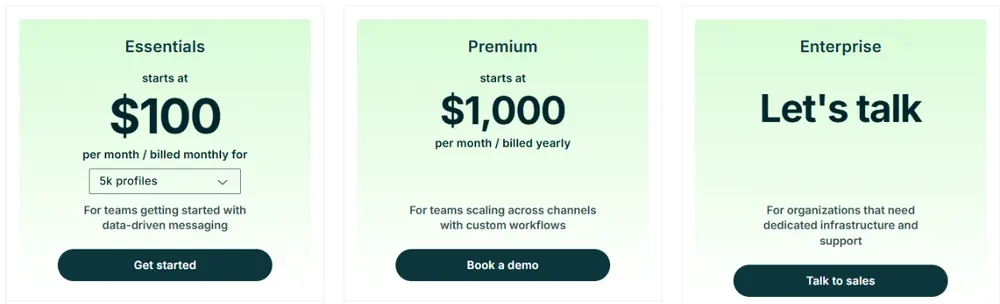
Two of those four rows are real prices. Premium’s $1,000 is a floor attached to unpublished volumes, and Enterprise has no number at all. In practice, if you are reading this to budget, Essentials is the tier you can actually cost out.
What you are actually buying: profiles, not emails
Almost every provider covered on this site bills you for messages. Customer.io bills you for profiles-the unique people and objects stored in your workspace, and treats the messages as something close to an afterthought.
Customer.io’s documentation is explicit that people and objects count together toward one limit. An “object” is a non-person entity you model in the platform: a company, a subscription, a shipment, a course. Essentials allows 2 object types, Premium 10, Enterprise custom. But every individual object instance you create consumes a profile from the same pool as your people.
This is the sizing mistake that costs the most money. A team with 4,000 customers assumes it fits in the 5,000-profile Essentials tier. Then it models each customer’s subscription as an object, and each of their two devices as another, and the profile count is 12,000, not 4,000. If your data model has any one-to-many relationship you intend to represent in Customer.io, count the many side before you pick a tier.
Essentials: the only self-serve plan, and what it really costs
Essentials is $100 a month, includes 5,000 profiles, and charges $0.009 per additional profile per month. There is no tier ladder and no slider: the price is a straight line from the base. Here is that line at eight points.
| Profiles | Monthly cost on Essentials | Per 1,000 profiles |
|---|---|---|
| 5,000 | $100.00 | $20.00 |
| 10,000 | $145.00 | $14.50 |
| 25,000 | $280.00 | $11.20 |
| 50,000 | $505.00 | $10.10 |
| 100,000 | $955.00 | $9.55 |
| 250,000 | $2,305.00 | $9.22 |
| 500,000 | $4,555.00 | $9.11 |
| 1,000,000 | $9,055.00 | $9.05 |
These are our calculations from Customer.io’s published base price and published overage rate, not figures quoted by Customer.io. The arithmetic is $100 plus $0.009 for every profile above 5,000, which is the formula Customer.io’s own billing documentation describes.
Two observations. The effective rate per thousand profiles falls sharply at first and then flattens: from $20.00 at the base tier to $10.10 at 50,000, but only to $9.05 at a million. Past about 50,000 profiles you are paying essentially a flat $9 per thousand with no volume relief at all, because overage rates do not tier on Essentials.
Where Premium starts to make sense. Customer.io’s documentation gives the Premium and Enterprise profile overage rate as $0.004 per profile, less than half the Essentials rate. It does not publish how many profiles the $1,000 Premium base includes, so the exact crossover cannot be calculated from public information. What you can say is this: if Premium included the same 5,000 profiles as Essentials, the two plans would cost the same at roughly 185,000 profiles, and Premium would be cheaper above that. Since Premium almost certainly includes more than 5,000, the real crossover is lower. If you are past 100,000 profiles on Essentials, ask for the Premium quote.
Premium and Enterprise: what “starts at $1,000” leaves out
The Premium card says “starts at $1,000 per month / billed yearly”, which means the smallest Premium commitment visible on the page is $12,000 a year. Both Premium and Enterprise are annual-term only; Essentials is the only monthly plan.
What the extra buys, according to the published comparison table:
| Essentials | Premium | Enterprise | |
|---|---|---|---|
| Profile overage rate | $0.009 | $0.004 | $0.004 |
| Object types | 2 | 10 | Custom |
| Workspaces | 2 | Unlimited | Unlimited |
| Anonymous messages | Not available | Unlimited | Unlimited |
| Custom collections | Not available | Yes | Yes |
| Reverse ETL, warehouse destinations | Yes | Yes | Yes |
| Data replay | Not available | Yes | Yes |
| Premium integrations | Basic only | Basic and Premium | Basic and Premium |
| Managed deliverability | No | Yes | Yes |
| Custom role-based permissions | No | Yes | Yes |
| HIPAA compliance | No | Custom, additional cost | Custom, additional cost |
| Chat support | No | Yes | Yes |
| Onboarding support | No | 90 days | Yes |
| Audit logging and data governance | No | No | By consultation |
| Dedicated hardware | No | No | Yes |
Read the asterisks on the Premium and Enterprise cards. Customer.io footnotes several headline items with “additional cost”: HIPAA compliance on Premium, and on Enterprise the migration support, the dedicated Customer Success Manager, the Technical Implementation Specialist and the shared Slack channel. These appear in the feature list as though they are included in the tier. They are billable extras on top of a price that already has no published number.
Two rows deserve separate mention because they change what the product can do rather than how much it costs. Anonymous messages are unavailable on Essentials entirely, so if your use case is messaging people you have not yet identified, abandoned carts from logged-out sessions, for instance. Essentials cannot do it at any volume. And audit logging and data governance is Enterprise-only and marked “available by consultation”, which is a soft way of saying it is neither included nor priced.
High-watermark billing, and the trap inside it
This is the part of Customer.io’s pricing that produces the most unexpected invoices, and it is documented clearly but not on the pricing page.
You are billed on the maximum number of profiles that existed at any point in the billing period, not the number you have at the end. Customer.io calls this a high watermark model. Its own example: start a cycle with 3,000 profiles, add 250, delete 50. You end with 3,200 profiles and you are billed for 3,250, because 3,250 distinct profiles existed at some point during the period. Deleting profiles never reduces the current month’s bill. It only reduces next month’s starting point.
That is reasonable on its own. The trap is what happens when an integration is syncing.
Delete-and-re-add doubles the count. Customer.io’s documentation spells this out with a worked example: you have 100,000 billable profiles, you delete 20,000 to save money, and your integration syncs them back the next day. Your billable count for that month is 120,000, not 80,000 and not 100,000, the original 20,000 counted because they started the period, and the re-added 20,000 counted because they were added during it. Customer.io describes this as “a common source of unexpected billing increases”. Before any list cleaning, pause or filter every inbound sync that could restore what you remove.
Two related counting rules from the same document:
- Profiles are counted across all workspaces, including test ones. The Plans and Billing page aggregates every workspace on the account, including any named “test”, “dev” or “sandbox”. The same person in two workspaces counts as two profiles.
- Child accounts roll up. If a Customer.io account was ever linked to yours as a child account for billing, its profiles count toward your total, and Customer.io states that account settings do not show you whether such a link exists. If your profile count does not add up, that is a question for their billing team.
Emails are nearly free here, and that is the whole pricing story
Essentials includes 1,000,000 emails a month in its $100 base, and additional emails cost $0.12 per 1,000-the same rate on every plan including Enterprise. Set that against what the same volume costs at providers that bill on messages.
| Scenario on Essentials | Profile cost | Email cost | Total /month |
|---|---|---|---|
| 5,000 profiles, 1,000,000 emails | $100.00 | $0.00 | $100.00 |
| 5,000 profiles, 2,000,000 emails | $100.00 | $120.00 | $220.00 |
| 5,000 profiles, 5,000,000 emails | $100.00 | $480.00 | $580.00 |
| 50,000 profiles, 1,000,000 emails | $505.00 | $0.00 | $505.00 |
| 50,000 profiles, 5,000,000 emails | $505.00 | $480.00 | $985.00 |
Look at the first row. A hundred dollars for a million emails is twelve cents per thousand, and the emails are bundled rather than metered. Look at the fourth row: adding 45,000 profiles costs $405, while adding four million emails costs $480. The two axes are priced within the same order of magnitude, which almost never happens.
The practical reading. Customer.io is expensive if you have a large audience you rarely message, and unusually cheap if you have a small audience you message constantly. A product sending twenty lifecycle emails per user per month to 5,000 users pays $100. A newsletter with 200,000 subscribers who each get four emails a month pays about $1,855 for the profiles and nothing for the sending. Work out your ratio of profiles to messages before comparing Customer.io to anything else, because that ratio is the entire question.
One caveat that matters for the email side: Customer.io counts every email that reaches your email service provider, including messages that bounce and messages that are suppressed. A dirty list costs you twice, once in profiles, once in sends that never arrive.
The Startup Program: 30,000 profiles for nothing
Customer.io runs a startup programme that is materially more generous than the paid entry tier, and it is easy to miss because the pricing page mentions it only in a banner.
| Startup | Essentials | |
|---|---|---|
| Price | $0 | $100 /month |
| Profiles included | 30,000 | 5,000 |
| Features | All Essentials features | Essentials |
| Support | Limited | Email and community |
| Term | Up to 12 months | Monthly, ongoing |
Thirty thousand profiles on Essentials pricing would cost $325 a month, so the programme is worth up to roughly $3,900 over its full term. The published eligibility rules are three: the business has raised less than $10 million in total funding; contact lists were obtained by standard methods rather than purchased; and the business is not and has never been a Customer.io customer.
The pricing page and the programme page do not say the same thing. The banner on customer.io/pricing reads “Get 12 months of Customer.io free” and “Early-stage companies get a full year free”. The programme page itself says “up to 12 months” and “For eligible new customers only”, and the plan card says “for up to 12-months based on application eligibility”. Read it as a discretionary award of at most a year, not an entitlement to a year, and confirm the term in writing before you build a migration plan around it.
What is not included: SMS, WhatsApp and AI credits
Customer.io is a multi-channel platform whose published price covers exactly one channel’s volume. Here is what the other channels cost.
| Channel or resource | What you pay |
|---|---|
| 1,000,000 included on Essentials, then $0.12 per 1,000 | |
| Push and in-app | Unlimited on every plan, subject to fair use |
| Webhooks | Unlimited on every plan |
| SMS | Custom on every plan, billed by Customer.io or by Twilio |
| Customer.io does not charge; Meta and Twilio do | |
| AI credits | $10 per 100,000 on Essentials and Premium, negotiated on Enterprise |
The “unlimited” on push and in-app has a published bound. Customer.io’s fair use policy sets it at sixty messages per profile per month across those unmetered channels unless your contract says otherwise, and states that exceeding it may result in messages being blocked or delayed, or the account suspended. On a 5,000-profile Essentials plan that is 300,000 push and in-app messages a month, which is generous, but it is a number and it exists.
Seven things that catch people out
- Objects eat your profile allowance. People and objects share one pool. Model a subscription per customer and you have doubled your count without adding a single user.
- Deleting profiles does not lower this month’s bill. High watermark billing counts everything that existed during the period, deleted or not.
- Deleting profiles an integration will re-add doubles them. Customer.io names this as a common cause of unexpected increases. Pause the sync before you clean.
- Test and sandbox workspaces are billable. Every workspace on the account counts, and the same person in two workspaces is two profiles.
- Bounced and suppressed emails count as sends. Any message that reaches the ESP is billable, whether or not it reaches a human.
- Premium and Enterprise are annual only. Essentials is the only plan you can pay for monthly, so moving up is a twelve-month commitment as well as a price increase.
- Several Enterprise headline features carry an asterisk. Migration support, the Customer Success Manager, the implementation specialist and the shared Slack channel are all marked as additional cost.
Who Customer.io is priced for
Customer.io is not competing with the SMTP relays elsewhere on this site, and comparing it to them on cost per thousand emails will give you a nonsensical answer in both directions. It is a customer engagement platform with a data model, a journey builder and a warehouse integration attached, and the sending is the cheap part.
The pricing suits that positioning honestly. Twelve cents per thousand emails and a million included in the base price is close to giving the channel away, which tells you the product’s value is meant to sit in the orchestration rather than the delivery. What you pay for is knowing who your users are and being able to act on it.
Good fit: product-led SaaS with a modest, well-defined user base and high message frequency per user; teams that need behavioural journeys and object modelling rather than list-and-blast campaigns; funded startups under the $10M threshold, for whom 30,000 profiles free for a year is one of the better offers in the market.
Poor fit: large low-engagement audiences, where you pay $9 per thousand profiles a month for people you email four times; anyone who needs a firm budget above 5,000 profiles without a sales call; teams wanting a monthly commitment at Premium level, which is not offered; pure transactional senders, who are paying for a journey engine they will not use.
How to size a Customer.io plan in four steps
- Count profiles, not contacts. Add every object instance you intend to create to your people count, then add a margin for the churn that high-watermark billing will charge you for anyway.
- Check the funding threshold first. If your business has raised under $10 million and has never been a customer, apply to the Startup Program before you enter a card. 30,000 profiles free is six times the paid entry tier.
- Work out your messages-per-profile ratio. High ratio favours Customer.io strongly. Low ratio means you are paying premium rates to store people you rarely contact.
- Get the Premium quote once you pass 100,000 profiles. The overage rate more than halves at that tier, and the exact crossover is not something you can calculate from the public page.
Frequently asked questions
How much does Customer.io cost?
Essentials starts at $100 a month and includes 5,000 profiles and 1,000,000 emails, with additional profiles at $0.009 each and additional emails at $0.12 per 1,000. Premium starts at $1,000 a month billed yearly, with unpublished included volumes and a profile overage rate of $0.004. Enterprise is quote only. There is also a Startup plan at $0 with 30,000 profiles for up to 12 months, subject to application. All figures were read from Customer.io’s pricing page and billing documentation in August 2026.
What is a profile, and does it include objects?
A profile is any uniquely identified person or object in your workspace, and Customer.io’s documentation states that people and objects count together toward the same limit. An object is a non-person entity such as a company, subscription, shipment or course. Essentials allows 2 object types, Premium 10, Enterprise custom, but each individual object instance consumes a profile. This is the single most common sizing mistake: 4,000 customers each with a subscription object and two device objects is 16,000 profiles, not 4,000.
What does Customer.io cost at 50,000 profiles?
On Essentials, $505 a month: the $100 base plus 45,000 profiles above the included 5,000 at $0.009 each. At 100,000 profiles it is $955, at 250,000 it is $2,305 and at 1,000,000 it is $9,055. These are our calculations from the published base and overage rate, not quotes from Customer.io. Note that overage does not tier on Essentials, so past roughly 50,000 profiles the effective rate flattens at about $9 per thousand with no further volume relief.
Does deleting contacts reduce my Customer.io bill?
Not for the month in which you delete them. Customer.io uses a high watermark model and bills for every profile that existed at any point during the billing period, including profiles you deleted. Deletion only lowers the following period’s starting count. Worse, if an integration re-adds the profiles you deleted within the same period, both the originals and the re-adds are counted. Customer.io’s own example turns 100,000 profiles into 120,000 that way, and describes it as a common source of unexpected billing increases.
Are test and sandbox workspaces billed?
Yes. Customer.io states that the Plans and Billing and Account Summary pages count profiles across all workspaces, including any named test, dev or sandbox, and that the same person present in two workspaces counts as two profiles. Linked child accounts also roll into the parent account’s total, and Customer.io notes that account settings do not indicate whether such a link exists, so an unexplained profile count is a question for their billing team.
How expensive is email on Customer.io compared with a plain relay?
It is very cheap, which is the unusual thing about this platform. Essentials bundles a million emails into the $100 base and charges $0.12 per additional thousand, the same rate on every tier including Enterprise. Five million emails a month on a 5,000-profile Essentials plan costs $580 in total. The cost lives in the profiles, not the sending, so Customer.io suits a small audience messaged often and penalises a large audience messaged rarely.
Is Customer.io’s free startup offer really a full year?
Up to a year, at Customer.io’s discretion. The pricing page banner says “12 months” and “a full year free”, while the programme page says “up to 12 months” and the plan card says “for up to 12-months based on application eligibility”. The published requirements are that the business has raised less than $10 million in total funding, that contact lists were not purchased, and that the business has never been a Customer.io customer. The plan includes 30,000 profiles and all Essentials features with limited support. Confirm your actual term in writing before planning a migration around it.
Are push and in-app messages really unlimited?
They are unmetered but not unbounded. Customer.io’s fair use policy sets the limit at sixty messages per profile per month across the unlimited channels unless your contract says otherwise, which on a 5,000-profile plan works out at 300,000 messages a month. Exceeding it may result in messages being blocked or delayed, and repeated breaches without contact may lead to suspension. Webhook messages are also unlimited on every plan.
What is not covered by the published price?
SMS is listed as custom on every plan and is billed either through Customer.io or through Twilio. WhatsApp carries no Customer.io charge but Meta and Twilio bill you directly. AI credits beyond the plan allowance are $10 per 100,000 on Essentials and Premium. On Enterprise, migration support, the dedicated Customer Success Manager, the Technical Implementation Specialist and the shared Slack channel are all footnoted as additional cost despite appearing in the feature list, and HIPAA compliance carries an additional cost on Premium.
Can I pay monthly for Premium?
No. Essentials is the only plan with a monthly term. Premium is described as “starts at $1,000 per month / billed yearly” and Enterprise is annual as well, so the smallest visible Premium commitment is $12,000 for the year. Customer.io accepts credit card only for monthly subscriptions; annual subscribers can be invoiced and pay by ACH or wire. Overages on annual plans are still calculated monthly and charged to the card on file.
Continue reading about Customer.io
Pricing is only part of the evaluation, and with a platform of this shape the data model matters more than the relay. For connection details, authentication and API behaviour, see the SMTP settings, API and integrations tabs on this platform. The alternatives tab compares Customer.io against the other engagement platforms that bill on people rather than messages.
Sources. All figures on this page were read from customer.io/pricing, customer.io/solutions/startups and Customer.io’s “How we bill” documentation on 21 August 2026, in USD. The cost table for Essentials at various profile counts is our own arithmetic from Customer.io’s published base price and published overage rate, and is labelled as such. Prices change; where a figure here disagrees with the vendor’s page, the vendor’s page is correct and we would be glad to be told.
This review follows our email infrastructure testing methodology. We disclose affiliate relationships in our editorial independence policy.