
How much does GetResponse cost in 2026?
Three self-serve plans plus Enterprise. At 1,000 contacts, monthly billing: Starter €16, Marketer €54, Creator €62, Enterprise on quote. Annual billing removes exactly 18%. Every paid plan carries unlimited monthly email sends, which almost nobody else in this category does. Two things decide whether GetResponse is cheap or expensive for you: Starter allows one automation workflow, and the premium Marketer commands over Starter collapses from 238% at 1,000 contacts to 11% at 100,000. Charities and NGOs get 50% off, the largest nonprofit discount in the category.
What GetResponse actually costs in 2026
GetResponse prices on stored contacts alone. There is no send limit to model, no email-volume tier, no overage meter. The full self-serve ladder, all seven list-size steps, read from the pricing slider in August 2026.
| Contacts | Starter | Marketer | Creator | Monthly sends |
|---|---|---|---|---|
| 1,000 | €16 | €54 | €62 | Unlimited |
| 2,500 | €27 | €69 | €79 | Unlimited |
| 5,000 | €48 | €82 | €94 | Unlimited |
| 10,000 | €69 | €99 | €114 | Unlimited |
| 25,000 | €149 | €189 | €219 | Unlimited |
| 50,000 | €259 | €319 | €369 | Unlimited |
| 100,000 | €469 | €519 | €599 | Unlimited |
| Above 100,000 | Quote | Quote | Quote | Quote |
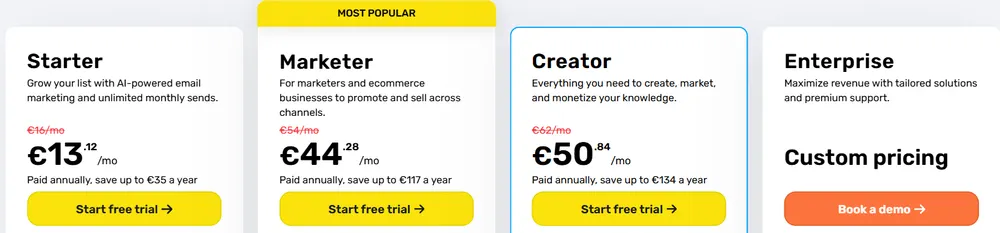
Annual billing takes exactly 18% off every figure, which we verified at both ends of the ladder: €16 becomes €13.12 and €469 becomes €384.58. That is the second-largest published annual discount in the category, behind Moosend’s 20% and ahead of AWeber, Constant Contact, iContact, MailerLite and Campaign Monitor.
GetResponse serves prices in the visitor’s local currency. The ladder above is the EUR price list. Reading the same page from a United States connection returns Starter $19, Marketer $59, Creator $69 at 1,000 contacts, with the same 18% annual discount ($15.58, $48.38, $56.58). Note that the ratio between the two lists is not constant: 1.19 on Starter, 1.09 on Marketer, 1.11 on Creator. These are separate price lists, not a currency conversion, so you cannot derive one from the other and neither can we. GetResponse also notes that all displayed prices are net amounts, with local taxes applied on top.
Unlimited sends changes which questions matter
Most of this category prices you twice: once on contacts stored, once on emails sent. GetResponse prices you once. That single decision removes the calculation that dominates every other pricing page we have written.
On Mailchimp you multiply your contacts by 10, 12 or 15 to find your send ceiling. On Campaign Monitor Lite the multiplier is 5. On Constant Contact it runs 10 to 24. On GetResponse there is no multiplier, on any paid plan including the €16 entry tier.
| Platform, entry paid plan | Send ceiling at 5,000 contacts | What breaches it |
|---|---|---|
| GetResponse Starter | No ceiling | Nothing |
| Campaign Monitor Lite | 25,000 sends (5×) | Two flows plus a newsletter |
| Mailchimp Essentials | 50,000 sends (10×) | A store running cart recovery |
| Constant Contact Lite | 50,000 sends (10×) | A store running cart recovery |
| Sender Standard | 60,000 sends (12×) | Heavy daily sending |
Who this is worth real money to. Anyone whose send-to-contact ratio is high: daily newsletters, publishers, deal sites, communities, anyone running several automation flows against the same list. A publisher mailing 5,000 subscribers every weekday sends roughly 110,000 emails a month, which is 22× their list. That profile breaks every plan in the table above except GetResponse, and on GetResponse it costs €48.
The flip side: a dormant list costs the same as an active one
Because you pay only for contacts, GetResponse charges you identically whether you mail your 25,000 subscribers daily or once a quarter. A seasonal sender with a large list and three campaigns a year pays €149 every month for storage. On a platform that bills sends rather than contacts, the same sender pays close to nothing between seasons. GetResponse rewards high frequency and penalises low frequency, which is the exact opposite of a credit-based provider.
The one number that decides Starter: a single automation workflow
Starter is priced like an entry plan and specified like one. The limit that matters is not sends or contacts, it is workflows.
Starter gives you one custom automation workflow. Marketer and Creator give you unlimited. Everything else that separates the tiers follows from that same line: advanced audience segmentation, abandoned cart recovery, sales funnels, promo codes and revenue reports, and unlimited web push notifications all start at Marketer. AI content generators on Starter are capped at three uses.
| On Starter you get | Unlimited sends, AI generators (3 uses), a welcome email series, 1 custom workflow, landing page builder, signup forms and popups, free custom domain on the yearly plan. |
|---|---|
| Marketer adds | Unlimited automation workflows, advanced segmentation, abandoned cart recovery, sales funnels, promo codes and revenue reports, unlimited web push. |
| Creator adds | Webinars, website builder, course creator for up to 500 students, premium newsletter subscriptions. |
| Enterprise adds | Dedicated sending domain, dedicated IP, SSO, SMS marketing, mobile push, AI product recommendations, transactional emails, unlimited users, priority support. |
Starter includes a welcome email series as a named feature plus one custom workflow. So you can onboard new subscribers and run one other automation, a re-engagement sequence, say, or a lead-magnet delivery. The second one you want costs the jump to Marketer. At 1,000 contacts that jump is €38 a month, or €456 a year, for your second automation.
The price of automation falls from 238% to 11% as your list grows
This is the most useful thing on the page and it is invisible unless you move the slider. The Starter-to-Marketer premium is not a fixed uplift. It shrinks dramatically with list size.
| Contacts | Starter | Marketer | Extra cost | Marketer premium |
|---|---|---|---|---|
| 1,000 | €16 | €54 | +€38 | +238% |
| 2,500 | €27 | €69 | +€42 | +156% |
| 5,000 | €48 | €82 | +€34 | +71% |
| 10,000 | €69 | €99 | +€30 | +44% |
| 25,000 | €149 | €189 | +€40 | +27% |
| 50,000 | €259 | €319 | +€60 | +23% |
| 100,000 | €469 | €519 | +€50 | +11% |
Read the extra-cost column: the absolute gap sits between €30 and €60 across a hundredfold range of list sizes. Marketer is essentially a flat surcharge that GetResponse charges for the automation engine, and it becomes proportionally trivial as the contact bill grows around it.
Below roughly 5,000 contacts, Marketer is a real decision: you are more than doubling your bill to unlock automation, and you should be able to name the second workflow you intend to build. Above 25,000 contacts, it stops being a decision. Paying +27% for unlimited automation, segmentation and cart recovery is not a close call, and staying on Starter at that size to save €40 is a false economy.
Creator is a flat 15% surcharge on Marketer
Creator’s premium over Marketer is remarkably consistent: 14.8% at 1,000 contacts, 14.6% at 5,000, 15.9% at 25,000, 15.4% at 100,000. Across the whole ladder it never leaves the 14.5-16% band.
What that 15% buys is a different product category rather than more email: webinars, a website builder, a course creator for up to 500 students, and paid newsletter subscriptions. If you sell knowledge, courses, memberships, paid newsletters, the surcharge replaces a separate tool that would cost considerably more than 15% of your email bill. If you do not, Creator is 15% of nothing you will open.
The 10,000 to 25,000 step is where growth hurts
GetResponse’s ladder is smooth in most places and has one visible cliff.
Moving from the 10,000 band to the 25,000 band raises a Starter bill from €69 to €149, an increase of 116% for 2.5× the contacts. On Marketer the same step runs €99 to €189, up 91%. Every other step on the ladder increases the bill by less than the increase in contacts; this one increases it by more.
| Starter cost per contact | €0.0160 at 1,000 → €0.0096 at 5,000 → €0.0069 at 10,000 → €0.0060 at 25,000 → €0.0047 at 100,000 |
|---|---|
| Where it stalls | Between 10,000 and 25,000 the improvement in unit cost nearly stops, from €0.0069 to €0.0060, while the bill more than doubles. |
| What to do | The bands are 10,000 then 25,000 with nothing between. If you are at 11,000 contacts you are paying for 25,000. Aggressive list hygiene before crossing 10,000 is the single highest-value housekeeping on this platform. |
The free account, and what survives after 14 days
GetResponse’s free offer is structured differently from everyone else’s, and the pricing page describes it in a way that is easy to misread.
You sign up for a Free account. For the first 14 days that account has trial access to the premium features. After 14 days you do not lose the account, you lose the premium features and keep using the free version. So it is a permanent free tier with a two-week premium trial bolted onto the front, not a trial that expires into nothing.
The published limitations on the free account:
| Branding | A GetResponse badge is added to every message you send. Removing it requires a paid plan. |
|---|---|
| Landing pages | Publish as many as you like, but capped at 1,000 unique visitors per month. No A/B testing. |
| Marketing automation | Unlimited workflows, but the dynamic segment filter is disabled. Any paid plan unlocks it. |
| Webinars | Limited to 10 people including you and your presenters. Recordings and on-demand included. |
| Course creator | Unlimited courses for up to 250 students, but selling them requires a paid plan. |
| Premium newsletters | Unlimited, free subscriptions only. Paid subscriptions require a paid plan. |
| Support | Live chat in English (7am, 11pm, weekends 7am, 9pm GMT+1) and Polish, 24/7 chatbot, 24/7 email in seven languages. |
Every other constraint above is published; the number of contacts you may store for free is not, and we are not going to supply a figure we cannot source. Check it inside the account before you plan around it. What the page does make clear is the practical ceiling: the GetResponse badge on every message rules the free tier out for anything client-facing or commercial.
Upgrading takes one click. Downgrading takes a support ticket.
This is the least advertised and most consequential detail on the page, and it explains a great deal of the search traffic around cancelling GetResponse.
GetResponse states it plainly. You can upgrade at any time through Billing then Upgrade account; the upgrade takes effect immediately and your billing cycle starts anew. Downgrades, by contrast, can only be performed by the Support Team at your request-you raise a support ticket through the contact form or ask on LiveChat. That applies both to moving down a plan and to switching from annual back to monthly.
Two consequences worth planning around
The billing cycle resets on upgrade. Upgrading on day 25 of a monthly cycle does not credit you for the five days remaining; it starts a fresh cycle from that moment. If you are upgrading anyway, doing it at the start of a cycle rather than the end avoids paying twice for the same week.
There is no self-serve downgrade path. Budget a human interaction and a response wait for any move down. If a seasonal peak pushes you up a list-size band, you cannot quietly drop back after it; you have to ask. Plan the exit before you take the upgrade, not after.
The asymmetry is not unique to GetResponse, but it is unusually explicit here, and it is the reason list hygiene deserves attention before you cross a band rather than after.
The nonprofit discount is the largest in the category
Two discounts are published, and one of them is genuinely exceptional.
| Provider | Nonprofit discount | Annual discount |
|---|---|---|
| GetResponse | 50% off every monthly plan | 18% |
| Mailchimp | 15% | None published |
| Constant Contact | 15% | 15% |
| Campaign Monitor | 15% | 10% |
| iContact | 15% | 15% |
| Moosend | Not published | 20% |
A charity at 25,000 contacts pays €94.50 a month on Marketer instead of €189, saving €1,134 a year. The same organisation at 15% off elsewhere saves a fraction of that. If you are a registered nonprofit, this discount alone is worth running the comparison again with GetResponse in it, even if the platform was not otherwise your first choice.
One detail in the wording: the offer is stated as 50% off every monthly plan. Whether it stacks with the 18% annual discount is not published, so ask before assuming the two combine.
What real accounts pay
Five worked examples at published monthly EUR rates, before tax, with no negotiated discount.
| Profile | Monthly | Composition | The trap avoided |
|---|---|---|---|
| Newsletter, 900 subscribers, weekly send, one welcome flow | €16 | Starter at 1,000 | Unlimited sends means weekly cadence costs nothing extra |
| Daily publisher, 5,000 subscribers, ~110,000 sends/month | €48 | Starter at 5,000 | A 10× multiplier elsewhere would cap this at 50,000 sends |
| Store, 9,000 contacts, cart recovery and segmentation | €99 | Marketer at 10,000 | Starter’s single workflow cannot run cart recovery |
| Course business, 4,000 contacts, selling courses | €94 | Creator at 5,000 | The free tier lets you build courses but not sell them |
| Registered charity, 25,000 contacts, annual billing | €94.50 | Marketer at 50% nonprofit rate | Whether 50% stacks with the 18% annual discount is unpublished |
Where GetResponse sits against the category
Comparing headline prices across currencies would be arithmetic presented as fact, so here is the structural comparison, which is what actually decides the bill.
| Platform | Billing basis | Send cap on entry paid plan | Automation on entry plan | Permanent free tier |
|---|---|---|---|---|
| GetResponse | Contacts only | None | 1 workflow | Yes, badge on every message |
| Mailchimp | Contacts + send multiplier | 10× | No Journey Builder below Standard | 500/month |
| Campaign Monitor | Contact bands + multiplier | 5× | Drip and journeys on Lite | None |
| Brevo | Emails sent only | Tier allowance | Limited on Starter | 300/day |
| MailerLite | Contacts + multiplier | 10× on Comfort | Included | 2,500/month |
GetResponse and Brevo are the two platforms here that refuse to charge you twice, and they do it from opposite ends: Brevo bills sends and ignores contacts, GetResponse bills contacts and ignores sends. Which is cheaper for you depends entirely on your ratio. Divide your monthly sends by your contact count. A high ratio favours GetResponse; a low ratio favours Brevo.
Who should pay for which plan
| Testing, or personal projects where branding does not matter | Free account. Permanent, not a 14-day trial. The GetResponse badge on every message is the real limit. |
|---|---|
| High send frequency, one or two automations | Starter. Unlimited sends on the cheapest paid plan is GetResponse’s strongest card. Name your second workflow before upgrading. |
| Any store, or anyone needing cart recovery and segmentation | Marketer. Below 5,000 contacts this more than doubles your bill, so be sure. Above 25,000 the premium is only 27% and it stops being a debate. |
| Selling courses, memberships or paid newsletters | Creator. A flat ~15% over Marketer at every list size, replacing a separate course or webinar platform. |
| Registered nonprofit or NGO | Any plan, at 50% off. The largest nonprofit discount in the category by a wide margin. |
| You need transactional email, SMS, a dedicated IP or SSO | Enterprise only. All of these are quote-only. GetResponse is not a self-serve transactional provider. |
| Large list, infrequent sending | Look elsewhere. You pay full price every month for storage you barely use. A send-billed provider suits this profile better. |
What GetResponse does not publish
- The free account’s contact limit. Every other free-tier constraint is documented; this one is not stated on the pricing page.
- Enterprise pricing. Quote-only, with monthly, 12-month and 24-month billing periods available and a 30-day Pilot Program to test it.
- Whether the 50% nonprofit discount stacks with the 18% annual discount. The nonprofit offer is worded against monthly plans.
- Anything above 100,000 contacts. The slider stops there; beyond it is a quote.
- Professional Services rates. Named as an additional paid Enterprise service, never priced.
- How USD, EUR and other price lists relate. They are separate lists, not conversions, and the ratios between them differ per plan.
Frequently asked questions
How much does GetResponse cost in 2026?
Read from getresponse.com in August 2026 at 1,000 contacts, monthly billing: Starter €16, Marketer €54, Creator €62, Enterprise on quote. The same page served from the United States shows $19, $59 and $69. Prices rise with list size to €469, €519 and €599 at 100,000 contacts. Annual billing removes exactly 18%. All prices are net of local taxes.
Does GetResponse limit how many emails I can send?
No. Every paid plan includes unlimited monthly email sends, including Starter at €16. GetResponse prices on stored contacts alone, with no send multiplier and no overage meter. This is unusual: Campaign Monitor’s entry plan caps sends at 5× your contact count, Mailchimp and Constant Contact at 10×. For a daily newsletter or a store running several flows, that difference is the whole comparison.
Does GetResponse have a free plan?
Yes, and it is permanent rather than a trial. You sign up for a Free account which has premium features for the first 14 days; after that you keep the account and lose the premium features. Published limits: a GetResponse badge on every message you send, landing pages capped at 1,000 unique visitors a month, no dynamic segment filter, webinars limited to 10 people, courses for up to 250 students that you cannot sell. The free contact limit is not stated on the pricing page.
What is the difference between GetResponse Starter and Marketer?
Chiefly automation. Starter allows one custom workflow; Marketer allows unlimited, and adds advanced segmentation, abandoned cart recovery, sales funnels, promo codes with revenue reports, and unlimited web push. Starter also caps AI content generators at three uses. The cost of that gap changes enormously with list size: +238% at 1,000 contacts, +44% at 10,000, and only +11% at 100,000.
Is GetResponse Creator worth the extra cost?
Creator runs a consistent 14.5% to 16% above Marketer at every list size on the ladder. What it adds is not more email but a different product: webinars, a website builder, a course creator for up to 500 students, and paid newsletter subscriptions. If you monetise knowledge, that surcharge replaces a separate platform for far less than a separate platform costs. If you do not, it buys nothing you will use.
How do I downgrade or cancel my GetResponse plan?
Not by yourself. GetResponse states that upgrades happen instantly through Billing then Upgrade account, but downgrades can only be performed by the Support Team at your request-you open a support ticket through the contact form or ask on LiveChat. The same applies to moving from annual back to monthly billing. Plan for a human interaction and a response wait, and note that if a seasonal peak pushes you into a higher list-size band you cannot quietly drop back down.
Does upgrading GetResponse mid-month waste what I already paid?
Partly, yes. GetResponse states that an upgrade takes effect immediately and your billing cycle always starts anew. There is no proration credit described for the days remaining on your old cycle. If the upgrade is not urgent, timing it at the start of a billing cycle rather than the end avoids paying twice for the same period.
Does GetResponse offer a nonprofit discount?
Yes, and it is the largest in the category: 50% off every monthly plan for charities and NGOs, against 15% at Mailchimp, Constant Contact, Campaign Monitor and iContact. A charity at 25,000 contacts pays €94.50 instead of €189 on Marketer, saving €1,134 a year. The offer is worded against monthly plans; whether it stacks with the 18% annual discount is not published, so confirm before assuming.
Can I send transactional email through GetResponse?
Only on Enterprise, which is quote-only. Transactional emails, SMS marketing, mobile push, a dedicated IP address, a dedicated sending domain and SSO all sit behind the Enterprise tier alongside unlimited users and priority support. If transactional volume is your requirement, GetResponse has no self-serve answer and providers built for it, such as Postmark, Mailgun or Amazon SES, price it per thousand.
Is GetResponse cheaper than Brevo?
It depends on one number: your monthly sends divided by your contact count. GetResponse bills contacts and ignores sends; Brevo bills sends and ignores contacts. A publisher mailing 5,000 subscribers daily, roughly a 22× ratio, is far better off on GetResponse. A retailer holding 50,000 contacts and mailing them twice a month, a 2× ratio, is far better off on Brevo. Neither platform is generally cheaper; they are cheaper for opposite sending profiles.
Changelog (recent)
This review follows our email infrastructure testing methodology. We disclose affiliate relationships in our editorial independence policy.