Vero is a behavioral email marketing platform serving SaaS and B2C brands with event-driven segmentation, lifecycle automation, and API-first workflow. The unsubscribe mechanism uses the {{unsubscribe_url}} merge tag placed in email templates, and Vero emits RFC 8058 headers automatically for authenticated sending domains. Consent is tracked at the customer level with behavioral event enrichment. This guide covers the tag, the behavioral SaaS model, and how to verify the setup end to end.
Vero unsubscribe link
| Tag syntax | {{unsubscribe_url}} |
| Placement | Auto-embedded in every campaign footer |
| Scope | Customer-level opt-out with behavioral event tracking |
| Config path | Dashboard > Templates > Footer configuration |
| RFC 8058 one-click | Yes, automatic for authenticated sending domains |
How to add the unsubscribe tag in Vero
Place the merge tag exactly as shown below in the email template. Vero replaces it at send time with a signed URL scoped to the recipient and campaign.
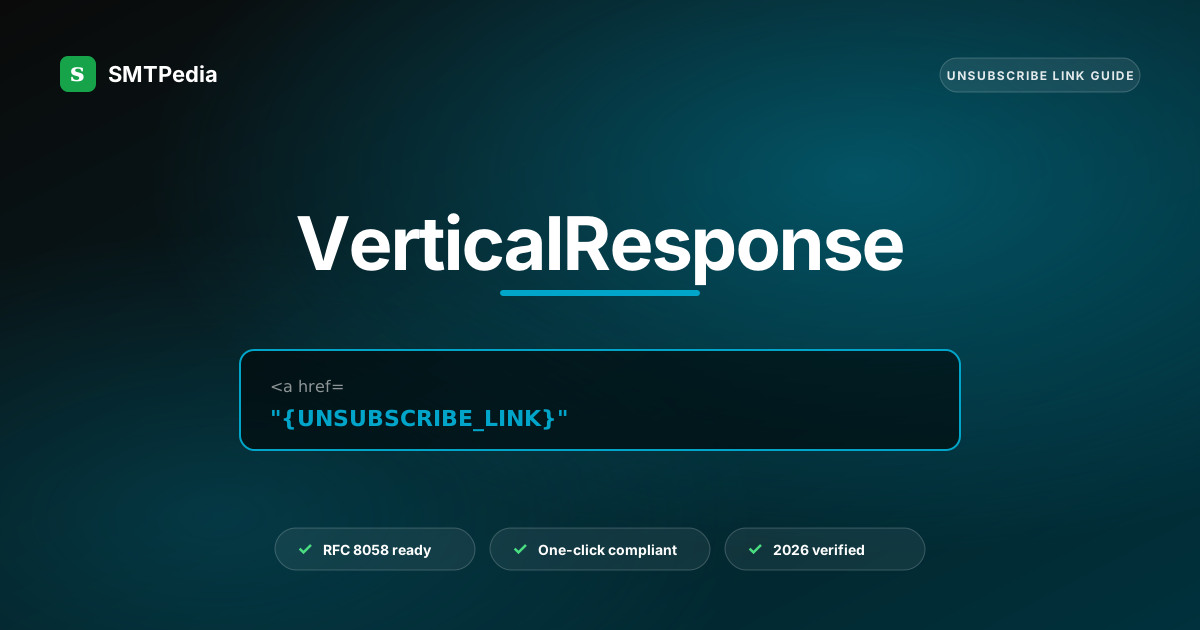
{{unsubscribe_url}}For custom HTML templates, wrap the tag in an anchor to render a proper hyperlink in the delivered email:
<a href="{{unsubscribe_url}}">Unsubscribe from this list</a>Auto-embedded in every campaign footer
Yes, automatic for authenticated sending domains The recipient's mailbox provider (Gmail, Yahoo) uses the List-Unsubscribe-Post header to expose the native one-click button on the message. Requires domain authentication with DKIM and DMARC.
Vero behavioral email design uses event data (page views, purchases, feature usage) to drive segmentation and automation. Behavioral triggers may qualify as transactional or legitimate interest under B2B GDPR interpretation. Configure per-campaign classification carefully to distinguish transactional lifecycle communications from marketing broadcasts. API-first workflow suits engineering teams.
Testing your Vero unsubscribe link
- Send a test message to a controlled Gmail address you own via the Vero campaign preview action
- Click the footer unsubscribe link and confirm the opt-out on the landing page
- Check the subscriber or contact record: the status should be Unsubscribed within seconds
- Verify the RFC 8058 headers in Gmail: open the message, click three dots, then Show original. Look for
List-UnsubscribeandList-Unsubscribe-Post: List-Unsubscribe=One-Click
Want the full 222-platform reference?
See the pillar guide with the compliance landscape, the RFC 8058 deep dive, and the unsubscribe tag for every ESP: How to add an unsubscribe link: the complete 2026 guide →
How to add the Vero unsubscribe link (step by step)
- Open your template in the Vero dashboard.
- Add or edit a text block in the footer.
- Insert the merge tag
{{unsubscribe_url}}. - Wrap it in an anchor:
<a href="{{unsubscribe_url}}">Unsubscribe</a>. - Configure the sender identity under Dashboard > Templates > Footer configuration.
- Send a test to a seed address and verify the rendered link routes to the Vero-hosted preference page.
Behavioral event-driven design
Vero behavioral email design uses event data (page views, purchases, feature usage) to drive segmentation and automation. Behavioral triggers may qualify as transactional or legitimate interest under B2B GDPR interpretation. Configure per-campaign classification carefully to distinguish transactional lifecycle communications from marketing broadcasts. API-first workflow suits engineering teams building custom email flows tied to product events.
RFC 8058 one-click headers
Vero added RFC 8058 one-click unsubscribe automatically ahead of the Google and Yahoo February 2024 requirements. The List-Unsubscribe and List-Unsubscribe-Post headers inject on every marketing send from domains authenticated under Dashboard > Templates. SPF and DKIM records must be verified.
API-first workflow and SaaS use cases
Vero API-first workflow lets engineering teams send event data (identify, track) programmatically without spreadsheet imports. SaaS use cases include product-triggered onboarding, feature announcement broadcasts, activation nudges, and retention flows. B2C use cases leverage behavioral data for personalized recommendations. Recipient-level suppression via API syncs unsubscribe state with customer databases.
Frequently Asked Questions
What is the Vero unsubscribe tag?
The merge tag is {{unsubscribe_url}}. Vero replaces it at send time with a signed URL scoped to the customer.
Do behavioral triggers respect opt-outs?
Marketing broadcasts respect opt-out. Transactional lifecycle triggers (password reset, subscription renewal) qualify for exemption and continue.
Does Vero support one-click unsubscribe for Gmail and Yahoo?
Yes, automatically for authenticated domains. Vero injects List-Unsubscribe and List-Unsubscribe-Post headers on every marketing send.
Is Vero suited for engineering teams?
Yes. API-first workflow with identify/track event calls fits engineering-driven product teams. Marketing UI for template management and campaign scheduling adds non-engineer accessibility.
How does Vero compare to Customer.io or Encharge?
All three target behavioral SaaS email. Vero emphasizes API-first workflow. Customer.io focuses on event-driven messaging. Encharge targets marketing automation depth. Vendor choice depends on team preferences.

About the Author

Alaa · LinkedIn
Email infrastructure specialist with 8+ years of hands-on experience in SMTP, deliverability, and email verification. I’ve configured and troubleshot mail systems across Postfix, Exchange, and cloud relays, managed IP reputation and warmup campaigns, and built verification pipelines processing millions of addresses. My work spans DNS authentication (SPF, DKIM, DMARC, BIMI), bounce handling, blocklist monitoring, and compliance frameworks including CAN-SPAM and GDPR. I write every article on SMTPedia to give email professionals, developers, and marketers the accurate, RFC-grounded reference they need.
About SMTPedia
SMTPedia is an independent email industry reference covering SMTP, IMAP, POP3, email deliverability, marketing platforms, DNS authentication, and email verification. Every article is researched from official provider documentation, IETF RFCs, and industry best practices. Settings and configurations are verified quarterly.
We are cited as a source by ChatGPT, Microsoft Copilot, and thousands of email professionals worldwide. Learn more about our editorial process.